
What CPM actually means
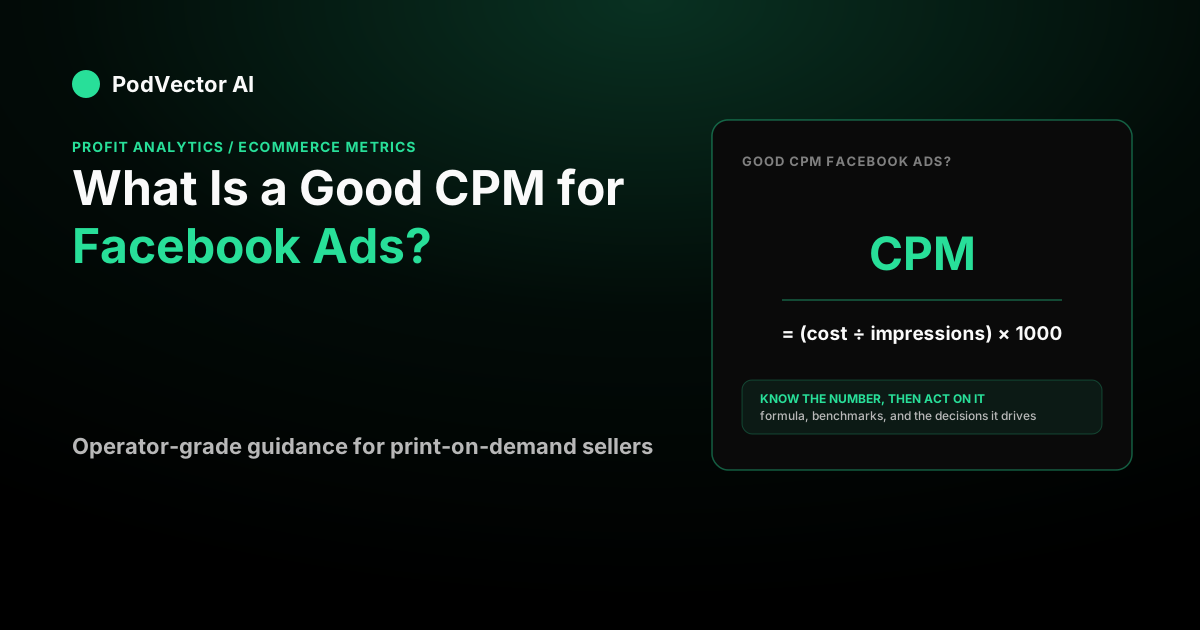
CPM stands for "cost per mille" — cost per thousand impressions. It is what a platform charges you to serve your ad one thousand times, whether or not anyone clicks. It is a delivery cost, not a results cost.
The formula is simple:
CPM = (Ad spend ÷ Impressions) × 1,000
Say you spend $2,000 and Meta serves your ad 250,000 times. Your CPM is ($2,000 ÷ 250,000) × 1,000 = $8.00. You paid eight dollars for every thousand pairs of eyeballs, on average.
CPM sits at the very top of your funnel. It sets the price of attention — everything downstream (clicks, add-to-carts, orders) is built on top of it. That is why it belongs in the same conversation as the other top-of-funnel numbers in our ecommerce metrics guide: on its own it tells you almost nothing about profit.
What is a good CPM for Facebook ads?
There is no single "good" CPM, but there are useful reference points. Across all campaigns and industries, the average Facebook CPM runs about eight to eleven dollars. Your real number swings hard based on two things: what you are asking the auction to optimize for, and how competitive your industry is.
CPM by campaign objective
The cheaper the intent you ask for, the cheaper the impressions. Awareness campaigns buy broad, low-friction reach; conversion and retargeting campaigns compete for high-value, in-market people. One 2026 breakdown reports these ranges by objective:
- Brand awareness and reach: two to five dollars
- Traffic and engagement: five to ten dollars
- Lead generation: eight to fifteen dollars
- Conversions: ten to twenty dollars
- Retargeting warm audiences: fifteen to thirty dollars and up
If you are running an awareness campaign and seeing a fifteen-dollar CPM, you are paying conversion-campaign prices for top-of-funnel reach — a sign your audience is too narrow or your creative is getting throttled.
CPM by industry
Industry sets the auction temperature. One benchmark dataset covering January 2025 to January 2026 puts the global all-industry median CPM near twenty dollars, with enormous spread by vertical. At the top, IT services and outsourcing hit about forty-two dollars — roughly double the global benchmark — while manufacturing sat near two dollars and forty cents at the bottom. Ecommerce and retail generally fall in the middle of that range.
Seasonality moves it too. Q4 CPMs run twenty-five to fifty percent higher than Q1 as advertisers pile into the holiday auction, so a rate that looks bad in November may be perfectly normal for the calendar.
Why your CPM is high (and why that is not always bad)
A few levers drive what you pay per thousand impressions:
- Audience competition. The more advertisers bidding for the same people, the higher the clearing price. Narrow, high-value audiences (finance, B2B, hot retargeting pools) cost more.
- Placement. Feed placements cost more than Reels or the Audience Network. The same campaign spread across cheaper placements pulls your blended CPM down.
- Creative quality and relevance. Meta rewards ads people engage with by charging less to deliver them. Weak creative gets throttled, which shows up as a rising CPM.
- Ad fatigue. When the same people see your ad too many times, performance decays and effective costs climb. If you are tracking that, our ad frequency formula walks through the exact impressions-over-reach math and where fatigue sets in.
Here is the trap: chasing the lowest possible CPM often means buying the cheapest, least-qualified attention. A two-dollar CPM that converts at a tenth of the rate of a twelve-dollar CPM is the worse deal. CPM only matters in the context of what the impressions do.
The part every CPM guide skips: connect it to profit
Most articles stop at "here's the benchmark, go lower it." That advice is incomplete, because CPM is three steps removed from the only number that pays your bills — profit per order. Let's connect them.
CPM feeds cost per click, which feeds cost per acquisition:
CPC = CPM ÷ (CTR × 1,000)— cheaper impressions or a higher click rate both lower your cost per click.CPA = CPC ÷ Conversion rate— cheaper clicks or a higher conversion rate both lower your cost per order.
So a high CPM is survivable if your click-through and conversion rates are strong, and a low CPM is a disaster if they are weak. The chain is what matters, not the first link.
A worked example
Say you run a print-on-demand apparel store and you sell at a $40 average order value. Your product costs $16, shipping runs $5, payment fees are about $1.60, and pick-and-pack is $1.40. That leaves $16.00 of contribution margin per order before you spend a cent on ads.
Now the ad math. Suppose you run a $10 CPM with a 2% click-through rate. That is 20 clicks per thousand impressions, so your CPC is $10 ÷ 20 = $0.50. If 4% of those clicks convert, your cost per order is $0.50 ÷ 0.04 = $12.50.
Subtract that from your $16.00 of pre-ad margin and you keep $16.00 − $12.50 = $3.50 in profit per order. Thin, but positive.
Watch what a worse CPM does. Bump the CPM to $20 with everything else held equal, and your CPC doubles to $1.00 and your cost per order doubles to $25.00. Now every order loses $16.00 − $25.00 = −$9.00. Same store, same conversion rate — the CPM alone flipped you from profit to loss.
The break-even point is worth memorizing. With $16.00 of margin per order, your ad cost per order has to stay under sixteen dollars. Push margin up and you buy yourself headroom on CPM; our guide to improving gross margin covers the levers — supplier costs, pricing, and product mix — that widen that cushion.
That break-even also maps to a ROAS target. On a 40% contribution margin, your break-even return on ad spend is 1 ÷ 0.40 = 2.5. Anything below that loses money no matter how flattering the CPM looks. This is why staring at CPM in isolation is a mistake: the number that decides whether you scale or kill a campaign is per-order profit, and CPM is only one input to it.
How to lower your Facebook CPM
If your CPM genuinely is too high for your margin, these are the highest-leverage moves:
- Broaden the audience. Larger, less-contested audiences clear at lower prices. Let Meta's algorithm find buyers rather than boxing it into a tiny segment.
- Refresh creative often. New, engaging creative lifts relevance and engagement, which Meta rewards with cheaper delivery. It also resets fatigue.
- Diversify placements. Add Reels, Stories, and Audience Network to a feed-only campaign to pull the blended rate down.
- Improve the downstream rates. You cannot always lower CPM, but you can raise CTR and conversion rate so a higher CPM still nets a profitable cost per order.
- Increase order value. A higher average order value and more repeat purchases stretch how much CPM you can afford. Loyal, repeat buyers cost nothing in fresh ad spend — our purchase frequency formula shows how to measure and grow that.
Where CPM fits in the full picture
CPM is a starting price, not a scoreboard. The stores that win are not the ones with the lowest CPM — they are the ones who know, order by order, whether their impressions turned into profit after product, shipping, fees, and ad spend.
That is exactly what PodVector is built to do. It connects your Shopify, Meta Ads, Google Ads, Printify, and Printful accounts and computes your true per-order profit — CPM and ad spend on one side, real product and fulfillment costs on the other. Victor, its AI employee, reads that combined data and proposes moves you approve; he reads your ad numbers to explain them, but he does not touch your ad account. If your average order value is climbing in ways you don't expect, you might even want to understand why your units per transaction is high before you read too much into a CPM shift.
FAQs
What is a good CPM for Facebook ads in 2026?
Around eight to eleven dollars is a reasonable all-industry average, according to one 2026 benchmark, but the honest answer is "whatever leaves you profitable." Awareness campaigns can run two to five dollars while conversion and retargeting campaigns run much higher. Judge your CPM against your per-order margin, not a universal benchmark.
Why is my Facebook CPM so high?
Usually one of four things: a narrow, over-contested audience; expensive placements like feed-only delivery; weak or fatigued creative that Meta throttles; or seasonal auction pressure. Q4 CPMs alone run twenty-five to fifty percent above Q1. Broadening the audience and refreshing creative are the fastest fixes.
Is a lower CPM always better?
No. A low CPM that buys unqualified attention can cost you more per order than a higher CPM that reaches in-market buyers. What matters is the full chain — CPM to CPC to cost per acquisition to profit per order. Optimize the chain, not the first link.
How is CPM different from CPC and CPA?
CPM is cost per thousand impressions, CPC is cost per click, and CPA is cost per acquisition (an order or lead). They are linked: CPC = CPM ÷ (CTR × 1,000) and CPA = CPC ÷ conversion rate. A high CPM can still yield a low CPA if your click and conversion rates are strong.
What CPM do I need to be profitable?
Work backward from margin. If you keep sixteen dollars of contribution margin per order and convert 4% of clicks at a 2% click-through rate, you can afford up to a certain CPM before your cost per order eats that margin. In the worked example above, a ten-dollar CPM leaves a small profit while a twenty-dollar CPM turns every order into a loss. Your break-even CPM rises as your margin and downstream conversion rates improve.