
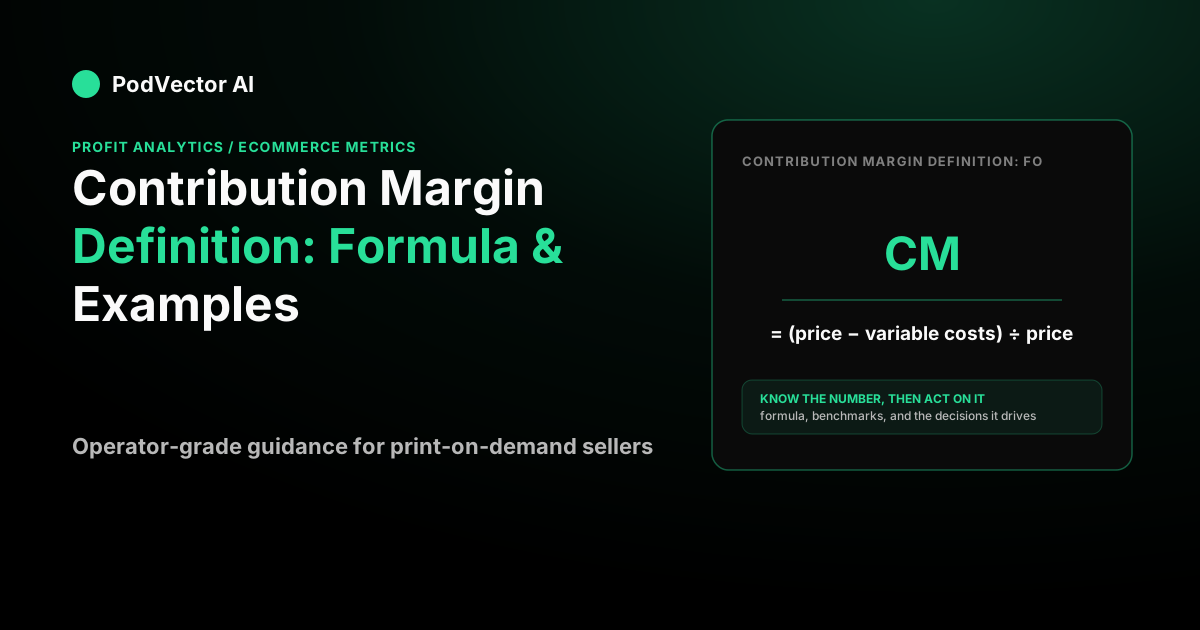
What is contribution margin?
Contribution margin answers one blunt question: when you sell one more unit, how much money actually stays in the business? It is your selling price minus only the costs that move with volume.
Fixed costs — rent, salaries, software — are deliberately left out. That is the whole point. Contribution margin isolates the profit each sale contributes before the fixed overhead that would exist whether you sold one order or one thousand.
That framing is why the term shows up everywhere in managerial accounting. The standard contribution margin definition in accounting is sales revenue minus variable costs, and reference sources like Investopedia describe it the same way: the portion of revenue not consumed by variable costs, available to cover fixed costs.
Contribution margin formula
There are three forms, and they all say the same thing at different zoom levels.
- Per unit:
Contribution margin = Selling price − Variable cost per unit - Total:
Contribution margin = Total revenue − Total variable costs - Ratio:
Contribution margin ratio = Contribution margin ÷ Revenue × 100
The per-unit version is best for pricing one product. The total version is best for judging a whole store or channel. The ratio strips out size so you can compare a nine-dollar sticker to a ninety-dollar hoodie on equal footing.
The only hard part is deciding what counts as variable. If a cost rises when you ship one more order, it is variable and belongs in the calculation. If it stays flat, it is fixed and stays out.
Contribution margin ratio, in plain numbers
Say you sell a mug for twenty-five dollars. The blank mug plus printing costs you nine dollars, shipping is four dollars, and the payment processor takes one dollar. Your variable costs are fourteen dollars.
Contribution margin per mug is $25 − $14 = $11. The ratio is $11 ÷ $25 = 44%. So forty-four cents of every dollar this product earns is available to cover fixed costs and then become profit.
Raise the price, cut the product cost, or negotiate cheaper shipping, and that ratio climbs. Discount the mug to twenty dollars without touching costs and the margin collapses to $20 − $14 = $6, a 30% ratio — which is exactly why blanket discounts quietly wreck profit.
A full worked example: a print-on-demand store
Definitions are cheap. Here is contribution margin doing real work across one average order at a print-on-demand apparel store we'll call Summit POD. Every line below is a variable cost — it scales with the order.
| Line | Amount |
|---|---|
| Revenue (average order value) | $40.00 |
| − Product cost (blank + print + base fulfillment) | −$16.00 |
| − Shipping | −$5.00 |
| − Payment processing (4% of $40) | −$1.60 |
| − Pick and pack labor | −$1.40 |
| = Contribution margin before ads | $16.00 |
So before any advertising, each order contributes sixteen dollars. The ratio is $16 ÷ $40 = 40%. Accountants sometimes call this tier CM2 — contribution margin after all non-advertising variable costs.
For a store that buys its customers with ads, though, the ad cost is also variable. Sell more, spend more. Netting it out gives a truer picture:
| Line | Amount |
|---|---|
| Contribution margin before ads | $16.00 |
| − Allocated ad spend | −$10.00 |
| = Contribution margin after ads | $6.00 |
Now each order contributes six dollars, a $6 ÷ $40 = 15% ratio (often called CM3). That six dollars — not the forty of revenue, not the twenty-four of gross profit — is the number that actually keeps the lights on. This ad-inclusive view is the piece most definition pages skip, and it is the single most useful reframe for an online seller.
Contribution margin vs. gross margin vs. net margin
These three get muddled constantly. They are different subtractions from the same revenue.
- Gross margin subtracts only the cost of goods sold. Summit's is
($40 − $16) ÷ $40 = 60%. It tells you if the product is worth making. - Contribution margin subtracts all variable costs — product plus shipping, fees, fulfillment, and ad spend. Summit's drops to 40% before ads and 15% after. It tells you if the product is worth selling through this channel at this acquisition cost.
- Net margin subtracts everything, including fixed costs. If Summit's fixed costs run four thousand dollars a month against six thousand of total contribution, net profit is two thousand — a 5% net margin. It is the final scoreboard.
Gross margin is optimistic, net margin is the verdict, and contribution margin is the one you steer with day to day. For a fuller map of how these interlock with the rest of your numbers, see the ecommerce metrics guide.
Why contribution margin is the number you actually steer with
Once you have contribution margin per order, three decisions get easier.
Break-even. Divide fixed costs by contribution margin per order and you get the volume where you stop losing money. Summit needs $4,000 ÷ $6 = 667 orders a month to cover fixed costs at the after-ads margin. That is the whole logic behind the break-even point — contribution margin is the denominator that makes it work.
Ad ceilings. Break-even return on ad spend equals 1 ÷ contribution margin ratio. On Summit's 40% pre-ad margin, that is 1 ÷ 0.40 = 2.5 — any campaign returning less than 2.5x revenue on spend loses money, no matter how good the ROAS looks. A thin margin forces a high ceiling; a fat margin gives you room to bid.
What you can afford to pay for a customer. Contribution margin is the raw material of customer economics. It sets how quickly acquisition spend pays back and feeds directly into what a healthy customer acquisition cost can be. And because retention stretches margin across many orders, cutting your churn rate lifts the lifetime contribution of every customer you already paid to acquire.
The trap is that most sellers never see contribution margin at the order level. They see revenue in one tab, ad spend in another, and a supplier invoice in a third — and the fifteen-percent reality hides inside a sixty-percent gross-margin story.
Victor is not a dashboard and he does not touch your ad account — he reads the ad data, does the contribution math, and acts on the Shopify side with your sign-off. That order-level margin view is also what powers deeper work like RFM segmentation to grow revenue from customers you already have.
FAQs
What is the simplest definition of contribution margin?
It is the money from a sale left over after you subtract the variable costs of making that sale. Per unit, it is selling price minus variable cost per unit. That leftover "contributes" to fixed costs, and then to profit.
What is the contribution margin formula?
Per unit: selling price minus variable cost per unit. In total: total revenue minus total variable costs. As a ratio: contribution margin divided by revenue, times one hundred, expressed as a percentage.
How is the definition of contribution margin different from gross margin?
Gross margin subtracts only the cost of goods sold. Contribution margin subtracts every variable cost — product, shipping, payment fees, fulfillment, and often ad spend. Gross margin says whether a product is worth making; contribution margin says whether it is worth selling through a given channel.
Should advertising be counted in contribution margin?
If your ad spend scales with sales — as it does for most online stores — treat it as a variable cost and net it out. That gives the after-ads figure, sometimes called CM3, which is the honest read on whether an order actually made money.
What counts as a variable cost?
Any cost that rises when you sell one more unit: the product itself, shipping, payment processing, pick-and-pack labor, and scaling ad spend. Costs that stay flat regardless of volume — rent, salaries, software subscriptions — are fixed and stay out of the calculation.
Is a higher contribution margin always better?
A higher margin gives you more room to cover fixed costs, absorb discounts, and bid on ads, so more is generally better. But a lower-margin product can still be worth selling in high volume, and one with a strong repeat-purchase habit can beat a high-margin one-time buy over a customer's lifetime.