
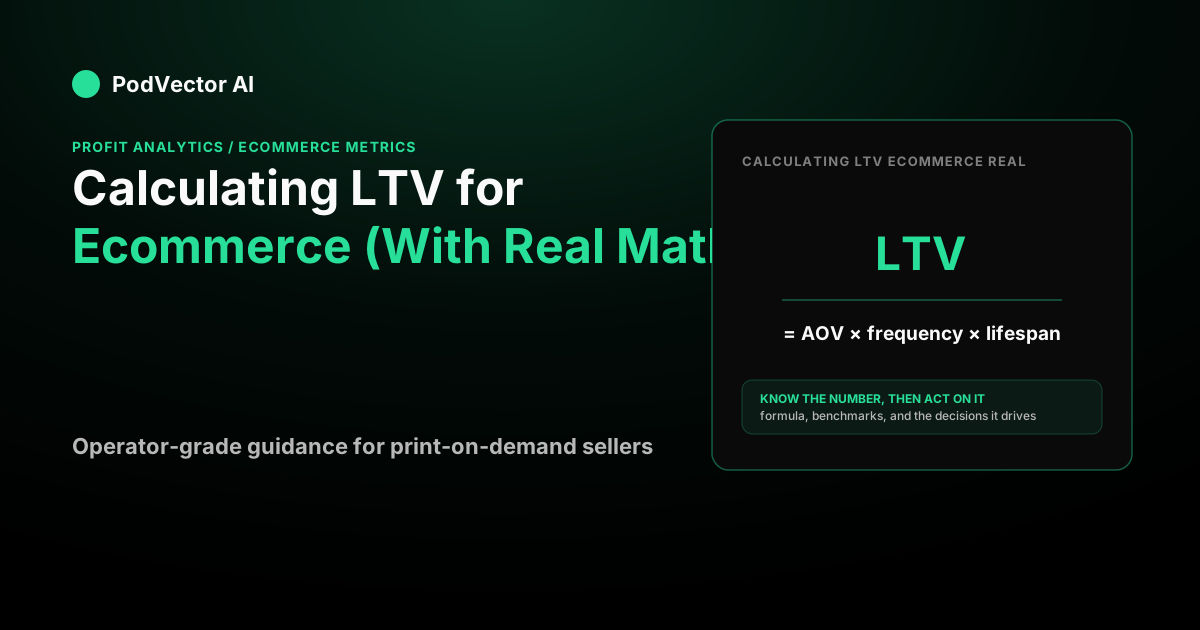
Calculating LTV for ecommerce means multiplying your average order value by how often a customer buys, by how long they stay a customer, and — the part most guides skip — by your profit margin. Revenue-only LTV flatters you; margin-based LTV tells you what a customer is actually worth. The full formula is LTV = AOV × purchase frequency × customer lifespan × gross-margin ratio, and this guide walks the whole calculation with real numbers.
If you only remember one thing, make it this: an LTV number is only useful if it is on the same basis as the cost you compare it against. Most articles hand you a revenue formula and stop. That leaves you comparing lifetime revenue to acquisition cost — apples to oranges — and it can overstate a customer's worth by nearly double.
Below, you'll calculate LTV the honest way, using one running example store so every number ties together. This piece sits alongside our broader profit analytics coverage, including our net profit margin benchmark guide, which gives you a reality check on what margin ranges are actually achievable.
What is customer lifetime value (LTV)?
Customer lifetime value (LTV, sometimes written CLV) is the total value a single customer generates over the entire relationship with your store — not one order, but all of them. "LTV" is the term that dominates in direct-to-consumer ecommerce; "CLV" shows up more in finance and SaaS. They're the same thing.
LTV matters because it tells you how much you can afford to spend acquiring a customer and still make money. Retaining customers is also where the profit hides: small retention improvements compound hard through LTV because every additional repeat order costs you no acquisition spend.
The LTV formula for ecommerce
There are two versions of the formula, and choosing the wrong one is the single most common mistake.
The revenue-basis formula:
AOV × purchase frequency × customer lifespan
The margin-basis formula (the one you should use):
AOV × purchase frequency × customer lifespan × gross-margin ratio
The only difference is the last term. Multiplying by your gross-margin ratio strips out cost of goods so you're measuring lifetime profit contribution, not lifetime sales. That's the number that belongs next to your acquisition cost. As Yotpo notes, the preferred LTV formula varies by how the number is being used — predictive LTV includes lifecycle timing, while the margin-adjusted version is essential for acquisition cost comparisons.
Revenue LTV vs. profit LTV (the number most guides skip)
Say a customer will generate $128 in lifetime revenue but your gross margin is sixty percent. Their profit-basis LTV is $76.80. If you compare the $128 figure to a cost-based CAC, you'll conclude the customer is worth far more than they are — and happily overspend to acquire the next one. Always state which basis you're using, and keep it consistent across every ratio.
Calculating LTV step by step (worked example)
Let's calculate LTV for a print-on-demand apparel store we'll call Summit POD. Every number below is drawn from the same store, so the math ties together end to end.
Step 1: Average order value (AOV)
AOV is revenue divided by orders. Summit did $40,000 in revenue across 1,000 orders last month:
$40,000 ÷ 1,000 = $40.00 AOV
Step 2: Purchase frequency
Purchase frequency is how many times an average customer buys in a period. Summit's customers order about 1.6 times per year. (You can calculate this yourself as total orders in a year divided by unique customers in that year.)
Step 3: Customer lifespan
Lifespan is how long a customer keeps buying. Summit's is about 2 years. If you don't track this directly, estimate it as 1 ÷ churn rate — a store losing eight percent of customers per period has a lifespan of roughly 12.5 periods.
Step 4: Profit margin
Summit's cost of goods (blank garment, print, base fulfillment) is $16 on a $40 order, so:
($40 − $16) ÷ $40 = 60% gross margin
Now assemble the full margin-basis LTV:
$40 × 1.6 × 2 × 0.60 = $76.80
That $76.80 is what one Summit customer is worth in gross profit over their lifetime. On a revenue basis it would read $128 — the same customer, a very different story.
For context on what print-on-demand base costs look like and how they affect that margin figure, see our Printful base price breakdown for POD sellers.
LTV:CAC — the ratio that actually matters
LTV on its own is only half the picture. The number operators live by is LTV:CAC — lifetime value divided by what it costs to acquire a customer.
Summit spends $12,500 on all sales and marketing to acquire 800 new customers a month, so its blended customer acquisition cost is:
$12,500 ÷ 800 = $15.63 CAC
That gives an LTV:CAC ratio of:
$76.80 ÷ $15.63 = 4.9:1
According to Rivo's ecommerce CLV benchmark research, a ratio of 3:1 or higher is the target for healthy unit economics; anything under 1:1 means you're losing money on each customer you acquire. A ratio well above 5:1 can even signal you're under-investing in growth. Summit's 4.9:1 is a strong, profitable position. Note both numbers here are on a profit/cost basis — that consistency is what makes the ratio trustworthy.
Raising the ratio comes down to two levers: lifting LTV (better retention and margin) or lowering CAC. Increasing average order value is one of the fastest ways to move both — our guide on increasing AOV with AI covers specific tactics for POD stores.
LTV benchmarks by ecommerce vertical
LTV varies dramatically by category, price point, and business model. According to Opensend's CLV research, average CLV for ecommerce stores ranges between roughly $100 and $300 depending on the industry — but the spread is wide. Repeat-purchase categories like beauty and consumables skew high because purchase frequency (the most powerful LTV lever) is baked into the product type. For print-on-demand apparel, where most customers buy once or twice and repurchase is driven by email retention rather than product necessity, frequency is the variable you have the most control over.
The practical takeaway: don't benchmark your LTV against a cross-industry average. Benchmark it against your own cohorts over time, and watch the trend. Newer cohorts worth less than older ones signal that acquisition quality or product-market fit is slipping.
Historic vs. predictive LTV
There are two ways to arrive at your LTV number:
- Historic LTV sums the actual gross profit a customer has generated to date. It's simple and true, but backward-looking.
- Predictive LTV forecasts future value from purchase patterns, cohort behavior, and churn. It's more useful for planning but only as good as your data. As Fairing explains, predictive LTV uses the same formula structure as historic LTV but with a churn-modeled expected lifespan rather than an observed one.
Most stores should start with historic LTV by cohort — group customers by the month they first bought, then track their cumulative margin over time. Cohorts reveal whether newer customers are worth more or less than older ones, which a single blended average completely hides.
How to improve LTV for POD stores
For print-on-demand sellers specifically, three levers move LTV the fastest:
- Email retention flows. A well-configured browse-abandonment or post-purchase sequence turns one-time buyers into repeat customers. Our Klaviyo browse abandonment flow setup guide walks the exact configuration.
- Checkout conversion. LTV starts at a first purchase, and a first purchase starts with checkout completion. Every cart abandonment means an LTV of zero. See our average checkout completion rate benchmark to understand where your store stands.
- AOV lift. Bundles, free-shipping thresholds, and upsells raise LTV without adding a single new customer. Our CRO techniques guide covers on-site tactics that raise both conversion rate and order value simultaneously.
These three compound: better checkout conversion feeds more customers into the LTV funnel, better email retention increases purchase frequency, and higher AOV multiplies through every repeat order.
Common mistakes when calculating LTV
Averaging across a bimodal base. A single blended LTV can mask a mix of many one-time buyers and a few high-value repeat customers. Segment before you act — RFM analysis groups customers by how recently, how often, and how much they buy, so you're not steering by a misleading mean.
Mixing revenue and profit bases. Covered above — the fastest way to overstate a customer's worth.
Ignoring the funnel that feeds LTV. LTV starts with a first purchase, and a first purchase starts with checkout. If shoppers abandon their carts, LTV never gets off the ground. Tightening your checkout funnel lifts the top of the LTV pipeline — our checkout completion rate benchmark gives you a sense of what healthy looks like.
Forgetting returns and fees. Refunds and payment processing quietly erode margin. If you want a stricter LTV, use contribution margin (which nets out shipping, fees, and returns) instead of gross margin. For a deeper look at what "true" profit means after all deductions, see our net profit margin benchmark.
Using a subscription-model formula for a transactional store. Some guides recommend the ARPU ÷ churn rate formula — that works for subscription businesses but overstates LTV for standard ecommerce stores with irregular purchase patterns. The AOV × frequency × lifespan × margin formula is the right starting point for most POD sellers.
Where the numbers come from matters
Every calculation above assumes you actually know your true per-order profit — COGS, shipping, payment fees, fulfillment, and ad allocation. Most stores don't. Ad platforms report revenue, not profit, and each one takes full credit for the same order, so your margin gets fuzzy exactly where LTV needs it to be sharp.
This is the problem PodVector is built for. It connects Shopify, Meta Ads, Google Ads, Printify, and Printful into a live data warehouse and computes your true per-order profit from live data — the exact margin figure the LTV formula depends on. PodVector is not a dashboard you have to read; its AI employee, Victor, analyzes your data and proposes moves, and with your approval carries out the Shopify-side actions. (Victor reads your ad data but does not touch your ad account.) With real margin flowing in, your LTV and LTV:CAC stop being guesses.
Once you can see LTV by segment, the natural next step is acting on it. PodVector's strategy content for POD sellers — including the full PodVector POD strategy overview — covers how to translate these numbers into targeted retention and margin plays.
FAQs
What is a good LTV for an ecommerce store?
There's no universal dollar figure — a good LTV depends entirely on your margins and acquisition cost. Rather than chase an absolute number, watch your LTV:CAC ratio. According to Rivo's ecommerce CLV benchmarks, a ratio of 3:1 or higher is generally considered healthy; below 1:1 means you're losing money on each customer acquired.
Should I calculate LTV on revenue or profit?
Profit, using the margin-basis formula (AOV × frequency × lifespan × margin ratio). Revenue LTV overstates a customer's worth and can't be fairly compared to a cost-based CAC. If you only ever see a revenue figure, mentally multiply it by your margin ratio to get the number that matters.
What's the difference between LTV and AOV?
AOV is the value of a single average order; LTV is the value of the whole relationship across many orders. LTV equals AOV only if every customer buys exactly once. Improving repeat purchase rate raises LTV without changing AOV at all.
How do I find my customer lifespan?
If you have order history, average the time between each customer's first and last order. If you don't, estimate it as 1 ÷ churn rate — a store losing ten percent of customers per year has an average lifespan of about ten years, while thirty-percent churn implies a bit over three.
How often should I recalculate LTV?
Recalculate at least quarterly, and always by cohort rather than as one blended average. Cohorts show whether the customers you're acquiring now are worth more or less than the ones you acquired last year — the trend matters more than any single snapshot.
Can I dropship from Etsy to Shopify and still calculate LTV?
LTV calculations live on your Shopify order data regardless of where your traffic originates. However, if you're running a hybrid fulfillment model, your cost-per-order data needs to be accurate for the margin step to work. See our guide on whether you can dropship from Etsy to Shopify for the operational and cost-tracking considerations.