
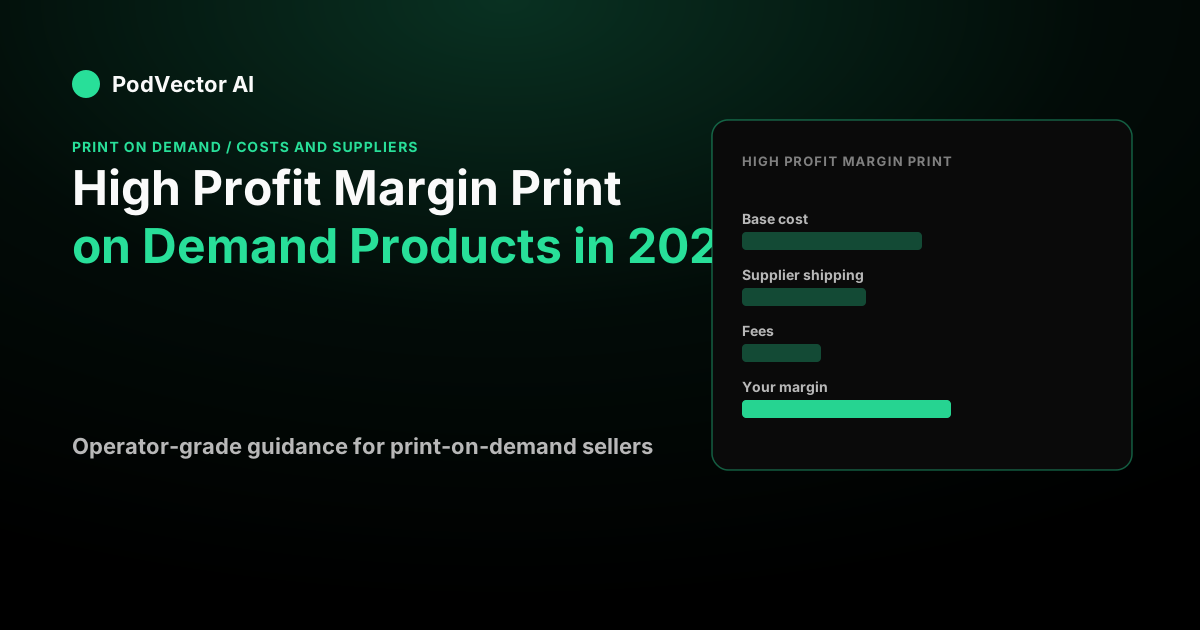
Most "best high profit margin print on demand products" lists stop at a product and a rough margin percentage. That is the easy half. The hard half—the half that decides whether you keep the money—is the invoice underneath each order. This guide covers both: the product families with the fattest markups, and the per-order math that turns a "60% margin" product into real take-home profit.
What "high margin" actually means in POD
A high margin product has a low landed cost relative to what a buyer will happily pay. Two levers drive that gap: a cheap-to-make, cheap-to-ship item, and a design people buy for identity rather than utility.
Stickers are the textbook example. They cost roughly twenty cents to a dollar to produce but sell for two to five dollars, which puts margins in the sixty to eighty percent range according to TrueProfit. Mugs run a similar story: about five to eight dollars to make, fifteen to thirty to sell, landing near fifty to sixty-five percent per the same TrueProfit breakdown.
Printify's own product roundup puts keychains, greeting cards, tote bags, phone cases, and wall art in the same high-margin tier, precisely because their material cost is a small fraction of a design-driven retail price (Printify). The common thread is emotional value: shoppers buy a niche hoodie or a personalized print for what it says about them, which makes them less price-sensitive.
The margin trap: gross margin is not profit
Here is the mistake almost every beginner list makes. They compute "retail price minus base cost" and call it margin. That number omits two real costs and ignores one lever.
Your true profit on a line is:
profit = (retail price + shipping you charge) − (base cost + supplier shipping + supplier tax) − payment fees
Supplier shipping and payment processing are the two costs the shiny margin percentages skip. A processor like Stripe takes 2.9% plus 30¢ per successful transaction on standard online card payments (Stripe pricing). On a small-ticket sticker order, that flat 30¢ can quietly eat a chunk of your "eighty percent" margin. We dig into the full ledger in our POD cost economics hub, and into realistic target numbers in what is a good profit margin for print on demand.
A worked example: the "high margin" mug
Say you sell a printed 11oz mug at $19.99 and charge $5.99 shipping. The customer pays $25.98.
- Base cost (mug): −$4.50
- Supplier shipping (fragile, first item): −$6.50
- Payment processing (2.9% + 30¢ on $25.98): −$1.05
- Your profit: $25.98 − $4.50 − $6.50 − $1.05 = $13.93
The base cost was tiny, but fragile-packaged shipping is the dominant line. That is why "mugs are cheap so they're high margin" is only half true—the landed cost is shipping-dominated. The processing math here uses Stripe's published 2.9% + 30¢ rate (Stripe pricing); the base and shipping figures are illustrative and change by provider.
Now watch what happens on apparel when a second item joins the order.
Why bundling beats picking the perfect product
Supplier shipping follows a first-item / additional-item structure: the first unit pays full freight, each extra unit from the same provider pays a steep discount. That single fact reshapes your margin strategy.
Say you sell a tee at $24.99 with $5.99 shipping:
- Customer pays: $30.98
- Base cost (tee): −$9.04
- Supplier shipping (first item): −$3.99
- Processing (2.9% + 30¢): −$1.20
- Profit: $16.76
Add a second identical tee, same flat $5.99 shipping to the buyer:
- Customer pays: $55.97
- Base cost (2 × $9.04): −$18.08
- Supplier shipping ($3.99 first + ~$2.00 additional): −$5.99
- Processing (2.9% + 30¢): −$1.92
- Profit: $29.98
The second shirt added roughly $13 of profit on about $16 of retail, because the additional-item shipping rate is far below the first-item rate. Raising average order value through bundles and cross-sells moves your margin more than shaving a few cents off base cost. Faster, cheaper delivery helps here too—see how Printify Express Delivery changes the shipping side of the ledger.
Product-by-product: where the margins really sit
Ranked by how forgiving the landed-cost math tends to be:
- Stickers, greeting cards, prints. Flat, light, cheapest to ship. Highest gross margins, but tiny ticket size means the flat 30¢ processing fee bites—push them as add-ons, not standalone $2 orders.
- Mugs and ceramics. Small base cost, but fragile shipping dominates landed cost. Good margin only if you price shipping in.
- Apparel (tees, tanks). Moderate base and shipping; the workhorse. Margin comes from AOV and design premium, not the blank.
- Hoodies and sweatshirts. Higher base cost and the highest additional-item shipping, but also the highest retail prices and strongest identity pull.
- Wall art and canvas. Big retail numbers, but shipping is often the dominant line on oversized pieces—model it before you assume it's high margin.
Across all of these, Printful's own guidance treats roughly thirty percent as a solid target margin, with forty to fifty percent as a healthy goal (Printful). Use those as planning anchors, not promises.
Base cost is a lever—choose your supplier deliberately
The same blueprint costs different amounts depending on which provider fills it, because base cost, shipping, and print method all vary. On a marketplace like Printify you can even route different regions to different providers so shipping stays local. If you want to see how provider choice swings a real number, our Printful vs Printify ornament cost breakdown walks a single product through both.
Paid membership tiers are pure volume math. Printify Premium runs from $39/month (or about $24.99/month billed yearly) for up to a third off product pricing (Printify pricing); on the widely-cited assumption of roughly a 20% everyday discount and a $12 average base cost, that's about $2.40 saved per order, so you need roughly 16–17 orders a month to break even on the monthly plan (EcommerceCEO). Printful Growth costs $24.99/month for up to a third off, and becomes free once your store crosses $12,000/year in sales (Printful pricing). Below those thresholds, the free plan is the correct choice.
The part the product lists never solve
Notice how many of the levers above are invisible on a product page: the flat processing fee that only hurts small orders, the additional-item shipping rate that makes bundles win, the supplier tax on some orders, the provider that quietly ships from farther away. A margin looks fine until you total the real invoice—and it changes order by order.
That is the gap PodVector is built to close. It connects Shopify, Meta Ads, Google Ads, Printify, and Printful, then computes your true per-order profit after base cost, supplier shipping, and payment fees—so "high margin" is a number you can see, not a guess. Victor, its AI employee, reads that live data, flags where margin is actually leaking, and proposes Shopify-side moves for you to approve. He reads your ad data but does not touch your ad account, and he is not a dashboard—he's an employee that acts on what the numbers say, with your sign-off.
FAQs
What is the single highest profit margin print on demand product?
By gross margin percentage, stickers usually top the list—roughly sixty to eighty percent, since they cost cents to make and sell for a few dollars according to TrueProfit. But by dollars of profit per order, apparel and bundled orders often win, because a higher ticket price absorbs the flat payment fee and spreads shipping across more units.
What is a good profit margin for print on demand in 2025?
Printful points to about thirty percent as a solid target and forty to fifty percent as a healthy goal (Printful). Treat those as planning anchors—your real margin depends on your base cost, shipping, and how much of it you pass to the customer.
Why is my margin lower than the percentages in these lists?
Because those percentages are gross margin—retail minus base cost. They ignore supplier shipping and payment processing (Stripe alone takes 2.9% plus 30¢ per transaction, per Stripe). Model the full invoice and the number drops, especially on cheap, small-ticket items.
How do I raise POD margins without raising prices?
Increase average order value. The additional-item shipping rate is far lower than the first-item rate, so bundles and cross-sells add profit faster than a price hike. Keeping a customer's items on a single print provider also avoids paying two first-item shipping charges.
Does choosing a cheaper supplier always improve margin?
No. The cheapest base cost can ship slower, farther, or at lower quality, and refunds or reprints are pure loss in POD. Optimize across base cost, shipping, speed, and reliability per destination—not on base cost alone. Provider count and coverage matter here; see how many print providers Printify has.