
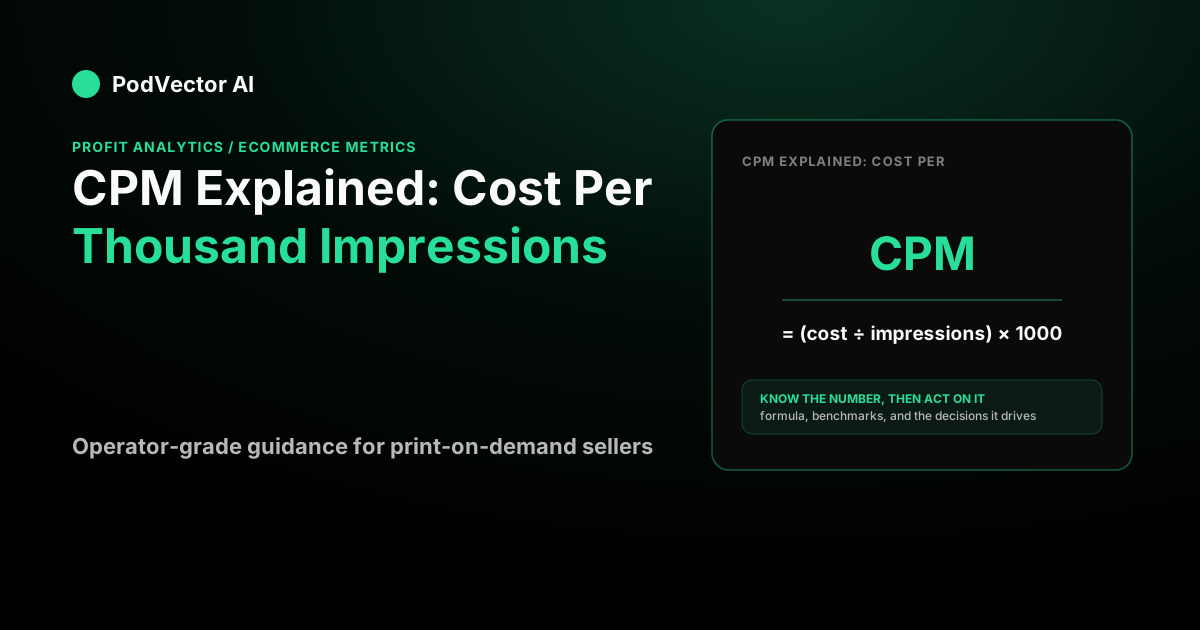
CPM = (Ad spend ÷ Impressions) × 1,000. CPM measures how expensive it is to reach eyeballs, not how many clicks or sales you get. A low CPM is only "good" if those cheap impressions eventually turn into profitable orders, which is why CPM is a starting metric, not a scoreboard.
What CPM actually means
CPM comes from the Latin word mille, meaning one thousand. So cost per mille is literally the cost per one thousand impressions, where an impression is a single instance of your ad being shown to someone.
It is a pricing and efficiency metric borrowed from traditional media buying. When you buy on a CPM basis, you are paying for exposure — for the chance to be seen — regardless of whether anyone clicks. That makes CPM the default currency of awareness and reach campaigns.
Most people meet CPM on Meta Ads, Google Display, YouTube, or programmatic platforms, where it shows up as a reporting column even when you are optimizing for clicks or conversions. Understanding it is the first rung on the ladder of advertising metrics — and it chains directly to conversion rate optimization, which is where impressions eventually become revenue.
The CPM formula
The math is simple. You take total ad spend, divide by impressions, and multiply by one thousand:
CPM = (Ad spend ÷ Impressions) × 1,000
Say you spend $500 on a campaign that delivers 100,000 impressions. Your CPM is ($500 ÷ 100,000) × 1,000 = $5.00. You paid five dollars for every thousand times your ad appeared.
You can also run the formula backwards. If you know a platform's CPM and your budget, impressions are (Ad spend ÷ CPM) × 1,000. At a $10 CPM, a $1,000 budget buys ($1,000 ÷ $10) × 1,000 = 100,000 impressions. That reverse math is how media planners size a campaign before it launches.
CPM also connects directly to CPC. Because CPC = CPM ÷ (CTR × 1,000), a campaign's click cost is fully determined by how expensive impressions are and how well the creative earns clicks. Tighten either lever and your cost per visit drops.
Impressions vs reach
One trap: impressions are not people. Impressions count every ad view, so one person who sees your ad four times generates four impressions. The unique-people count is called reach, and impressions ÷ reach gives you frequency. A CPM can look cheap simply because the platform is showing the same small audience over and over — rising frequency with flat sales is a fatigue warning, not a bargain.
What is a good CPM?
There is no universal "good" number, because CPM swings with platform, audience, season, and industry. The honest answer is that it depends on your vertical and how narrowly you target.
For a rough 2026 anchor on paid social: according to Superscale, broad prospecting under $10 CPM is strong, $10–$15 is normal for direct-response ecommerce, and $20-plus is typical for competitive verticals like health and finance. The ecommerce picture is more expensive — Triple Whale measured a median Meta CPM of $14.19 across nearly 35,000 brands in 2025, up roughly 20% year over year, with Health & Wellness the steepest riser at $20.70, per the same Superscale analysis.
On Google Display, costs are considerably cheaper. According to bir.ch's 2026 Google Ads Cost Breakdown, advertisers pay an average of $0.63 per click on Display, which implies CPMs well below paid-social levels — but Display audiences are browsing, not searching, so conversion rates reflect that difference.
A few things reliably push CPM up:
- Narrow targeting. Small, specific audiences cost more per thousand impressions than broad ones.
- Competitive seasons. Q4 and big shopping holidays spike CPMs as budgets flood in — according to Sender, Facebook CPCs peak in November and reset sharply in January, a pattern CPMs mirror.
- High-value verticals. Finance, wellness, and other categories with deep-pocketed advertisers bid impressions up.
- Premium placements. Feed and Reels placements usually carry higher CPMs than cheaper inventory, though Reels can offer lower CPCs when the creative fits the format.
CPM vs CPC vs CPA
CPM is one of a family of "cost per" metrics, and mixing them up leads to bad decisions. Each measures a different stage of the funnel.
CPM is cost per thousand impressions — you pay to be seen. CPC is cost per click — you pay when someone acts on the ad. According to Web Tonic, the 2026 average search CPC across industries is $5.42, though the spread is wide — from $1.63 in arts and entertainment to $9.87 in legal services. CPA (cost per acquisition) is cost per conversion — you pay per result, like an order or signup.
These metrics chain together. CPC = CPM ÷ (CTR × 1,000), and CPA = CPC ÷ conversion rate. So a cheap CPM does not guarantee a cheap sale — if nobody clicks or buys, those inexpensive impressions are worthless. That relationship is exactly why chasing the lowest CPM in isolation can quietly bankrupt a campaign.
According to Web Tonic, improving ad relevance is the only lever that simultaneously lowers CPC and raises traffic volume — and the same logic applies one step up the chain to CPM.
CPM by platform: 2026 reference points
Because CPM varies so much by channel, it helps to keep platform-level anchors handy:
- Meta (Facebook/Instagram): According to Superscale, Meta CPMs run $8–$14 across all advertisers in 2026, with ecommerce brands typically in the $10–$15 range.
- Google Display: Display CPMs are structurally lower than paid social because the audience is browsing rather than actively engaging. According to bir.ch, the average Display CTR is $0.46%$ with low CPCs, implying CPMs in the low single digits for most categories.
- LinkedIn: According to Sender, LinkedIn CPMs average $26.91 — the most expensive major platform, reflecting the premium B2B audience.
- YouTube/Video: CPMs vary by targeting and format; skippable in-stream ads are generally cheaper than non-skippable placements.
For print-on-demand sellers advertising on Meta and Google, the practical takeaway is that Meta CPMs are the dominant cost driver for most paid-social spend — and they have been rising steadily. Treat any platform benchmark as a directional reference, not a target to hit.
The profit angle most guides skip
Here is what most CPM explainers leave out: CPM by itself tells you nothing about whether you made money. To connect it to profit, you have to walk the whole chain from impressions to margin. Let's do that with a worked example.
Say you sell print-on-demand apparel and run a campaign with these numbers. You spend $1,000 at a $10 CPM, which buys 100,000 impressions ($1,000 ÷ $10 × 1,000). Your click-through rate is 2%, so you get 2,000 clicks — a CPC of $1,000 ÷ 2,000 = $0.50.
Now the sales math. Say your landing page converts at 3%, so those 2,000 clicks produce 2,000 × 0.03 = 60 orders. Your cost per order is $1,000 ÷ 60 = $16.67. If each order leaves you $16 of contribution margin after product cost, shipping, and payment fees but before ad spend, then your total margin is 60 × $16 = $960 — against $1,000 of ad spend. That is a $40 loss on a campaign with a perfectly ordinary CPM.
Watch how fragile that is. Say your conversion rate slips to 2% instead of 3%. Now you get 2,000 × 0.02 = 40 orders and 40 × $16 = $640 of margin — a $360 loss on the exact same $10 CPM and the same spend. The CPM never changed. The profit did.
That is the whole point. CPM is an input, three steps removed from the number that pays your rent. To judge whether ads actually work, you need to push all the way down to return and profit. One useful companion metric is net profit margin — that is the number CPM ultimately needs to move in the right direction. And keeping an eye on your checkout completion rate ensures those clicks are actually becoming orders rather than abandoned carts.
Lowering CPM without lowering profit
Because CPM sits at the top of the funnel, you have real levers to pull:
- Improve creative and relevance. Platforms reward ads people engage with by charging you less per impression, so stronger creative often drops CPM on its own.
- Broaden targeting. Wider audiences usually mean cheaper impressions; let the algorithm find buyers instead of over-constraining it.
- Test placements. Shifting spend toward lower-cost placements can cut CPM — but only keep the ones that still convert. See CRO techniques for how to pressure-test landing pages once you have cheaper traffic.
- Watch frequency. If the same people keep seeing your ad, refresh creative or expand the audience before fatigue drives costs up.
- Scale winning creative aggressively. The fastest path to a lower effective CPM is a creative that the algorithm wants to serve — more volume at lower cost per impression.
The catch, again: a lower CPM is a win only if downstream conversion and margin hold. Cheap impressions from a badly matched audience can raise your true cost per order even as the CPM column looks better. For more on scaling without margin bleed, see increasing average order value.
Where CPM fits in your metric stack
Think of your paid-media metrics as a funnel. CPM measures the top — the cost of attention. CPC measures the middle — the cost of interest. CPA and customer acquisition cost measure results. And blended measures like your marketing efficiency ratio tell you whether the entire engine is profitable once every channel and cost is counted.
CPM is worth watching because it is an early-warning signal. A sudden CPM spike tells you the auction got more expensive before your sales data catches up. But it should never be the metric you optimize toward, because you can win the CPM game and still lose the business.
The hard part is that these metrics live in different tools. CPM sits in your ad platform, order margin lives in your store, and true per-order profit depends on product cost, shipping, fees, and returns that no single dashboard sees at once. Print-on-demand sellers face an extra wrinkle: Printify and Printful cost data enters the picture only through completed orders, so a campaign that looks profitable on CPM alone can be hiding margin problems that only show up when fulfillment costs are accounted for.
That gap is what PodVector is built to close. It connects Shopify, Meta Ads, Google Ads, Printify, and Printful into a live data warehouse, then computes your true per-order profit across all of them. Victor, its AI employee, reads that live data — including ad metrics like CPM — and proposes moves such as repricing products to a target margin, adjusting discounts, or updating your free-shipping threshold. The merchant approves or rejects each proposed action on an approval card, and Victor executes the approved move on the Shopify side. Victor reads Meta and Google ad data and proposes ad-side moves, but ad-platform writes are not executed by Victor — those stay in your hands. PodVector is not a dashboard you babysit; it is an employee that turns numbers like CPM into decisions about profit. For a deeper look at what Victor can do for POD sellers, see how PodVector works.
FAQs
What does CPM stand for?
CPM stands for cost per mille, where mille is Latin for one thousand. It is the cost of showing your ad one thousand times. It is sometimes written as cost per thousand or CPT, but CPM is the standard term across advertising platforms.
How do you calculate CPM?
Divide your total ad spend by the number of impressions, then multiply by one thousand: CPM = (Ad spend ÷ Impressions) × 1,000. For example, $500 spent for 100,000 impressions gives ($500 ÷ 100,000) × 1,000 = $5.00 per thousand impressions.
Is a lower CPM always better?
No. A low CPM only matters if those impressions convert into profitable orders. Cheap impressions from a poorly matched audience can produce zero sales, making them more expensive per result than a higher CPM that reaches the right buyers. Always judge CPM alongside conversion rate and per-order profit, not on its own.
What is the difference between CPM and CPC?
CPM charges you per thousand impressions, so you pay to be seen. CPC charges you per click, so you pay only when someone acts. CPC equals CPM divided by (CTR × 1,000), which is why two campaigns with the same CPM can have wildly different click costs depending on how well the creative earns clicks.
What is a good CPM for Facebook ads?
It varies by industry and season. According to Superscale, Meta CPMs run $8–$14 across all advertisers in 2026, with ecommerce brands typically higher. As a rule of thumb, broad prospecting under $10 is strong, $10–$15 is normal for direct-response ecommerce, and $20-plus is what competitive verticals like health and finance pay. Use benchmarks as a loose reference, then judge your own CPM by whether the resulting orders are profitable.
Does CPM include clicks or conversions?
No. CPM measures only impressions — the number of times your ad is displayed. It says nothing about clicks, sales, or revenue. Those live in CPC, CPA, ROAS, and your true per-order profit, which is why CPM is best treated as a top-of-funnel input rather than a success metric.
How does CPM relate to ad quality and auction dynamics?
On both Meta and Google, ad quality directly affects how much you pay per impression. Platforms want to serve ads that users engage with, so higher relevance scores and stronger creative earn lower effective CPMs — the algorithm rewards you with cheaper reach. According to Web Tonic, you almost never pay your maximum bid because ad quality discounts the price. This means creative quality is not just a conversion lever; it is a cost lever that operates all the way up at the impression level.
What is CPM vs CPV?
CPV (cost per view) is a video-specific metric used on YouTube and some programmatic platforms. Where CPM counts every ad display, CPV counts only views that meet a threshold — typically a user watching at least 30 seconds or clicking the ad. CPV campaigns can be more efficient for video creative because you only pay for genuine engagement, but CPM is still the dominant metric for display and social feed placements where there is no "view" threshold to clear.