
If you already run a store with real sales, "eco-friendly" is a positioning and pricing question, not a feelings question. You know your repeat-buyer rate and your ad costs. This guide covers what actually qualifies as eco on Printful, which certifications hold up, and the per-order math that decides whether the line earns its place.
What counts as a Printful eco-friendly product
Printful defines an eco-friendly product as one made from at least 70% organic or recycled materials, or blends of both — not a vague "sustainable" label slapped on a standard blank. That threshold is stated directly on Printful's eco-friendly t-shirt page.
The materials in the category are organic cotton, recycled cotton, recycled polyester, and certified fabric blends. These are sourced from established sustainable apparel brands — Stanley/Stella, Econscious, and District among them — rather than being a Printful-only house line, again per Printful's eco page.
Operationally, an eco product behaves exactly like any other Printful product. It syncs to your store, flows through the same order statuses, and ships from the same fulfillment network — nothing in the way you run Printful day to day changes because a tee is organic instead of standard.
The certifications that actually mean something
The word "eco" is worthless on its own. What gives it weight is third-party certification, and Printful names the ones it holds on its eco-friendly product page:
- GOTS (Global Organic Textile Standard) — full traceability and responsible farming of the organic cotton.
- GRS (Global Recycled Standard) — verifies the recycled content in the fabric and how it was processed.
- Oeko-Tex® — confirms the inks and threads used in printing and embroidery are free from harmful substances.
For a store owner, this is the part worth putting on the product page. A buyer who cares about sustainability has been burned by greenwashing, so naming GOTS or GRS on the listing does more conversion work than the word "eco" ever will. Printful itself states it won't call a product eco-friendly without certification to prove it — borrow that discipline in your copy.
What's in the eco catalog
The eco range leans into the products that sell best in this niche: organic cotton t-shirts, eco hoodies, and organic ribbed beanies, with the hoodie and beanie among the most popular picks. The t-shirts span organic cotton, recycled cotton, and recycled polyester options.
When you build these, the workflow is the same as any Printful product. You design in the Design Maker, generate photos in the Printful Mockup Generator, set your price, and sync. For an eco line especially, order a sample first — the fabric hand on organic and recycled blends feels different from a standard tee, and you want to see the print result before you scale a design.
The margin math: what eco products cost you per order
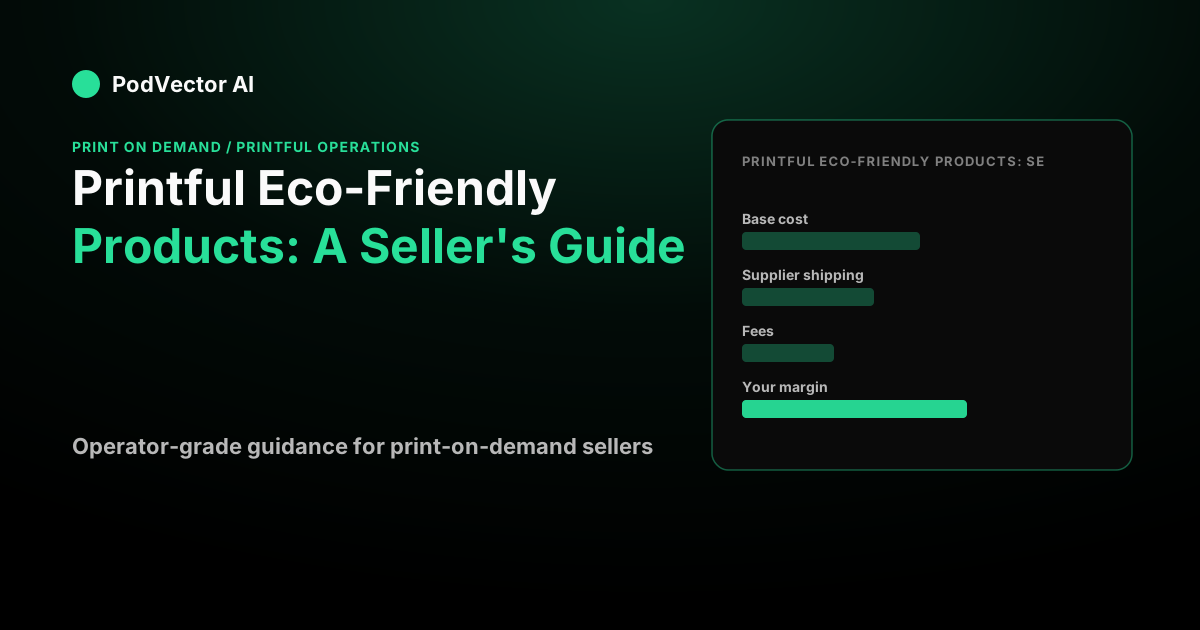
This is the part the ranking pages skip. Eco blanks cost more than standard blanks, so the only question that matters is whether the premium survives your ad spend. Here is a worked example — treat the numbers as an illustration, not a quote.
Say you run 340 orders a month at a $31 average order value, with $2,800/month in Meta spend. That is about $8.24 of ad cost per order ($2,800 ÷ 340). Now compare a standard DTG tee against its organic equivalent at a $32 retail price:
Standard tee — base cost $9.00, shipping $4.69, Shopify payment fees ~$1.23 (2.9% + $0.30 on $32): $32.00 − $9.00 − $4.69 − $1.23 − $8.24 = $8.84 profit per order.
Organic tee — base cost $13.50, everything else the same: $32.00 − $13.50 − $4.69 − $1.23 − $8.24 = $4.34 profit per order.
That $4.50 swing is the whole decision. At 340 orders a month, carrying the eco blank at the same retail price costs you roughly $1,530 in monthly profit. To hold the $8.84 margin, you would raise the eco tee to about $36.50 — and your real question becomes whether your buyers convert at that price. An operating store already has the data to answer that; a beginner guessing does not.
Packaging and the fulfillment footprint
The sustainability story is not only the fabric. Printful ships apparel in packaging it says is made from at least 70% post-consumer recycled plastic, with a stated target of 90–100% PCR packaging across all facilities, per its eco page.
Fulfillment location matters too. Printful reports that around 81% of orders are printed and shipped within the same region they're placed, which cuts the shipping distance on most orders, also from its eco page. The model's core claim is that on-demand production avoids the overproduction behind a large share of textile waste — Printful cites that print on demand helps prevent roughly 40% of global textile waste tied to overproduction on the same page.
These are claims you can honestly repeat on your store because they come with a named source. Resist inflating them — the anti-greenwashing posture is itself a selling point to this audience.
Should you convert the whole catalog or add an eco line?
For most operating stores, the answer is add, don't convert. Run your eco SKUs as a distinct line at a distinct price, and let the sales data tell you whether to widen it.
The reason is the margin example above. If you blanket-convert and keep prices flat, you quietly surrender several dollars per order across your entire volume. If you add an eco line priced for its cost, you learn the real willingness-to-pay before you bet the store on it.
This works the same whether you sell through Shopify, Squarespace, or another platform — the Printful Squarespace integration and the official Shopify integration both sync eco products identically to standard ones. The platform is not the variable; your pricing is.
How Victor keeps the eco-line profit honest
The trap with an eco line is that the higher base cost hides inside a catalog that looks fine in aggregate. Your store total looks healthy while two eco SKUs quietly lose money after ad spend. That is exactly the blind spot PodVector AI's AI employee, Victor, closes.
Victor connects your Shopify store, your Meta and Google Ads, and your Printful products and orders, and computes the true per-order profit on every SKU — the retail price minus the real Printful base cost, shipping, fees, and the ad dollars that drove the sale. Because he knows each Printful blank's cost before the first order ships, he flags the eco tee that is margin-thin at its current price the moment it starts running, not months later.
From there he acts. Victor reprices the thin-margin eco SKUs, pauses the ad set that is burning spend on a product that can't carry it, and shifts budget toward the eco variants that actually convert at the premium. He sees every order, every ad dollar, and every supplier cost together, so the eco line gets judged on profit, not on vibes.
Want the per-SKU profit picture on your own eco products? Start with PodVector AI.
FAQs
What makes a Printful product eco-friendly?
It has to be made from at least 70% organic or recycled materials, or blends of both, according to Printful. That is a content threshold, not a marketing label — and the specific fabrics are organic cotton, recycled cotton, recycled polyester, and certified blends.
Which certifications do Printful's eco products carry?
GOTS for organic cotton traceability, GRS for recycled content, and Oeko-Tex® for inks and threads free from harmful substances, per Printful's eco page. These are the names worth putting directly on your product listings, because sustainability buyers trust certifications over adjectives.
Do eco-friendly products cost more to sell on Printful?
Yes. The organic and recycled blanks have a higher base cost than standard equivalents, which compresses your per-order margin unless you raise the retail price. The practical move is to price the eco line for its cost rather than absorb the difference across your whole catalog.
Is the packaging also eco-friendly?
Printful ships apparel in packaging made from at least 70% post-consumer recycled plastic, targeting 90–100% PCR across facilities, per its eco page. Combined with roughly 81% of orders fulfilled in-region, the shipping footprint is part of the story you can honestly tell buyers.
Will eco products slow down my fulfillment or change the order flow?
No. Eco products sync, import, and move through the same order statuses as any Printful product, so your production and shipping timelines don't change. The only operational difference is the higher base cost, which lives in your pricing, not your workflow.
How do I know if my eco line is actually profitable?
Look at true per-order profit, not store-level revenue — retail minus base cost, shipping, payment fees, and the ad spend per order. Victor computes that automatically across your Shopify, ads, and Printful data so you can see exactly which eco SKUs earn their premium and which ones to reprice or pause.