
If you already run a Printful store, you've seen the catalog. The operator problem isn't discovery — it's that a tee that looks profitable at a $27.99 retail price can net you almost nothing once the base cost, the shipping leg and your Meta spend all hit the same order. This guide covers what a custom product is, how it gets built, and — the part the ranking pages skip — how to tell which ones actually pay.
What "Printful custom products" means for an operating store
A custom product is a blank from Printful's catalog — a DTG tee, an embroidered cap, a sublimation mug — that you decorate with your own artwork and sell under your brand. Printful prints and ships it only after a customer buys, so you carry no inventory and pay base cost plus shipping at fulfillment, not before.
Printful's catalog runs to more than 400 custom products across apparel, accessories, and home and living. For an established store, that breadth is a trap as much as a feature — most of those SKUs will never clear your margin bar, and the job is narrowing to the handful that do.
If you're mapping the full operational picture — sync statuses, order lifecycle, holds — start with the Printful operations guide; this page stays on products and profit.
How a custom product gets built and synced
The creation flow is consistent across the catalog:
- Pick a blank and print technique (DTG, embroidery, sublimation, all-over print).
- Upload or build the design in Printful's free in-browser Design Maker.
- Position it on the product's print area(s).
- Generate mockups — the product photos your store and ads will use.
- Set retail price and sync the listing to your store.
The mockup step matters more than it looks. For a store that already converts traffic, the mockup is the product photo, so a sharp lifestyle render is a conversion lever, not a nicety. We break the render settings down in the Printful mockup guide.
Only synced products fulfill automatically — each store variant has to be mapped to a Printful product and a print file, or the order won't process. If you sell on Shopify, the Printful Shopify app handles that mapping and the tracking hand-back.
The number that decides everything: true per-order profit
Here's the calculation the "what is Printful" articles never finish. Say you sell a branded tee:
- Retail price: $27.99
- Printful base cost: $11.00
- Shipping (US domestic): $4.69
- Shopify payment fee (roughly 2.9% + $0.30 on $27.99): $1.11
Gross per order: 27.99 − 11.00 − 4.69 − 1.11 = $11.19. That looks healthy. Now add acquisition.
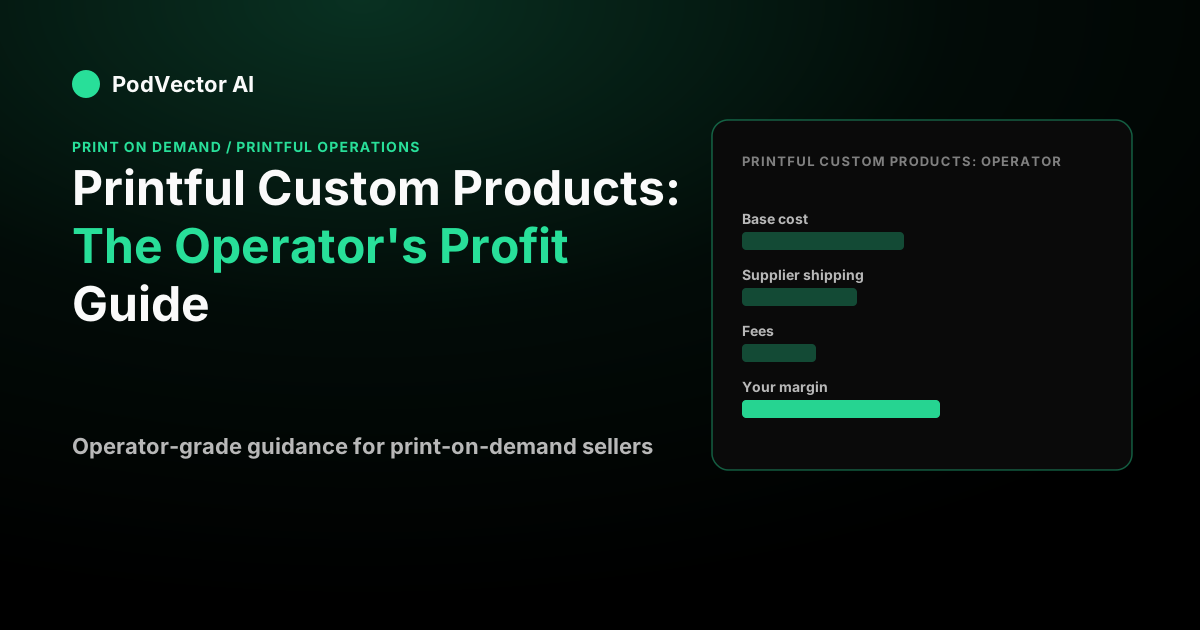
Say your store runs at a $31 average order value on $2,800/month in Meta spend, and that spend brings in 340 orders a month. Your blended customer acquisition cost is 2,800 ÷ 340 = $8.24 per order. Subtract it: 11.19 − 8.24 = $2.95 of real profit on that tee.
That's the gap operators miss. The same product at a $24.99 retail price flips to a loss the moment a discount code or a slightly worse ad week lands. The lesson: price and product selection are a margin decision made before you scale a design, not after.
Print files and mockups — where margin leaks before a single sale
Rejected or ugly prints cost you reprints, refunds and ad budget spent sending traffic to a product that disappoints. The specs that prevent that, captured from Printful's guides on 2026-09-22:
- Upload PNG or JPEG, not PDF. DTG needs a transparent-background PNG.
- Work in the 150–300 DPI band; small items like mugs and phone cases should be 300 DPI, per Printful's DTG file guide.
- Build files in sRGB (IEC61966-2.1), not CMYK — Printful's printers are tuned for sRGB input, also per the DTG file guide.
A practical safe size for apparel art is 4500 × 5400 px, which covers Printful's large DTG placements with headroom — but the product editor's per-product template is the authority at upload time, so check it rather than trusting a blanket number. And always order a sample before you put ad spend behind a design; a photo of a real print tells you more than any on-screen preview.
Fulfillment and shipping times (set delivery expectations right)
Delivery is two separate clocks, and conflating them is the classic support-ticket generator. Estimated delivery = fulfillment time + shipping time.
Printful quotes 2–5 business days to fulfill an order, per its shipping page. According to Printful's Help Center, over 97% of orders ship within five business days and more than half ship within three. US domestic standard shipping then runs 3–4 business days on top, per the same shipping page.
So a tee a customer orders Monday isn't a "3–4 day" delivery — it's production plus transit, closer to a week or more. Quote the sum on your product pages, never the shipping leg alone.
One more operator note: Printful routes orders to the nearest capable facility automatically, so a multi-item order can arrive as a split shipment from different locations. That's normal, but it can raise your shipping cost — worth modeling if you sell bundles.
Which custom products tend to hold a margin
No product is universally "best," but the pattern across operating POD stores is consistent:
- High perceived value, low base cost: posters, mugs and stickers often carry fatter percentage margins than apparel because the blank is cheap and shipping is light.
- Embroidered apparel supports a higher retail price than DTG, which can offset its higher base cost — if your audience will pay for it.
- Avoid over-personalized, seam-crossing designs on cheap blanks; the reprint and claim risk eats the margin you thought you had.
If your store lives on Squarespace rather than Shopify, the mechanics are the same — the connection specifics live in Printful's own Squarespace integration docs. Selling through Payhip instead? The Payhip + Printful integration covers that lane.
Where Victor fits
The hard part of a Printful catalog isn't building products — it's knowing, per SKU, what you actually keep. That's what Victor does.
Victor is the AI employee inside PodVector AI. He connects your Printful products, mockups and orders to your Shopify store, your Meta Ads and your Google Ads, and because he knows your Printful base cost before the first sale, he computes the true per-order profit on every product — the base cost, the shipping, the fees and the ad spend, together. When a design is selling below its margin bar, Victor reprices the thin-margin SKUs in Shopify and pauses the ad set that's feeding it losses. He builds the Klaviyo flow that resells your winners, drafts the customer-support email when a print comes out wrong, and delivers the profit report to your Google Drive.
Victor is not a dashboard you read once a week. He's the operator who sees every order, every ad dollar and every supplier cost in one place — and acts on the ones losing you money.
FAQs
How many custom products does Printful offer?
Printful's catalog includes more than 400 custom products spanning apparel, accessories, and home and living. For an operating store, the useful count is far smaller — the subset that clears your margin bar after base cost, shipping and acquisition.
What's a realistic profit margin on a Printful custom product?
It depends entirely on retail price and acquisition cost. In the worked example above, a $27.99 tee with an $11.00 base cost nets about $11.19 before ads — but only $2.95 after an $8.24 blended acquisition cost. Run your own numbers per SKU; blended margin hides the losers.
Do I need to hold inventory for custom products?
No. Printful prints and ships each item only after a customer orders, and bills you base cost plus shipping at fulfillment. There's no upfront inventory cost and no signup or monthly fee to list products.
How long do Printful custom products take to arrive?
Fulfillment is 2–5 business days per Printful's shipping page, then shipping on top — US domestic standard adds another 3–4 business days. Quote customers the sum, not the shipping leg alone.
What if a custom product arrives damaged or misprinted?
Printful covers its own errors with a free reshipment or refund, and the customer doesn't return the item — you just need a clear photo. The claim window is 30 days from delivery, per Printful's Help Center. Address errors, though, are on you — the reshipment cost is yours, so validate addresses on flagged orders.
Can I sell the same custom design across multiple products?
Yes. Save it as a Product Template in your Printful dashboard and re-publish it across products and stores without rebuilding the design — useful when a single artwork earns its keep on a tee, a mug and a poster.