
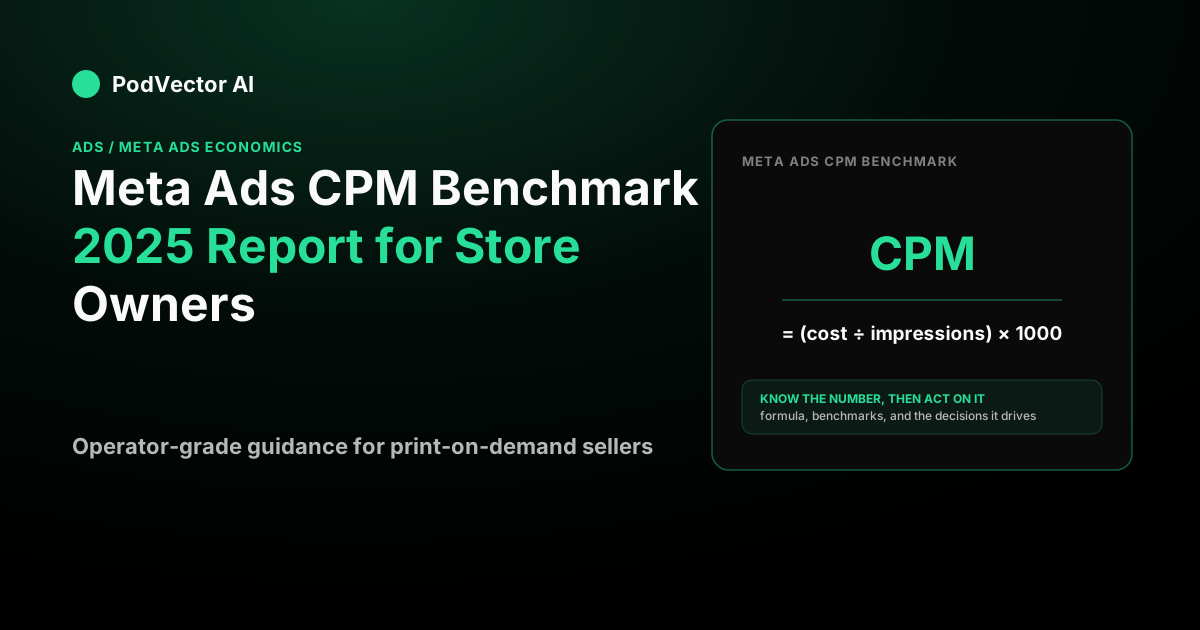
If you already run a store with real ad spend, you don't need another chart telling you the "average" CPM. You need to know where your number should land, why it drifts, and when a rising CPM is actually a problem worth fixing versus noise you should ignore. This report gives you the 2025 figures, then shows you how to read them against your own margins.
For the full economics of running paid social profitably, start with our Meta ads economics guide — this page zooms in on CPM specifically.
What CPM actually ran in 2025
CPM is the cost to put your ad in front of one thousand people. It is the market price of attention, and in 2025 that price sat in a fairly wide band for ecommerce.
Across industries, reported Meta CPMs clustered between $8 and $15, with many sectors averaging over $12. The platform-wide average came in near $8.19, while e-commerce specifically averaged about $10.76 — ecommerce runs above the all-industry mean because stores compete for high-intent, conversion-ready placements.
Here is the practical takeaway before the detail: if your store sits anywhere in the $8–$15 range, you are normal. A CPM of $11 is not a red flag. A CPM of $11 that used to be $7 last quarter is worth a look — and we'll get to how to tell those apart.
Meta CPM benchmarks for 2025, in detail
By geography
Where your buyers live moves CPM more than almost anything else. The United States is the most expensive auction on the planet.
One widely cited breakdown put US CPM at $20.48, the UK at $10.85, Germany at $10.05, and India at $2.70. So a US-only apparel store and a store selling into India are playing entirely different games — comparing your US CPM to a global "average" is meaningless.
By campaign type
What you ask Meta to optimize for changes the price. Broad reach is cheap; high-intent conversion placements cost more.
For the US market, one 2025 benchmark reported reach campaigns at $10–15 CPM, product-feed sales ads to new audiences at $10–15, and remarketing or manually targeted sales ads at $30–50. Lead-gen objectives ran higher still. Retargeting carries a higher CPM because the audience is small and you're paying a premium to reach the same warm buyers repeatedly.
The downstream metrics CPM feeds into
CPM never travels alone. It combines with your click-through rate and conversion rate to produce the only number that matters for scaling: your cost to acquire a customer.
For retail and ecommerce in 2025, one report pegged the average CPC at about $0.21, CTR near 1.90%, and ROAS around 3.56x. Conversion rates varied sharply by category — retail around 3.26%, apparel near 4.11%, and beauty as high as 7.10% — which is why two stores with identical CPMs can have wildly different results.
Why your CPM is probably different from the benchmark
A benchmark is an average of thousands of accounts. Yours differs for reasons you can diagnose, and the diagnosis matters because the fix is different each time.
Meta's auction doesn't just pick the highest bidder. It ranks on total value — roughly your bid times Meta's estimate that this person takes your action, adjusted for ad quality. A relevant, high-converting ad can win impressions and pay a lower CPM, because Meta would rather show a great ad than a mediocre one with a bigger bid.
That gives you two very different root causes when CPM climbs. Either the market got more expensive — more advertisers in your auction, seasonal crowding, a competitor entering — or your ad quality decayed and Meta is charging you more to keep showing a tired creative. Seasonal crowding is real: some sources reported apparel and food CPMs rising 50–80% year over year around peak periods.
The quick test: if CPM is up while your CTR and conversion rate are flat, it's the market, and there's little to fix besides widening your audience or accepting a seasonal cost. If CPM is up and CTR is falling, your creative is fatiguing — that's on you, and it's fixable.
CPM is a cost, not a verdict — the profit angle
Here is what every benchmark post skips. A "good" CPM can still lose you money, and a "high" CPM can be wildly profitable. CPM only decides the price of attention. Your margin decides whether that attention was worth buying.
Say you sell a tee at a $31 average order value, and after product cost from Printify, shipping, and fees your contribution margin is 50% — so $15.50 of gross profit per order. You run an $11 CPM, which is dead-center for ecommerce.
Walk the math. $11 buys 1,000 impressions. At a 1.9% CTR that's 19 clicks. At a 3.26% conversion rate that's about 0.62 orders. So your cost per order is $11 ÷ 0.62 = roughly $17.75. Against that $15.50 of gross profit, you're losing about $17.75 − $15.50 = $2.25 on every order — at a perfectly average CPM.
Now change one thing that has nothing to do with the ad account. Add a bundle that lifts AOV to $45 at the same margin rate, and gross profit per order becomes $22.50. Same CPM, same clicks, same conversion rate — but now each order throws off about $22.50 − $17.75 = $4.75 in profit. You didn't touch Meta at all.
That's the whole insight: your break-even ROAS is 1 ÷ contribution margin. At 50% margin you break even at 2.0x; at 40% you need 2.5x. Raising AOV lowers the ROAS your ads have to clear, which is mathematically identical to making every ad more efficient. If you only ever watch CPM, you'll miss the lever that actually decides profit.
For the full picture on the return side of that equation, read what counts as a good ROAS for Facebook ads.
What to do when your CPM climbs
Work top-down. Rule out measurement and market before you blame the campaign.
- Check whether it's the market or you. CPM up, CTR and CVR flat → auction density, not your fault. CPM up, CTR down → creative fatigue.
- Check frequency. If the same people are seeing your ad over and over and cost-per-result is rising alongside it, your audience is too small for your budget. That pairing — rising frequency and rising cost — is the reliable fatigue signal, not frequency alone.
- Refresh creative before it dies. Because Meta now leans on your creative to decide who sees the ad, a fresh hook often lowers CPM faster than any audience change. Thumbstop rate erodes before ROAS visibly moves, so it's your early warning.
- Don't scale on average ROAS. A campaign averaging 4.0x can have a marginal ROAS near zero on the last chunk of budget. Scale decisions live on the marginal number, not the headline.
None of this is complicated. It's just tedious to do across every ad set, every day, which is exactly where most operators fall behind.
How Victor handles your Meta CPM
Victor is the AI employee inside PodVector AI. He connects to your Meta Ads account, your Shopify store, and your print-on-demand supplier — Printify, Printful, or Gelato — so he sees every impression you paid for, every order it produced, and the true cost of the product that shipped.
That means Victor computes real per-order profit, not just ROAS. When a CPM climbs, he can tell whether CTR fell with it, pause the ad set that's bleeding margin, shift budget to the creative that's still converting, and reprice or bundle the thin-margin SKUs on the Shopify side. He also builds the Klaviyo flows that lift repeat-order value, and delivers the profit report to your Google Drive so you're reading conclusions, not spreadsheets.
Victor sees the ad dollar and the product cost in one place — so a benchmark CPM becomes an actual profit number for your store.
See what Victor finds in your store
You can also compare platforms directly in our breakdown of Instagram ads cost and average CPC and CPM.
FAQs
What is a good Meta CPM for ecommerce in 2025?
Most ecommerce stores fell in the $8 to $15 range, with many sectors averaging over $12, and e-commerce overall near $10.76. But "good" depends on your margin, not the benchmark — a $14 CPM is great if your orders are profitable at that cost per acquisition and bad if they aren't.
Why is my CPM so much higher than the average?
Geography and campaign type explain most of it. US CPMs ran around $20.48 versus $2.70 in India, and remarketing can cost $30–50 versus $10–15 for broad reach. If none of that explains it, check whether your CTR is falling — that points to creative fatigue pushing your price up.
Does a low CPM mean my ads are profitable?
No. CPM is only the price of attention. You can pay a cheap CPM and still lose money if your conversion rate is weak or your margin is thin. Profit depends on cost per order against contribution margin, where break-even ROAS equals 1 ÷ your margin.
How do I actually lower my Meta CPM?
Improve the signals Meta rewards. A more relevant, higher-CTR creative can win impressions at a lower CPM because the auction optimizes total value, not just your bid. Widening a too-small audience and refreshing fatigued creative are the two highest-leverage moves.
Is a rising CPM always a problem?
No. If CPM rises while CTR and conversion rate hold steady, it's usually the auction getting more crowded — seasonal, external, and not fixable by editing your ad. It only becomes your problem when cost-per-result climbs with it.