
If you run a store, CPM is the price tag on attention. You pay it every time Meta shows your ad a thousand times, whether or not anyone clicks or buys. So knowing where yours sits against the market is the first step in figuring out whether your ads are expensive — or just normal.
This guide gives you the real numbers, shows you why yours differs, and connects CPM back to the only thing that matters: profit per order. For the fuller picture of how every Meta ad metric fits together, start with the Meta ads economics guide.
What CPM actually measures
CPM is cost per mille — the cost to reach one thousand impressions. An impression is one appearance of your ad on one screen, not a click and not a sale.
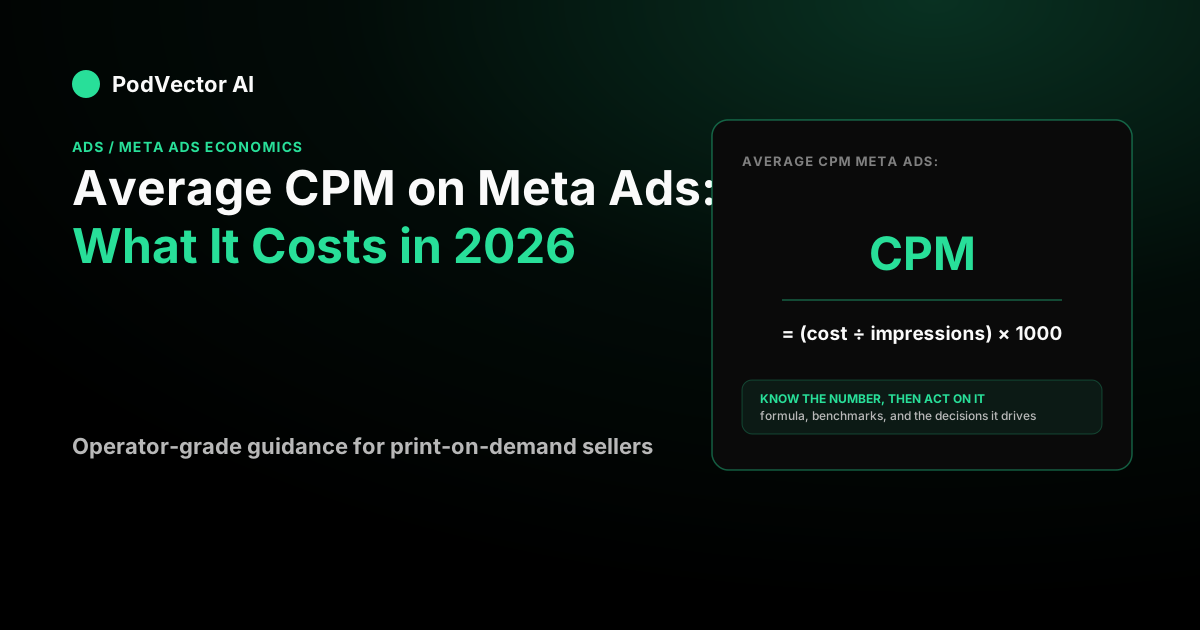
The formula is simple: total spend divided by impressions, times a thousand. If you spent $280 and got 20,000 impressions, your CPM is $280 ÷ 20,000 × 1,000 = $14.00.
CPM is the market price of attention. It is an input cost — upstream of clicks, conversions, and revenue — which is why a "good" CPM and a profitable campaign are two different questions.
So what is the average CPM on Meta ads?
There is no single official number — Meta does not publish one, so every benchmark comes from a sample of accounts. But the 2026 ranges cluster tightly for ecommerce.
A benchmark of actively managed DTC brands covering July of last year through June of this year reports a median Meta CPM of $13.52, with the middle half of accounts falling between $11.04 and $22.90. A broader 2026 read puts the all-industry median around $14.
Treat those as a center of gravity, not a target. The same source notes CPM rose roughly a fifth year over year as more advertisers crowded into the same auction — so last year's "normal" is this year's "cheap."
CPM by industry
Where your store sits in the market moves your baseline more than almost anything else you control. These 2026 medians come from the same industry benchmark:
- Food & beverage: $8–$10
- Apparel & fashion: $9–$11
- Ecommerce (general): $10–$13
- Electronics: $12–$14
- Home & garden: $13–$16
- Beauty: $13–$16
Most print-on-demand catalogs — apparel, home goods, accessories — live in the lower bands. If you sell tees and mugs and your CPM reads $22, you are not paying an apparel price; something in your account is pushing it up.
Why awareness CPMs read lower than sales CPMs
Your campaign objective shifts CPM too. Awareness and reach objectives tend to show the lowest CPMs, while sales and lead objectives show higher ones.
That is not Meta charging you a penalty for wanting sales. It is selection: when you optimize for purchases, Meta spends your budget finding the narrower slice of people likely to buy, and that slice costs more to reach per thousand than "anyone who will see this." Compare a cheap awareness CPM against a sales CPM and you are comparing two different products.
Why your CPM is above or below average
When your number drifts off the benchmark, there are two completely different root causes — and the fix depends entirely on which one you are looking at.
The market got more expensive. Meta runs an auction for every impression, and when more advertisers chase the same users, the clearing price rises. This is why CPMs climb every Q4 and around big sale events — it hits everyone, and it is not your fault. You can widen your audience or geo to dodge the worst of it, but you cannot tweak your way out of a seasonal spike.
Your ad quality decayed. Meta does not simply award impressions to the highest bid; it ranks on total value, roughly your bid times its estimate of how likely this person is to take your action. A relevant, high-engagement ad can win the auction at a lower CPM than a weak ad with a higher bid.
So a relevant ad is literally a discount on attention, and a stale one is a surcharge. The practical test: if your CPM is up while your click-through rate is flat, that is the market. If CPM is up and click-through is falling, that is creative fatigue — your audience has seen the ad too many times and stopped reacting.
CPM is a cost input, not a goal
Here is the trap store owners fall into: chasing a low CPM as if it were the win. It isn't. You can hit a rock-bottom CPM reaching people who never buy and lose money all day.
Walk the full chain. Say you run $2,800 a month in Meta spend at a $14 CPM. That buys about 200,000 impressions ($2,800 ÷ $14 × 1,000).
At a 2% click-through rate, that is 4,000 clicks. At a 3% landing-page conversion rate, that is 120 purchases. Your cost per purchase is $2,800 ÷ 120 = $23.33.
Now bring in margin. Say your average order is $42 and, after product cost, shipping, and fees, you keep 55% — that is $23.10 of gross profit per order. Against a $23.33 cost per purchase, you are essentially break-even, making nothing on new-customer orders.
Watch what a market-wide CPM rise does to that. If CPM climbs the roughly 20% seen year over year — to about $16.80 — the same $2,800 now buys ~166,700 impressions, ~3,333 clicks, and ~100 purchases. Cost per purchase jumps to $28, and that break-even order is now a $4.90 loss. Nothing about your ad changed; the auction got more expensive and your margin absorbed it.
That is the whole point: CPM only matters in relation to what each order is worth. The downstream metric that actually governs scaling is a good ROAS for your margin, not a low CPM.
This is exactly the blind spot Victor, the AI employee inside PodVector AI, is built to close. Victor sees every order, every ad dollar, and every supplier cost from Printify, Printful, or Gelato together, so he computes the true per-order profit behind your Meta spend — not just the ROAS the ad account reports. When a CPM creep quietly pushes an ad set below break-even, Victor pauses the losing ad set and shifts budget toward the ones still clearing margin.
Put Victor to work on your store and let him connect your Meta Ads spend to real profit.
How to pull your CPM back down
You cannot control the auction, but you can control your relevance — and relevance is what Meta rewards with cheaper impressions.
Fresh, scroll-stopping creative is the biggest lever. Because Meta's system now leans on your creative to decide who sees the ad, a stronger hook does double duty: more clicks per impression and a lower CPM. The average cost per click on Instagram ads tells the same story one step downstream.
Watch frequency as an early warning. When the same people see your ad again and again, engagement drops, Meta reads the fatigue, and your CPM drifts up — the reliable signal is frequency rising together with cost per result, not frequency alone.
And give the system room to settle. Each new ad set re-enters a learning phase and stays volatile and pricier until it gathers about 50 optimization events in a week; splitting tiny budgets across many ad sets traps all of them there. Consolidate so each one can actually learn.
Victor handles this layer directly inside Meta Ads — he changes budgets and bids, edits audiences, and pauses fatigued ads before they bleed margin, and he reprices thin-margin SKUs in Shopify so the orders your ads buy are worth more. He also delivers a plain report of it all to your Google Drive, so you see what moved and why.
Geography matters too, and it is worth knowing your own backyard: CPMs in markets like Brazil run far below US levels, which is why blended global CPMs can look misleadingly cheap.
FAQs
What is a good CPM for Meta ads?
"Good" depends on your margin, not on a universal number. For an ecommerce store, a CPM in the low-to-mid teens is in line with the 2026 DTC median of $13.52. But a $9 CPM that reaches non-buyers is worse than an $18 CPM that reaches people who purchase — judge CPM by the cost per purchase and profit it eventually produces, never on its own.
Why is my Meta CPM so high?
Two causes, and they need different fixes. Either the auction got more expensive (seasonality, more competitors — check whether your click-through rate held steady while CPM rose), or your ad quality slipped (fatigue, narrow saturated audience, weak relevance — you will see click-through falling as CPM climbs). Diagnose which before you touch anything.
Is CPM higher on Instagram or Facebook?
It varies by placement, audience, and season, and the gap is usually smaller than the difference between your industries or objectives. Rather than chase the "cheaper" platform, let Meta's delivery spread spend across placements and judge each by cost per purchase, not by CPM in isolation.
Does a lower CPM mean better ads?
Not by itself. A low CPM only means you are reaching people cheaply — it says nothing about whether they click or buy. A cheap CPM paired with a weak conversion rate can lose money, while a higher CPM that reaches genuine buyers can be very profitable. Optimize for profit per order, not for the lowest cost of attention.
How is CPM different from CPC and cost per purchase?
CPM is the cost per thousand impressions — paying to be seen. CPC is the cost per click — paying for interest. Cost per purchase is the cost to actually acquire one order. They sit in a chain: CPM feeds clicks, clicks feed purchases, and only the last one connects to revenue. A low CPM upstream can still produce an expensive cost per purchase if your clicks or conversion rate are weak.