
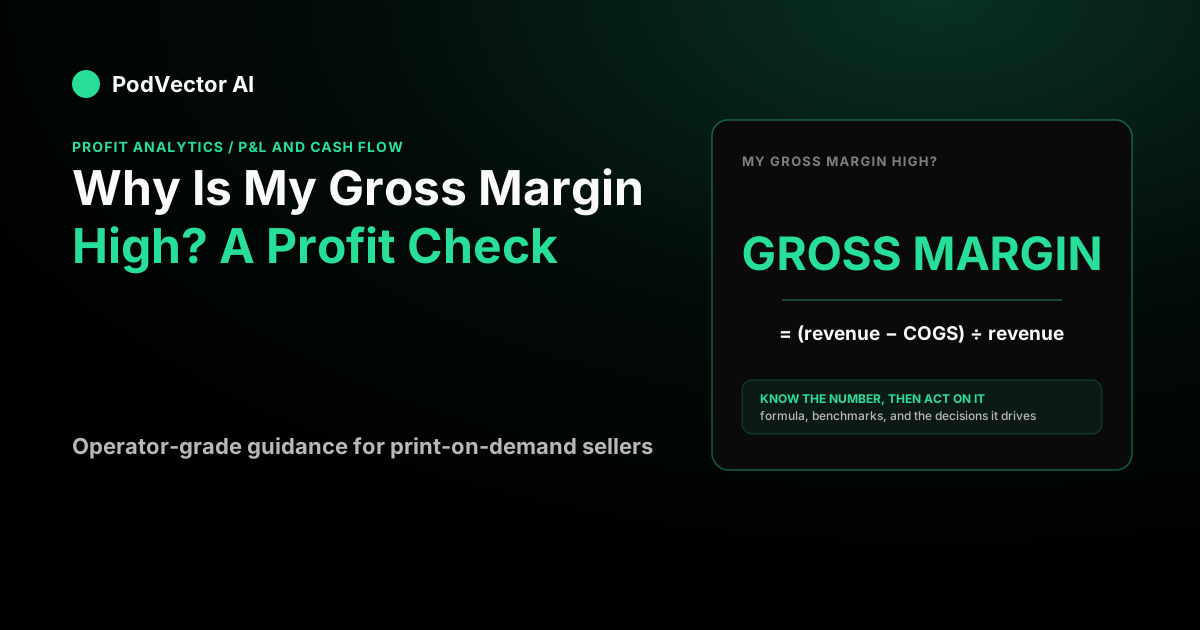
What a high gross margin actually measures
Gross margin is the share of each net sales dollar left after the direct cost of the product. The formula is simple: net sales minus cost of goods sold (COGS), divided by net sales.
A high number means the gap between price and product cost is wide. That is genuinely good — it gives you room to spend on ads, absorb refunds, and still keep profit.
But "high" only means something inside your industry. One benchmark guide puts mature SaaS around seventy to eighty-five percent, retail at twenty-five to forty-five percent, and luxury fashion at fifty-five to seventy-five percent. A print-on-demand store landing near fifty percent is normal; the same number would be alarming for a grocery reseller and modest for software.
So the first question is not "is my margin high?" It is "is my margin high for what I sell, and did I count every direct cost?"
The three real reasons your gross margin is high
There are only a few honest explanations, plus one that should worry you.
1. You have real pricing power
Customers pay a premium your competitors can't command — a strong brand, a niche design, a bundle nobody else offers. Your price sits well above product cost and stays there. This is the reason you want.
2. Your product costs genuinely dropped
A supplier price cut, a switch to a cheaper blank, better freight terms, or moving volume to a higher tier all widen the gap. If your COGS fell and price held, margin rises for the right reason. This is the lever most owners underuse — see how to attack it in the guide to why gross profit rises when costs move.
3. Your sales mix shifted toward high-margin items
If more orders this month came from your best-margin product, blended gross margin climbs even though no single item changed. That is real, but it's fragile — it reverses the moment the mix shifts back.
4. The dangerous one: a cost is missing from COGS
This is the trap. Gross margin looks high because a direct cost never made it into the calculation. The usual suspects:
- Supplier shipping billed inside the print charge but recorded somewhere else, or not at all.
- Payment processing fees left out of COGS entirely.
- Refunds not subtracted from revenue, so your top line is inflated.
- Ad spend accidentally left out — or worse, the reverse problem covered below.
If any of these are missing, your margin is high on paper and wrong in reality. Clean books are the only way to tell reason four apart from reasons one through three. The full line-by-line build is in the ecommerce P&L guide.
Worked example: a print-on-demand month
Numbers make this concrete. These figures are illustrative — plug in your own.
Say your store took three hundred orders last month, and you decide to model an average order value of thirty-two dollars. That's three hundred × 32 = $9,600 in gross sales. Now the deductions:
- A ten-percent-off code ran, costing $480 in discounts.
- Nine orders were refunded, worth $290.
- Net sales = 9,600 − 480 − 290 = $8,830.
Then the direct costs that belong in COGS:
- Print-on-demand production at twelve dollars per unit across three hundred units = $3,600 (supplier shipping to the customer is bundled into that print charge here).
- Payment processing. Shopify Payments commonly runs around two-point-nine percent plus thirty cents per online transaction on lower-tier plans, so on this month that's 8,830 × 0.029 + 300 × 0.30 = $256 + $90 = $346.
Gross profit = 8,830 − 3,600 − 346 = $4,884. Gross margin = 4,884 ÷ 8,830 = 55.3%.
That looks like a healthy, "high" margin. And the product is healthy. But watch what happens next.
Why a high gross margin can still mean thin profit
Gross margin stops above the operating-expense line. Everything it takes to actually run the store sits below it — and for most ad-driven stores, that's where the money goes.
Continue the example. Below gross profit:
- Ad spend on Meta and Google: $3,000.
- Shopify plan plus apps: $180.
- Email and design tools: $90.
- Owner draw or a contractor: $500.
Operating profit = 4,884 − 3,000 − 180 − 90 − 500 = $1,114. Operating margin = 1,114 ÷ 8,830 = 12.6%.
Same store. Gross margin of 55%, operating margin of 13%. The product economics are strong, but ad spend eats most of the gross profit. If ad costs rise twenty percent — another $600 — operating profit nearly halves.
This is the number-one reason a high gross margin misleads owners: it describes the product, not the business. A store can post a beautiful 55% gross margin and still barely clear a profit once acquisition, tools, and pay come out.
The mirror-image mistake: hiding ad spend in COGS
There's a version of a high gross margin that is purely an accounting error. If you drop ad spend into COGS instead of operating expenses, your gross margin shrinks — but quietly moving any variable cost out of COGS inflates it.
The rule: direct per-unit costs go in COGS; ad spend goes in operating expenses. Ad spend scales with revenue, which tempts owners to treat it like a cost of goods. Don't. Burying acquisition cost above the gross-profit line inflates gross margin and hides that customer acquisition cost is your real risk. When you see a suspiciously high margin, this is the first thing to check. The opposite failure — a margin that looks too low — often comes from the reverse error, covered in why your gross margin looks low.
High margin, and still short on cash?
One more twist: a high gross margin, and even a real operating profit, does not guarantee cash in the bank.
Profit is booked on the sale date. Cash moves on its own schedule. Your ad card is charged today, your print supplier bills when the order is produced, but your Shopify payout lands days later on a rolling delay. The faster you scale that healthy-margin product, the wider the gap between money going out and money coming back.
So a store can show 55% gross margin, a genuine profit, and still run short the week before payouts catch up. Margin is about product economics; cash is about timing. Read both.
How to confirm your high margin is real
Run this checklist before you trust the number:
- Recompute COGS from scratch. Product cost, supplier shipping, and processing fees for the units actually sold — not units purchased.
- Subtract refunds and discounts from revenue so your net sales are honest.
- Confirm ad spend is in operating expenses, not COGS. If it's in the wrong bucket, your margin is fiction.
- Read gross margin next to operating margin. A wide gap between them is the ad-spend story from the example above.
- Check cash separately. Profit and cash are different questions.
Doing this by hand every month across Shopify orders, Stripe deposits, Meta and Google spend, and Printify or Printful charges is where most owners give up — and where the numbers quietly drift wrong. If you'd rather not reconcile it manually, see the Shopify and QuickBooks COGS integration options.
PodVector connects Shopify, Meta Ads, Google Ads, Printify, and Printful, then computes your true per-order profit so a "high" gross margin can't hide a missing cost. Victor, its AI employee, reads that live data and proposes moves you approve — he is not a dashboard, and he does not touch your ad account. Start free and see your real per-order profit.
FAQs
Is a high gross margin always a good thing?
Usually, but not automatically. A high margin from real pricing power or lower product costs is excellent. A high margin because you forgot to book supplier shipping, processing fees, or refunds is just a bookkeeping error. Confirm the number is complete before you treat it as good news.
What is considered a high gross margin for ecommerce?
It depends entirely on what you sell. One benchmark guide places retail around twenty-five to forty-five percent and luxury fashion at fifty-five to seventy-five percent. A print-on-demand store near fifty percent is typical. Compare yourself to your own category, not a universal number.
Why is my gross margin high but my profit low?
Because gross margin stops before operating expenses. Ad spend, subscriptions, tools, and owner pay all come out below the gross-profit line. As the worked example shows, a store with 55% gross margin can land near 13% operating margin once acquisition cost is subtracted. High gross margin describes your product; low profit describes your whole business.
Does high gross margin mean I have plenty of cash?
No. Profit is recorded when a sale happens; cash arrives when Shopify pays out, on a delay. Ad spend and supplier charges leave first. A profitable, high-margin store can still be cash-tight during a fast growth push, so track cash timing separately from margin.
Should ad spend go in COGS or operating expenses?
Operating expenses. It's tempting to put it in COGS because it scales with sales, but that inflates your gross margin and hides that customer acquisition cost is your biggest risk. Keep COGS to direct per-unit costs — product, supplier shipping, and processing — and put paid acquisition below the gross-profit line.
How do I know if a cost is missing from my COGS?
Rebuild COGS from your source data for the units you actually sold, then reconcile it against your supplier invoices and processor statements. If your Shopify payout doesn't tie out to gross sales minus fees, refunds, and discounts, something is miscategorized — and a suspiciously high margin is often the first symptom.