
What contribution margin actually measures
Contribution margin is the share of a sale left over after you subtract the costs that rise and fall with each order. Those variable costs are things like product cost, shipping, and payment fees.
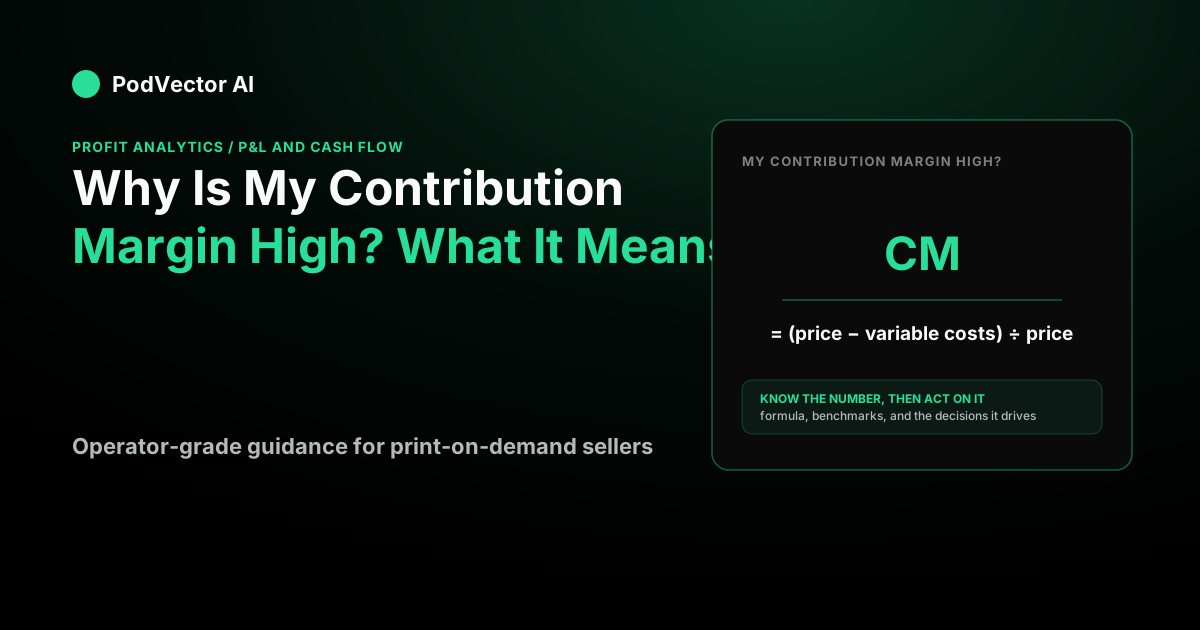
The formula is simple. Contribution margin dollars equal revenue minus variable costs. Contribution margin percent is that number divided by revenue.
Say you sell a t-shirt for $30. Your print-on-demand supplier charges $12 to make and ship it, and your card processor keeps a fee. Everything left after those per-order costs is your contribution — the money that "contributes" toward fixed costs and, eventually, profit.
So when you ask why is my contribution margin high, you are really asking one of two things: is my product genuinely efficient, or am I just leaving costs out of the calculation?
Why your contribution margin might be high
Most ranking guides list the same handful of causes. They are correct as far as they go, so here they are — with the ecommerce detail those guides skip.
Your prices are strong relative to variable cost
The most common reason is pricing power. If customers happily pay $30 for a shirt that costs you $12 to produce, a big gap opens between price and variable cost, and that gap is your contribution margin.
This is the healthiest reason to have a high margin. It means your brand, design, or niche lets you charge more than the raw production cost.
Your variable costs are genuinely low
Low product cost does the same thing from the other side. Negotiating a better supplier rate, switching blanks, or reducing per-order shipping all widen the gap.
For print-on-demand sellers, this is where the resale certificate matters. If your supplier is charging you sales tax on every production order, that tax quietly inflates your variable cost — fixing it lifts your margin.
Your cost structure is mostly fixed
Some business models simply carry more fixed cost than variable cost. When most of your spending is fixed — software, tools, a monthly plan — very little cost attaches to each individual order, so contribution margin per unit looks high by design.
That is normal for digital-heavy or subscription-style stores. It is not a mistake, but it changes how you should read the number, as the next section explains.
You are not counting all your variable costs
This is the cause the other articles almost never mention, and for ad-driven Shopify stores it is the important one. If your "variable costs" only include product and shipping — but not the ad spend it took to win the order — your contribution margin will look great and mean almost nothing.
Paid acquisition scales with orders, so for decision-making it behaves like a variable cost even though a formal profit and loss statement parks it in operating expenses. Leave it out and you are measuring a product that has no customers attached to it yet.
A high contribution margin is not the same as profit
Here is the profit angle nearly every top result glosses over. Contribution margin tells you what each sale leaves behind. It does not tell you whether that leftover is enough to cover your fixed costs and clear a profit.
Think of it as a two-step test. Step one: does each order contribute money? Step two: do enough contributing orders stack up to beat your fixed costs? A high answer to step one can still fail step two.
Worked example — high margin, thin profit
Say you run a t-shirt store and one month looks like this. These are illustrative numbers, not benchmarks.
You sell each shirt for $30 and you get 300 orders, so revenue is 300 × $30 = $9,000. Your supplier charges $12 per shirt to produce and ship, which is 300 × $12 = $3,600. Your payment processor keeps 2.9% plus 30 cents per order — a standard Shopify Payments online rate according to Shopify's pricing page — which on a $30 order is about $1.17, or 300 × $1.17 = $351.
Add the variable costs: $3,600 + $351 = $3,951. Contribution margin dollars are $9,000 − $3,951 = $5,049. As a percent, that is $5,049 ÷ $9,000 = 56%. That is a genuinely high contribution margin.
Now bring in the costs that do not move with each order. Say your fixed costs for the month are a Shopify plan and apps at $180, design and email tools at $90, and owner pay at $500 — $770 in total. And say you spent $4,000 on Meta and Google ads to get those 300 orders.
Subtract both: $5,049 − $770 − $4,000 = $279. Your operating profit is $279 on $9,000 of revenue — barely 3%. The contribution margin screamed "healthy product." The bottom line whispered "you are one bad ad week from red."
What the example teaches
The gap between the 56% contribution margin and the 3% operating margin is entirely ad spend. That is the number to watch, and it is exactly why a high contribution margin can lull you into scaling spend that erases your profit.
If you want to see how these lines fit together from revenue down to net profit, our ecommerce P&L guide walks the whole statement. And if your margin is moving the other way, why your contribution margin is low covers the mirror-image problem.
Contribution margin vs gross margin vs operating margin
These three get muddled constantly, and knowing which one is "high" changes what you do next.
Gross margin subtracts cost of goods sold — the direct product costs — from revenue. Contribution margin is close, but it subtracts all variable costs, which can include costs that sit outside cost of goods sold. Operating margin goes further down, subtracting operating expenses too, and is the truest read on whether the business works.
A store can post a high contribution margin and a high gross margin while its operating margin sits near zero. If that sounds like your store, the companion pieces on why your operating margin is high and why your operating margin is low unpack that layer.
What to do with a high contribution margin
A high margin is an opportunity, not a finish line. Three moves make it pay off.
First, decide how aggressively to spend on acquisition. A wide contribution margin gives you room to bid more per customer than a thin-margin competitor can — but only up to the point where added ad spend still leaves profit after fixed costs.
Second, protect the margin. Watch supplier price creep, refunds (where you often eat the original processing fee even though the sale reversed), and discount codes that quietly shrink the gap.
Third, mind cash timing. A profitable, high-margin store can still run short on cash because ad spend leaves your account daily while payouts arrive on a delay. If that squeeze is biting, weigh your funding options carefully — our rundown of Shopify Capital alternatives lays out the trade-offs.
Where the numbers usually hide
The reason contribution margin gets miscalculated is that the costs live in different places. Product cost is on your supplier's invoice. Processing fees are buried inside your Shopify payout, which is a netted deposit, not your sales figure. Ad spend sits on Meta's and Google's dashboards. Refunds and discounts are elsewhere again.
To get a true per-order number, someone has to stitch those sources together for every single order — the same product, fees, shipping, and ad cost, matched to the revenue it produced.
That stitching is what PodVector does. It connects Shopify, Meta Ads, Google Ads, Printify, and Printful, then computes true per-order profit so your contribution margin reflects every variable cost, not just the ones that were easy to find. Victor, its AI employee, reads that live data and can act on your Shopify store with your approval — he reads your ad data and proposes moves, but does not touch your ad account. It is not a dashboard you have to go read; it is an employee working from the real numbers. You can try PodVector free if you want your margin math done for you.
FAQs
Is a high contribution margin always good?
Usually, but not automatically. A high contribution margin is a strong signal about product economics — each sale leaves a lot behind. It only translates to profit if you have counted every variable cost (including acquisition) and your fixed costs are low enough that the leftover survives. A "high" number built on an incomplete cost list is a false comfort.
What is a good contribution margin for an ecommerce store?
There is no universal figure, and any single benchmark you see quoted should be treated skeptically, because it depends on your niche, price point, and whether ad spend is included. More useful than chasing a target percent is making sure your calculation captures all variable costs, then tracking whether the number is stable or drifting month to month.
Does contribution margin include shipping and payment fees?
Yes. Any cost that scales with each order belongs in the variable-cost side of contribution margin — product cost, supplier shipping, and payment processing fees all count. Many sellers forget the processing fee, which on a typical online card sale runs about 2.9% plus 30 cents per Shopify's published rate.
Should I count ad spend in my contribution margin?
For a formal profit and loss statement, ad spend sits in operating expenses, not variable cost. But for real decisions about how much you can afford to grow, treat per-order acquisition cost as variable — because it scales with orders. Run the number both ways: contribution margin before ads shows product health, and after ads shows whether growth actually pays.
Why is my contribution margin high but my profit low?
Almost always because fixed costs or ad spend are eating the contribution. Contribution margin measures what each sale leaves after variable costs; profit is what remains after fixed costs too. If acquisition or overhead is heavy, a high contribution margin can shrink to a razor-thin profit — exactly the pattern in the worked example above.
This article is general information, not tax, accounting, or financial advice. Rules and rates change and vary by situation — consult a licensed CPA or professional before acting.