
What contribution margin actually is
Contribution margin is the money left from a sale after you subtract the costs that only exist because that sale happened. The formula is simple:
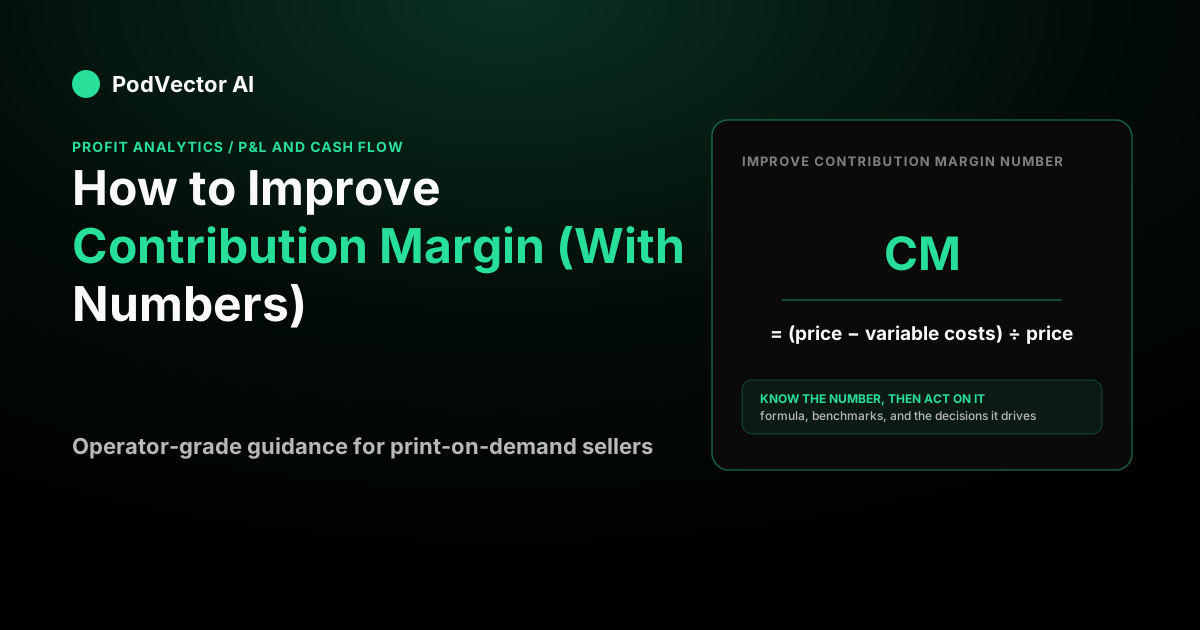
Contribution margin = Revenue − Variable costs. Divide by revenue and you get the contribution margin ratio, expressed as a percent.
Variable costs are the ones that scale with each order: the product's cost of goods, shipping, payment processing fees, packaging, and — for many ecommerce operators — the variable marketing spent to win that order. Fixed costs (your Shopify plan, apps, salaries, your own pay) are not in the calculation. That is the whole point: contribution margin isolates the per-order economics before overhead muddies the picture.
This is different from gross margin, which lives on your income statement. If you want the full stack — gross margin, operating margin, and net profit — the ecommerce P&L guide walks the whole statement top to bottom. Contribution margin sits one level below the SKU and answers a sharper question: does this order, at this price, actually pay for itself?
The five levers that move contribution margin
There are only five things you can pull. Everything you read about "improving contribution margin" is one of these in disguise.
1. Raise price — the fastest lever
Price flows almost entirely to contribution margin, because raising it barely changes your variable cost. The only cost that moves is the percentage-based processing fee. On Shopify Payments' Basic plan, that fee is 2.9% + 30¢ per online card transaction, so a four-dollar price increase gives back only about twelve cents to the processor and keeps the rest.
The risk is volume. A small price rise on a differentiated product usually holds; a large one on a commodity tee does not. Test in steps, watch conversion, and keep the increase where units sold barely dip.
2. Cut variable cost per order
Every dollar you shave off cost of goods lands in contribution margin one-for-one — no volume risk at all. For a print-on-demand store that means negotiating blank and print costs, choosing a supplier or product with a lower base charge, or consolidating so more items ship in one package.
Two quiet leaks belong here. Refunds do not return the original processing fee — Shopify Payments keeps that fee even on a fully refunded order, so a refunded sale is a pure variable-cost loss. Chargebacks add a $15 dispute fee in the US on top of the reversed sale. Reducing both directly widens margin.
3. Shift the mix toward high-margin SKUs
Two products can have the same revenue and wildly different contribution. When you know each SKU's real margin, you can push traffic, ad budget, and homepage space toward the winners and quietly retire the losers.
Contribution margin ratios vary hugely by category — Saras Analytics puts strong verticals around 50–60% and thin ones like electronics near 8–12%. Inside your own catalog the spread is just as wide, and mix is the lever most stores never pull because they never calculate margin per SKU.
4. Lift average order value
Some variable costs are fixed per order, not per unit — the 30¢ transaction fee and part of your shipping. Selling two items in one order spreads those flat costs across more revenue, so the contribution margin ratio of the whole basket rises. Bundles, volume tiers, and free-shipping thresholds all work by nudging average order value up.
5. Retain customers so acquisition cost amortizes
If you count variable marketing in your contribution math, the first order often looks thin because it carries the full customer acquisition cost. The second and third orders carry little or none. Improving retention spreads that acquisition cost across more orders, which lifts the lifetime contribution margin of every customer you win. This is why retention shows up in every serious margin discussion — it is a cost lever wearing a marketing costume.
Worked example: one POD order, before and after
Say you sell a t-shirt for $32. Your Printify-style production charge (blank plus print plus supplier shipping) is $12. Payment processing at 2.9% + 30¢ on a $32 order is about $1.23 (Shopify Payments Basic rate). Here is the per-order math:
| Line | Amount |
|---|---|
| Price | $32.00 |
| Less: production (COGS) | −$12.00 |
| Less: processing (2.9% + 30¢) | −$1.23 |
| Contribution margin | $18.77 |
| Contribution margin ratio | 58.7% |
Figures are illustrative; the processing rate is Shopify Payments' Basic online card rate and the rest are example inputs.
That 58.7% is $18.77 ÷ $32.00. Now pull two levers at once — raise price to $36 and negotiate the blank down to $10:
New processing fee is 2.9% × $36 + $0.30 = $1.34. Contribution margin becomes $36.00 − $10.00 − $1.34 = $24.66, a ratio of $24.66 ÷ $36.00 = 68.5%. You added $5.89 of margin per order without touching a single fixed cost — a roughly 31% jump in per-order contribution from a modest price move and one supplier conversation.
Now the part the ranking guides skip. Subtract variable marketing. If your acquisition cost is $10 per first order, contribution after marketing on the original order was $18.77 − $10.00 = $8.77 — a 27.4% ratio, less than half the headline number. That gap is exactly why per-order truth beats store-wide averages.
The mistake that sinks most contribution-margin math
The number-one error is running the calculation on a store-wide average instead of the real cost of each order. Blended averages hide the SKUs that lose money and the ad campaigns that never pay back. You cannot pull any of the five levers well if your inputs are a smear.
The second error is burying ad spend where it inflates the number. Acquisition cost is a variable cost of winning the order, but it is not cost of goods — keep it visible. The guide to improving operating margin covers where each cost belongs on the statement so your margins stay honest.
Getting real per-order cost is a data problem. Your revenue lives in Shopify, your fees in Stripe, your fulfillment cost with Printify or Printful, and your acquisition cost in Meta and Google — four or five systems that never talk to each other. Stitching them by hand in a spreadsheet is where most merchants give up, which is why so many run on averages. Clean, reconciled books make the math trustworthy; see how a Shopify accounting integration or automated bookkeeping closes that gap.
PodVector connects Shopify, Meta Ads, Google Ads, Printify, and Printful and computes true per-order profit, so contribution margin is measured on real costs instead of estimates. Its AI employee, Victor, reads that live data and proposes moves — and he does not touch your ad account; the actions he executes are Shopify-side and only with your approval. If margin math is where you keep stalling, you can start with PodVector for free and see per-order contribution across your whole catalog.
When you are ready to weigh doing this yourself against outsourcing it, the ecommerce bookkeeping pricing breakdown lays out what accurate books actually cost.
FAQs
What is a good contribution margin ratio?
It depends on your category. There is no universal target — a strong vertical can run 50–60% while thin categories like electronics sit near 8–12%, per Saras Analytics. What matters more than hitting an outside benchmark is that your ratio, measured on true per-order cost, is high enough to cover fixed costs and leave profit. Track your own trend and push it up.
Is contribution margin the same as gross margin?
No. Gross margin subtracts cost of goods sold from revenue and appears on your income statement. Contribution margin subtracts all variable costs — including processing fees, shipping, and often variable marketing — and it typically lives at the order or SKU level, below the P&L. Contribution margin is the sharper tool for pricing and product-mix decisions.
Should I include advertising in contribution margin?
You can, and many ecommerce operators do, calling it "contribution margin after marketing." Ad spend is a variable cost of acquiring an order, so including it gives the most honest per-order picture — but keep it on its own line, never folded into cost of goods. Just be consistent: pick one definition and use it everywhere so your trend stays meaningful.
Why does raising price help contribution margin so much?
Because price barely changes your variable cost. The only cost that moves with a price increase is the percentage-based processing fee — on Shopify Payments' Basic plan, 2.9% of the transaction plus a flat 30¢. So on a four-dollar increase, roughly twelve cents goes to the processor and the rest becomes contribution margin. It is the highest-leverage move you have, as long as volume holds.
How do refunds and chargebacks affect contribution margin?
Both destroy it. A refund does not return the original processing fee — Shopify Payments keeps that fee even on a full refund — so a refunded order is a pure loss of that variable cost. A chargeback adds a $15 US dispute fee on top of the reversed sale. Reducing return and dispute rates is a direct, often-overlooked margin lever.