
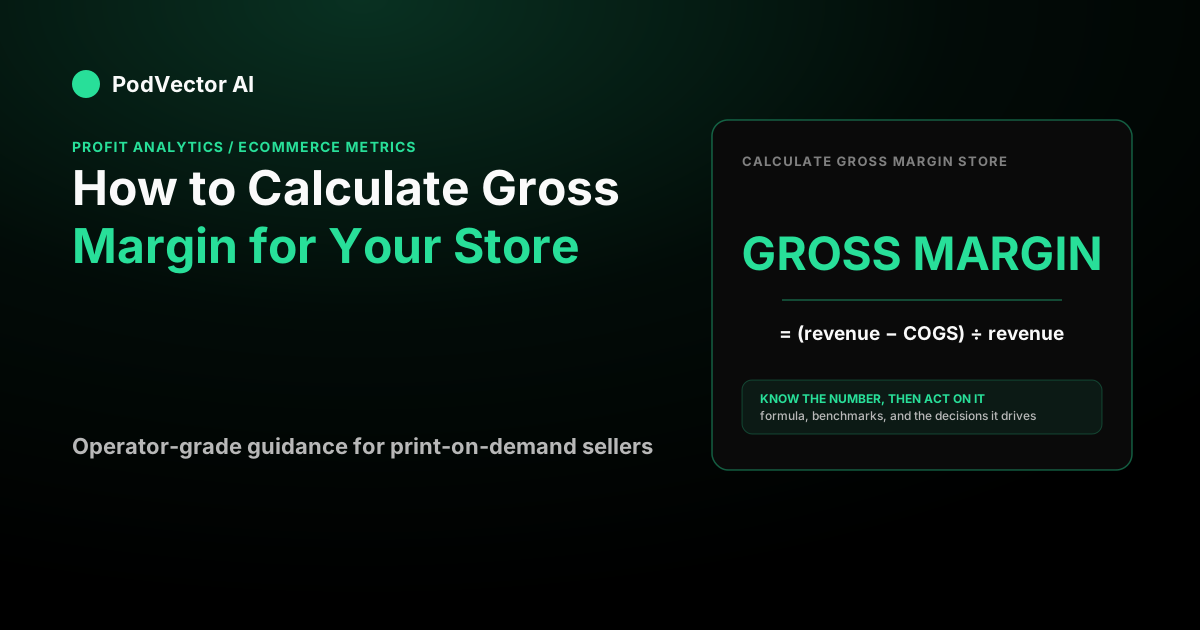
The gross margin formula
Gross margin is the share of revenue left after you subtract the direct cost of the product you sold. Written as a percentage, it's the cleanest read on whether your pricing clears your supplier cost.
The formula is short:
Gross margin % = (Revenue − COGS) ÷ Revenue × 100
Gross profit is the dollar version of the same thing — just Revenue − COGS without the final division. Margin is the ratio; profit is the dollars. You need both, and they come from the same two inputs.
If you want the deeper breakdown of the dollar figure on its own, the companion walkthrough on gross profit margin covers it. This page stays focused on the percentage and how to calculate it for a real store.
How to calculate gross margin, step by step
Say you run a print-on-demand apparel store doing 500 orders a month at a $34 average order value. Your supplier (Printify, Printful, or Gelato) charges you $13.60 per item for the blank garment plus the print. Here's the calculation, one step at a time.
Step 1 — Find revenue. That's your net sales for the period. For the month: 500 orders × $34 = $17,000.
Step 2 — Find COGS. Add up the direct product costs of everything you sold. At $13.60 per order: 500 × $13.60 = $6,800.
Step 3 — Subtract to get gross profit. $17,000 − $6,800 = $10,200.
Step 4 — Divide by revenue and multiply by 100. $10,200 ÷ $17,000 × 100 = 60%.
So this store runs a 60% gross margin. On a single order the math is identical: ($34 − $13.60) ÷ $34 × 100 = 60%, with $20.40 of gross profit per hoodie.
Notice you can calculate gross margin per order or for the whole month and get the same percentage — as long as your cost per unit is stable. That's what makes it a fast daily gut-check on pricing.
Gross margin vs gross profit vs markup
These three get mixed up constantly, and confusing them is a classic pricing error.
Gross profit is dollars: Revenue − COGS = $20.40 per hoodie. Gross margin is that profit as a percentage of the selling price: 60%. Markup is the same gap measured against your cost instead of your price.
Markup % = (Price − Cost) ÷ Cost × 100 → ($34 − $13.60) ÷ $13.60 = 150%.
Same $20.40 gap, two different percentages: a 150% markup is a 60% margin. Suppliers and marketplaces quote markup; your profit-and-loss statement quotes margin. If you price off markup but report on margin, your numbers will never reconcile — so pick one lens and convert when you need the other.
What counts as COGS for a print-on-demand store
Gross margin is only as honest as your COGS. For a POD store, COGS is the direct cost of the item itself: the blank garment plus the print charge your supplier bakes into each unit.
The gray area is the supplier's per-order fulfillment fee. You can put it in COGS or treat it as a separate fulfillment line — either is defensible, but pick one and hold it, or your margin will silently drift between months.
What does not belong in COGS: shipping to the customer, payment processing fees, your email platform, or ad spend. Those are real costs, but they live below the gross-margin line. Fold them in here and you're no longer measuring gross margin — you're measuring something fuzzier.
One advantage you have as a POD operator: your product cost is known before the first sale, straight from the Printify, Printful, or Gelato price. You never have to guess COGS or wait for sales history to see it.
Why gross margin alone can mislead you
A 60% gross margin looks great until you subtract everything else. Gross margin only accounts for COGS — it says nothing about the shipping label, the card fee, or the ad that won the order.
Keep walking the same $34 order down the page:
| Line | Amount | Running margin |
|---|---|---|
| Revenue (AOV) | $34.00 | — |
| − COGS | −$13.60 | 60% gross |
| − Shipping + payment fee + pick/pack | −$6.80 | ~40% after variable costs |
| − Ad spend (at a 4.0 ROAS) | −$8.50 | ~15% after ads |
That last line — profit after all variable costs including ads — is your contribution margin, and it's the number that tells you whether an order is actually worth selling through paid traffic. A healthy gross margin can still hide a break-even order once ads are in.
This is why the pros track both. Gross margin tells you if the product is worth making; contribution margin tells you if it's worth selling at your current ad cost. For the full picture of what's left at the very bottom, see net profit margin, and to find the volume where you stop losing money, work through how to calculate your break-even point.
What's a good gross margin?
There's no universal target — it depends on your category. For apparel companies, the long-run average gross margin is about 56.88%, versus roughly 26.31% for grocery and food retailers, according to Shopify's retail benchmark data drawn from NYU Stern.
So if your POD apparel store clears 60%, you're sitting right around — or just above — where a typical apparel seller lands. The more useful question isn't "am I at 50%?" but "am I where my band should be, and is enough of this margin surviving to contribution?"
Don't chase a round number. A 60% gross margin that collapses to 5% after ads is weaker than a 50% margin that holds 20% — which is why gross margin is the start of the analysis, not the end. The full map of how these metrics connect lives in the ecommerce metrics guide.
How to improve gross margin as an operator
Gross margin has only two levers: raise price or lower COGS. Most operators default to cutting cost, but on thin-margin SKUs a small price move usually does more — and raising your average order value lifts the dollars even when the percentage holds steady.
- Reprice the thin-margin SKUs so your weakest products stop dragging the blended average down.
- Switch suppliers or garment tiers where a cheaper blank doesn't hurt quality, dropping COGS directly.
- Lift AOV with bundles and upsells so each order carries more gross profit — walk through how to increase average order value for the tactics.
The catch is doing this across hundreds of SKUs by hand. This is where Victor, the AI employee inside PodVector AI, does the work for you. Victor computes true per-order profit by seeing every order, every supplier cost, and every ad dollar together — then he reprices the thin-margin SKUs in Shopify, pauses the ad sets eating your margin, and delivers the profit report to your Google Drive.
Victor already knows your Printify, Printful, and Gelato product costs, so he reads real gross margin on day one instead of waiting for history. Put Victor to work on your store's margins and stop reconciling spreadsheets by hand.
FAQs
What is the gross margin formula?
Gross margin % = (Revenue − COGS) ÷ Revenue × 100. Take your sales, subtract the direct cost of the products sold, divide by sales, and multiply by 100. The dollar version — gross profit — is just revenue minus COGS without the final step.
How do I calculate gross margin from gross profit?
Divide gross profit by revenue and multiply by 100. If your gross profit is $10,200 on $17,000 of revenue, that's $10,200 ÷ $17,000 × 100 = 60%. Gross profit is the dollars; gross margin is that same amount expressed as a percentage of sales.
Is gross margin the same as markup?
No. Margin measures the price-to-cost gap against the selling price; markup measures it against your cost. A $13.60 item sold for $34 carries a 60% margin but a 150% markup — same dollars, different base. Mixing them up is one of the most common pricing mistakes.
Should shipping and payment fees be in my gross margin calculation?
No — gross margin only subtracts COGS, the direct product cost. Shipping, payment processing, and ad spend sit below the gross-margin line and belong in contribution margin instead. Folding them into COGS makes your gross margin look worse than it is and muddies comparisons across months.
What's a good gross margin for a print-on-demand store?
For apparel, the benchmark average is roughly 56.88% per Shopify's retail data from NYU Stern, so a POD store clearing around 60% is in healthy territory. But the real test is how much of that margin survives after shipping, fees, and ads — a high gross margin that erodes to nothing after paid traffic isn't actually healthy.
How is gross margin different from net margin?
Gross margin subtracts only COGS; net margin subtracts everything, including fixed costs like rent, software, and salaries. Gross margin tells you if a product is priced right; net margin tells you if the whole business made money. You want both, and they're usually far apart.