
Table of Contents
- Why POD Sellers Are Especially Vulnerable to Chargebacks
- The Two Types of Chargebacks You're Actually Fighting
- The Danger Thresholds You Must Stay Under
- Pre-Sale Prevention: Stop Disputes Before They Start
- Post-Sale Communication: The Window That Matters Most
- Friendly Fraud: When Good Customers Go Bad
- True Fraud: Stolen Cards and Account Takeovers
- When a Chargeback Arrives: How to Win Representment
- POD-Specific Wrinkles: Printify, Printful, and Your Refund Flow
- How PodVector Helps You Stay on Top of the Numbers
- FAQs
Why POD Sellers Are Especially Vulnerable to Chargebacks
In a traditional retail model, a chargeback is painful but recoverable — you still have the product. In print on demand, your supplier has already charged you and shipped a one-of-a-kind custom item that can't be restocked. That double loss is unique to the POD model and makes chargeback prevention a margin issue, not just an accounting headache.
Friendly fraud covers customers who buy something legitimately, then dispute the charge with their bank rather than going through returns — sometimes deliberately, sometimes because they don't recognize the descriptor, sometimes because filing a chargeback is easier than emailing support. For POD sellers selling branded custom apparel on Shopify with Printify or Printful, all three triggers are common.
The good news is that most disputes are preventable. The strongest programs treat prevention and dispute response as ongoing operational discipline — not a fire-drill that happens after your processor flags you.
The Two Types of Chargebacks You're Actually Fighting
Understanding the cause of a dispute determines how you fight it.
Friendly fraud is the dominant source for POD sellers. These customers aren't trying to commit credit card fraud, but the financial loss is identical to deliberate fraud. The challenge with friendly fraud is that it's often a communication problem disguised as a fraud problem.
True fraud involves stolen payment credentials — someone else's card used on your store. Almost every case of true fraud will result in a chargeback, so one of the most effective ways for merchants to reduce the number of chargebacks they receive is to bolster their fraud prevention efforts.
Account takeover fraud and chargeback scam losses are reduced by matching the defense to the specific scheme rather than treating all disputes alike. Knowing which type you're dealing with also determines which evidence to include in representment.
The Danger Thresholds You Must Stay Under
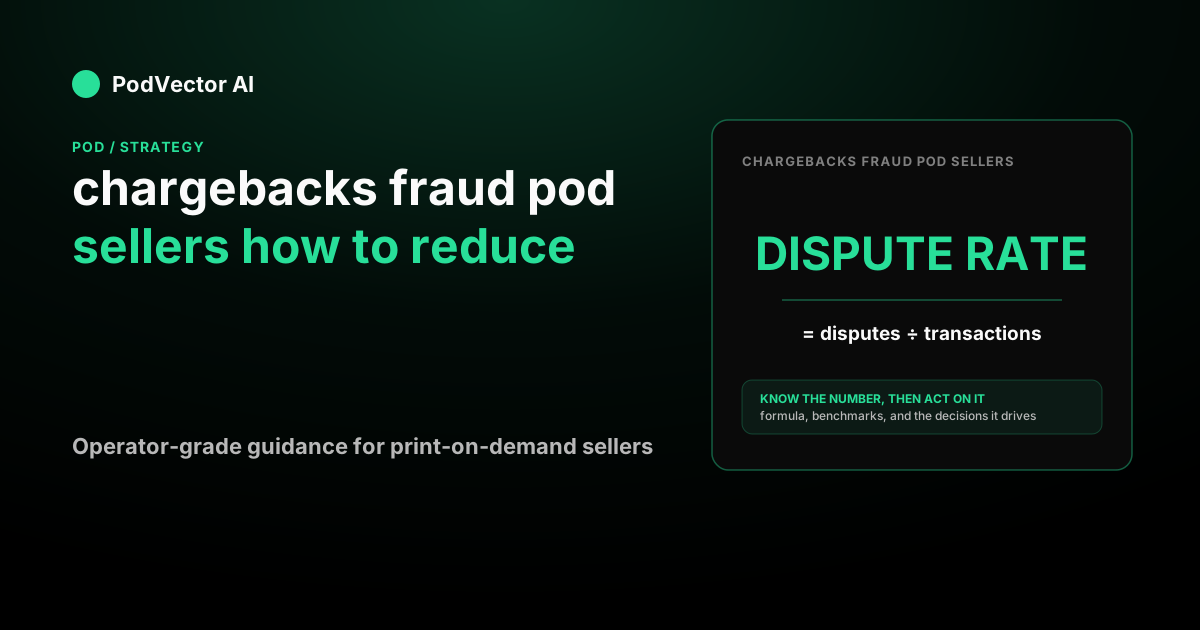
Your chargebacks divided by total transactions should stay under 0.65% to keep you out of monitoring programs. Over 0.9% puts you in Visa's Acquirer Monitoring Program (VAMP), which triggers fees and scrutiny.
Crossing these thresholds doesn't just cost you fees — it can get your merchant account terminated. Keeping the chargeback ratio below card-network thresholds protects the merchant account itself. For a POD business running paid ads on Meta and Google, losing the ability to accept cards is existential.
Track your ratio monthly. A sudden spike in dispute volume often traces to a single ad campaign driving low-intent buyers — exactly the kind of signal your Shopify data and ad-platform reads can surface early.
Pre-Sale Prevention: Stop Disputes Before They Start
The cheapest chargeback to handle is the one that never happens. These are the highest-leverage pre-sale moves for POD sellers.
Use a recognizable billing descriptor
Make sure your merchant descriptor will be clearly identifiable to your customers. If you do business under more than one name, make sure the company name on the merchant descriptor matches the name of your online storefront. Also make sure the description includes a working phone number so that customers have a chance to contact you first before they go to their bank.
Ecommerce merchants should be able to change the name that shows up, also known as the statement descriptor, within the settings of their payments platform. In Shopify Payments, this lives under Settings → Payments → Statement descriptor.
Enable CVV and address verification
Many credit card issuers provide Address Verification Service (AVS) to enable retailers to match the provided address with the one that banks have on file. A security code called a CVV is placed on the back of a credit card, and is very useful for avoiding card theft-related transactions. Merchants can decide whether to accept, alert, or refuse a particular transaction for possible fraud by utilizing CVV and AVS.
Both controls are built into Shopify Payments and most major gateways — make sure they're switched on, not set to "accept" regardless of mismatch.
Be PCI-compliant with your payment processor
The Payment Card Industry (PCI) security guidelines are intended to assure security and a secure environment for all businesses that accept, process, or transmit credit card information. The PCI compliance of the payment processors used by merchants is a requirement. Using Shopify Payments or another hosted gateway takes most of this off your plate, but verify your SAQ annually.
Set honest shipping and production timelines
POD production adds 2–7 business days before a carrier ever touches the package. The Order Merchandise Rule requires sellers to have a reasonable basis to ship within the time advertised, to ship within 30 days when no time is stated, and to obtain the buyer's consent or issue a refund when shipment is delayed. Displaying realistic timelines on product pages and at checkout prevents "item not received" disputes that stem from impatience, not deception.
Make your return policy visible and easy
Clear return policies posted prominently on your site reduce friendly fraud chargebacks. If the customer has to hunt for your policy, they'll go to their bank instead. Link your policy in the footer, on the product page, and in your order confirmation email.
Post-Sale Communication: The Window That Matters Most
Most "item not received" chargebacks are filed in the silence between purchase and delivery. Filling that silence with proactive updates removes the uncertainty that drives buyers to their bank.
Buyers may initiate a chargeback if they think their package won't make it to them. Avoid these instances by emailing and/or texting customers when an order is made and again when the package ships.
Most smaller sellers can't fulfill orders in the two-day window Amazon has popularized, but shoppers are more understanding if they know when their package will arrive. Updates are essential for backordered items or shipments that hit delays.
Invest in shipping insurance or shipping confirmation services to reduce your potential liability for a mistake. Follow up proactively with customers once their package is marked as delivered to make sure they got what they expected and are enjoying their purchase.
For Klaviyo users, a simple post-delivery flow — triggered by Shopify's fulfillment event — can dramatically reduce "where's my order" inquiries and disputes at the same time. See our guide on automating Klaviyo lifecycle campaigns for how to build that flow.
Friendly Fraud: When Good Customers Go Bad
Friendly fraud is the single biggest chargeback driver for established POD stores. The challenge with accidental fraud is that it's often a communication problem disguised as a fraud problem. Better transaction descriptors, clearer billing practices, and easier access to customer support can prevent many of these illegitimate chargebacks before they escalate to the bank level.
The most effective antidote is making a refund or exchange easier than a bank dispute. Make returns easier than chargebacks to reduce disputes. Use signature confirmation for high-value orders, send tracking updates, make your billing descriptor recognizable, and make returns easier than disputes.
For POD, a "no questions asked" reprint policy on print errors costs you less than one lost chargeback fee plus the time to fight it. Reserve friction for obvious abuse patterns — repeat refund requesters, mismatched shipping addresses, and complaints filed suspiciously close to the return window closing. Train your team to watch for suspicious patterns, repeat refund requests, mismatched shipping addresses, and vague complaints right before the return window closes.
True Fraud: Stolen Cards and Account Takeovers
True fraud is less common in POD than friendly fraud, but it tends to cluster — one stolen card list generates a wave of orders before the cardholder notices. Before the account is canceled, the fraudster is attempting to use the whole amount on the card. Verify any orders that were placed from the same account repeatedly and quickly.
There are a variety of fraud prevention tools available to merchants these days, including two-factor authentication, device fingerprinting, velocity checking, and tools that use machine learning to identify potential fraud.
Prevention uses tools built into modern payment processing: address verification, card security-code checks, fraud-scoring systems that flag risky orders, authentication tools like 3-D Secure, multi-factor authentication on customer accounts, and clear policies on returns and refunds.
In Shopify, enable the built-in fraud analysis score and consider third-party tools like Signifyd or NoFraud for higher-volume stores. Flag orders with AVS/CVV mismatches, unusually high quantities of the same custom item, or shipping addresses that differ from billing — all are red flags in POD fraud patterns.
Also watch your ad traffic. Campaigns with very broad targeting on Meta or Google can pull low-quality traffic that converts at high fraud rates. If your chargeback spike correlates with a new campaign launch, the problem may be upstream in your ad account rather than at checkout. Our article on Google Ads smart bidding and ROAS issues covers how to audit that traffic quality.
When a Chargeback Arrives: How to Win Representment
Not every chargeback is winnable, but a well-documented dispute response wins more than sellers expect. Mastercard's 2025 chargebacks report found that businesses win an average of 50% of the representments they submit — 54% in the US. But only 11% of large enterprises with over $2 billion in revenue represent more than 50% of the chargebacks they receive. Smaller sellers who are organized and fight back consistently outperform that benchmark.
Fighting chargebacks depends on evidence assembled in advance: proof of delivery with tracking and signature, records of the customer's authorization and identity, communications, and a documented order history that supports representment.
Know when to triage. If the product is under $20 and the documentation is weak, consider it a write-off and move on. For higher-value orders, fight — but only if you have solid proof (tracking, delivery confirmation, buyer messages). Every dispute costs time, and sometimes peace of mind is worth more than being right.
Fraud controls should be carefully calibrated for each merchant's individual needs. Reviewing fraud outcomes alongside subsequent chargebacks helps teams adjust thresholds, retire ineffective rules, and identify signals that deserve attention.
POD-Specific Wrinkles: Printify, Printful, and Your Refund Flow
Here's where generic chargeback advice breaks down for POD sellers. Your refund and dispute process has an extra layer that most e-commerce guides ignore: your print provider has already been paid and has likely already shipped.
The fulfillment decoupling problem. Shopify refunds only return money — they don't automatically halt fulfillment. Once orders sync to Printful, refunds don't stop production if it has already started. The same is true for Printify. To avoid charges, manually cancel orders in Printful before issuing refunds in Shopify, especially during the brief window before production starts.
This gap matters for chargeback management because if you issue a refund fast (a common way to abort a dispute before it escalates), you may still owe your supplier. Build a cancellation SOP that hits both platforms, and see our guide on Printify customer service and refund processing for the exact steps.
Provider fault vs. customer fault. Both Printful and Printify offer free replacement or refund if the error is their fault, with a 30-day claim period. If a customer files a chargeback for a print defect, your first move should be to claim the replacement from your provider — that evidence also strengthens your dispute response to the card network.
Payout timing. Chargebacks often land after Printful or Printify payouts have already cleared, creating a cash-flow gap. Our article on Printful payout delays and missing balances walks through how to keep that gap from becoming a cash crisis.
Margin visibility. Every chargeback has a hidden cost: you lose the sale revenue, you've paid the fulfillment cost, and you absorb a dispute fee. If your margins are already thin, even a modest chargeback rate can make a "profitable" product line a money loser. See our articles on inventory carrying cost in the POD model and Shopify reconciliation to get the full picture.
How PodVector Helps You Stay on Top of the Numbers
Chargebacks are a downstream symptom of upstream problems — wrong pricing, slow fulfillment communication, bad ad traffic, or product issues. Catching those problems early is where PodVector fits in.
Victor, PodVector's AI employee, reads your live Shopify, Printify, Printful, Meta Ads, and Google Ads data into a central warehouse every week. Each Monday, you get a Health Report that surfaces margin anomalies, revenue gaps, and order-level issues before they compound. If a product line is generating outsized refund requests, that shows up in the Shopify order data before it becomes a chargeback wave.
When Victor spots an issue, he proposes a concrete action — like repricing a product, adjusting a discount, or modifying your free-shipping threshold to protect margin. You review the proposal and approve it; only then does Victor execute the write on Shopify. He never acts autonomously.
Victor can also draft and schedule Klaviyo email campaigns and lifecycle flows — including the post-fulfillment sequence that keeps customers informed and reduces "where's my order" disputes. See our guide on automating Printful order fulfillment on Shopify and bulk updating Shopify product prices for adjacent automation wins.
PodVector is built for intermediate-to-advanced Shopify sellers who fulfill through Printify and Printful and advertise on Meta and Google — exactly the seller profile where chargeback exposure is highest and the data to fight it already exists.
Keep chargebacks from eating your margins. Victor reads your Shopify, Printify, Printful, Meta, and Google Ads data and surfaces margin and order issues before they escalate — then executes approved fixes directly in Shopify.
FAQs
What is a chargeback in print on demand?
A chargeback is when a customer's bank reverses a charge on their behalf, pulling the funds back from your Shopify Payments or gateway account. In POD, this is especially costly because your print provider has usually already fulfilled and shipped the item — so you lose the revenue, pay the fulfillment cost, and absorb a dispute fee, all at once.
What chargeback rate is dangerous for a Shopify store?
Your chargebacks divided by total transactions should stay under 0.65% to keep you out of monitoring programs. Over 0.9% puts you in Visa's Acquirer Monitoring Program (VAMP), which triggers fees and scrutiny. Staying well under 0.65% should be the target for any POD seller running paid ads.
What's the difference between friendly fraud and true fraud?
Friendly fraud covers customers who buy something legitimately, then dispute the charge with their bank rather than going through returns — sometimes deliberately, sometimes because they don't recognize the descriptor, sometimes because filing a chargeback is easier than emailing support. True fraud involves a stolen card or compromised account that was never authorized by the real cardholder. The prevention tactics and dispute evidence differ significantly between the two.
Can I cancel a Printful or Printify order after a customer disputes?
You can cancel before production begins, but the window is narrow — sometimes just a few hours. Shopify refunds only return money; they don't automatically halt fulfillment. Once orders sync to Printful, refunds don't stop production if already started. You must request cancellation in the Printful dashboard before production begins. Build a written SOP for your team that covers this exact scenario.
Should I fight every chargeback?
No. If the product is under $20 and the documentation is weak, consider it a write-off and move on. For higher-value orders, fight — but only if you have solid proof (tracking, delivery confirmation, buyer messages). Every dispute costs time, and sometimes peace of mind is worth more than being right.
How does improving my billing descriptor reduce chargebacks?
Better transaction descriptors, clearer billing practices, and easier access to customer support can prevent many illegitimate chargebacks before they escalate to the bank level. When customers can quickly verify their transaction records and understand what they purchased, accidental fraud drops significantly. A confusing descriptor is one of the top reasons customers call their bank instead of you.
What evidence do I need to win a chargeback representment?
Fighting chargebacks depends on evidence assembled in advance: proof of delivery with tracking and signature, records of the customer's authorization and identity, communications, and a documented order history that supports representment. For POD, also include the print provider's fulfillment confirmation and any post-delivery communication showing the customer received the item.
How does PodVector help with chargeback prevention?
PodVector's AI employee, Victor, reads your Shopify, Printify, Printful, Meta Ads, and Google Ads data and delivers a weekly Health Report every Monday. If a product line is generating unusual refund or return patterns, that surfaces in your Shopify order data before it escalates to a chargeback wave. Victor can also build Klaviyo post-fulfillment flows that keep customers informed and reduce "item not received" disputes — and he executes every approved action directly in Shopify, with your sign-off first.
Part of the Print on Demand Strategy cluster · Print on Demand hub