
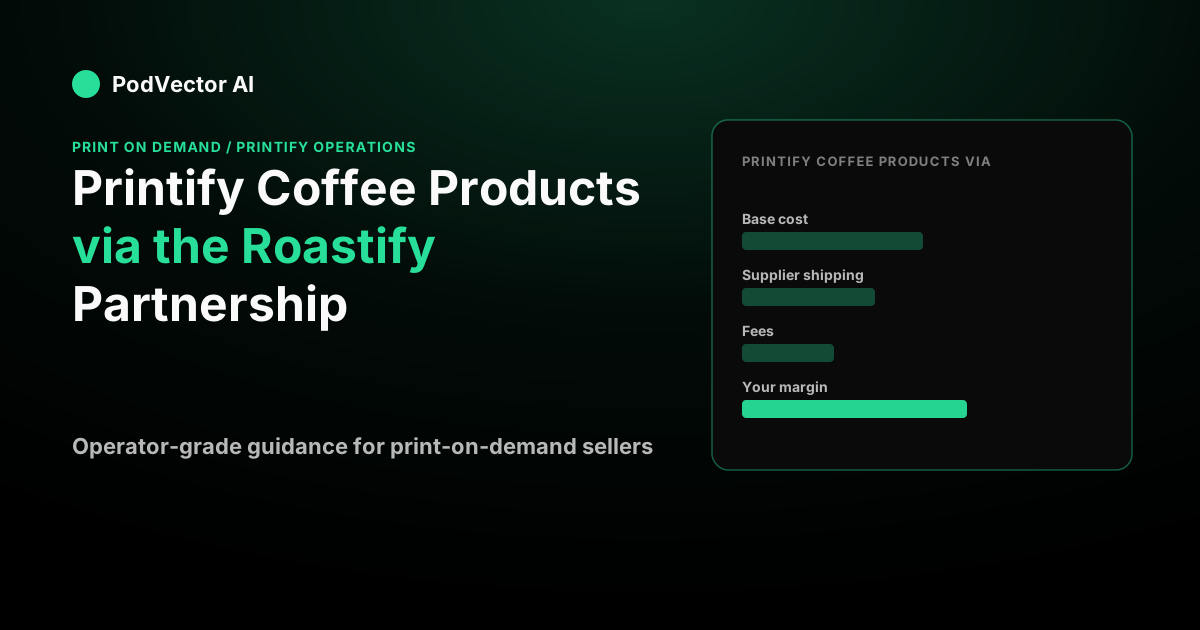
If you already run a Printify store doing real volume, coffee is the rare add that fits your existing workflow but changes your margin math. It is the same print-on-demand model you know — a blueprint fulfilled by a specific provider — just with a consumable inside the bag and a tighter shipping footprint. This page covers what you can sell, the constraints that actually matter, and the per-order profit on a realistic order.
What the Printify–Roastify partnership actually is
Roastify is a US-based coffee roaster that operates as a Printify print provider. When you add a coffee product, you are picking a Roastify blueprint and designing the packaging in the Product Creator exactly like you would a mug or a tee. Roastify then roasts the beans to order, applies your label, and ships the bag.
That "print provider" framing is the important part for an operating store. Everything you already know about Printify providers applies: Roastify carries its own base cost, its own shipping table, its own production speed, and its own performance track record. You are not bolting on a separate coffee platform — you are adding one more provider to a catalog you already manage.
For the mechanics of how blueprints, providers, and publishing fit together, the Printify operations guide is the hub. Coffee rides those same rails.
What you can sell
Roastify's lineup on Printify centers on three formats. According to this 2026 dropshipping-supplier breakdown, Roastify offers single-serve coffee pods, 12oz coffee bags, and instant coffee packets — with the guide noting Roastify positions itself as the roast-on-demand manufacturer offering all three alongside each other.
Within the bags you choose roast level (light through dark), whole bean versus ground, and single-origin versus blend. Each of those is a variant on the listing, the same way color and size are variants on a shirt. The design surface is the bag label, and the mockup generator renders it on the bag for your product photos.
If you have never built a product on a new provider before, the mockup generator upload-and-preview walkthrough covers placing and previewing artwork — the coffee-bag flow is identical.
The constraint that shapes everything: US and Canada only
Here is the fact that should decide whether coffee goes in your catalog at all. Unlike most Printify products, which ship worldwide, Roastify coffee ships only to the US and Canada. The same supplier breakdown puts transit at roughly 3–5 business days inside the US and 10–15 business days to Canada.
For a store whose orders are mostly North American, that is a non-issue. For a store with meaningful UK, EU, or Australian demand, it is a real one: a customer outside the US and Canada simply cannot buy the coffee SKU. If you run paid traffic, you do not want to send international clicks to a product they cannot check out.
The practical move is to gate it. Keep coffee in a US/Canada-targeted collection or campaign, and let the rest of your worldwide-shippable catalog carry everyone else. This is a merchandising decision, not a limitation to apologize for.
What a coffee order actually costs you
This is where the SERP goes quiet and where an operator needs the numbers. Let's walk a realistic 12oz bag.
Base cost first. A 12oz Roastify bag starts from about $16.10 on the standard plan, dropping to roughly $11.67 with Printify Premium, per this 2026 coffee guide. That is the single biggest input to your margin, so your plan choice is a margin decision, not just a subscription.
Say you list a single-origin bag at $27 with $4.95 shipping charged at checkout, so the customer pays $31.95. Assume Roastify bills you around $7.50 to ship that first bag, and payment processing runs about $1.23 (roughly 2.9% + $0.30 on $31.95). On the standard plan:
- Revenue you collect: $27.00 + $4.95 = $31.95
- Base cost: $16.10
- Supplier shipping: $7.50
- Processing: $1.23
- Per-order profit: 31.95 − 16.10 − 7.50 − 1.23 = $7.12
Now swap in the Premium base cost of $11.67 and hold everything else constant: 31.95 − 11.67 − 7.50 − 1.23 = $11.55. The Premium pricing lifts this single order by $4.43 — and across hundreds of coffee orders a month, that spread is the whole reason to be on the higher plan.
The trap worth naming: if you had baked shipping into a "$24, free shipping" price instead, the same standard-plan order collects $24.00 and nets 24.00 − 16.10 − 7.50 − 1.23 = −$0.83. You would lose money on every bag. Coffee's base cost plus supplier shipping is high relative to the item's retail ceiling, so free-shipping-at-a-low-price quietly turns negative. Price the shipping in visibly, or raise the sticker.
For the broader picture of how base cost, Printify fees, and ad spend stack into real margin across your catalog, the men's-apparel example in this product cost list applies the same arithmetic to a different category.
How coffee fits your existing workflow
Two workflow differences matter.
First, timing. Because every bag is roasted after the order lands, the production clock runs before the 3–5 day US transit even starts. Your customer-facing delivery promise is roast time plus shipping, not shipping alone — so write store policy and post-purchase emails as the sum, and set expectations higher than you would for a pre-printed tee.
Second, the approval window still works the way it always has. A coffee order lands in Printify and waits per your order-approval setting (the 24-hour default, or whatever you've configured) before it submits to production. That window is your buffer for address fixes and duplicate-order catches — same as every other product. Nothing about coffee changes it.
Publishing and syncing to Shopify is also unchanged. If you sell on Shopify, the Printify Shopify app integration handles the push the same way for a coffee bag as for a hoodie, and the step-by-step in how to add products from Printify to Shopify is the one to follow when you publish your first SKU.
Let Victor run the coffee math and the catalog work
Victor is the AI employee inside PodVector AI. Because product costs from Printify are known before the first sale, Victor already knows your Roastify base cost the moment you add the bag — he computes the true per-order profit on each coffee SKU, folding in the supplier shipping and your ad spend, so you see which blends actually clear money instead of guessing from the sticker price.
Victor also does the operational work this page describes. He creates and publishes the coffee products, approves or cancels the orders in the window, and switches print providers when it makes sense — the same Printify operations you'd otherwise do by hand. He sees every order, every ad dollar, and every supplier cost together, so when a coffee campaign is selling bags that lose money after shipping, he's the one who catches it. Put Victor to work on your store.
FAQs
Is Roastify a separate platform or part of Printify?
It's part of Printify. Roastify is a print provider inside the Printify catalog, so you build, design, and publish coffee products in the same Printify dashboard you already use. There's no second account to manage. Roastify roasts and ships the beans; Printify handles the storefront and order flow.
Where does Printify coffee ship, and how long does it take?
To the US and Canada only. Transit runs roughly 3–5 business days inside the US and 10–15 business days to Canada, according to this supplier guide. Add roast-to-order production time on top of transit when you set delivery expectations, because the beans are roasted after the order comes in.
What does a 12oz coffee bag actually cost me?
The base cost starts from about $16.10, dropping to roughly $11.67 with Printify Premium, per this 2026 guide. On top of that you pay the Roastify shipping charge per order and your payment processor's fee. Run the full subtraction before you set a retail price — coffee's base cost is high relative to its retail ceiling, so a low sticker with free shipping can go negative.
Is coffee worth adding to an established apparel store?
If your orders are mostly US and Canada, it's a strong catalog extender and a natural bundle with mugs. If a real share of your demand is international, coffee can't fulfill those orders, so gate it to US/Canada traffic rather than showing it everywhere. The economics only work when you price shipping in visibly and, ideally, run on Premium base pricing.
Can I order a sample before I sell it?
Yes — the same sample-order path that exists for other Printify products applies to Roastify coffee, and tasting your own roast before you list it is worth doing. Treat the sample cost as a one-time product-research expense, not a per-order cost, when you build your margin model.
Do I need minimums or roasting equipment?
Neither. It's pure print-on-demand: no minimum order quantity, no inventory, and no roasting gear. Roastify roasts, bags, labels, and ships each order after it's placed, and you pay the base cost plus shipping only when a customer buys — the same economics as any other Printify product, just with beans inside the bag.