
If you already sell clothing and you're weighing Gelato as a supplier, you've probably read ten pages telling you it has local production and nice mockups. None of them tell you what a hoodie nets after ads. Let's fix that.
This is written for a store with sales history and a live ad account — not a first-store checklist. For the broader picture of running this supplier day to day, the Gelato operations guide is the hub this article sits under.
How Gelato's apparel model actually works
Gelato doesn't own factories the way Printful does, and it isn't a marketplace of providers you pick from the way Printify is. It routes each order automatically to a local production partner near the buyer. Gelato's own Shopify listing describes a network of "140+ production hubs across 32 countries", while its site elsewhere cites 130+ local print partners in 32 countries — call it roughly 130–140 partners either way.
The practical payoff for apparel is distance. Gelato states that about 95% of orders are produced in the same country they're delivered to, so a US store selling hoodies to EU customers isn't paying trans-Atlantic shipping — the garment is printed in Europe. Gelato also attributes an emissions benefit to this, stating local production can cut carbon up to 67% per order (that's Gelato's own figure, not an independent measurement).
The trade-off to say out loud: you can't pick the factory. Routing weighs proximity, stock, and capacity, so the same hoodie blueprint may print on different machines in different countries. You give up provider-level control to get local delivery. If precise, consistent provider selection matters more to you than shipping distance, read whether Gelato is the right call for your store before committing a catalog to it.
The apparel catalog you can actually sell
Gelato's catalog is narrower than Printify's marketplace but strong exactly where apparel sellers live: tees, premium and organic cotton shirts, sweatshirts, hoodies, and some branded blanks. Its Shopify listing cites "100+ custom products" across all categories; the exact apparel blueprints and their colors live in your dashboard. Treat any product count you read online as a ballpark and check the live catalog.
For an operating store, the catalog question is less "how many products" and more "do my best-selling garment types exist here at a base cost that still leaves margin after my ad costs." That's a per-SKU calculation, which is the next section.
What a Gelato apparel order really costs
A Gelato order's merchant cost is production cost plus shipping, both quoted per destination. Shipping uses a first-item/additional-item structure: the first garment pays the full rate, each additional one from the same location pays a smaller add-on. In Gelato's own worked example, one poster to the US ships for EUR 4.40 and three ship for EUR 5.00 — the add-on is tiny. Exact apparel rates sit on each product page in your dashboard.
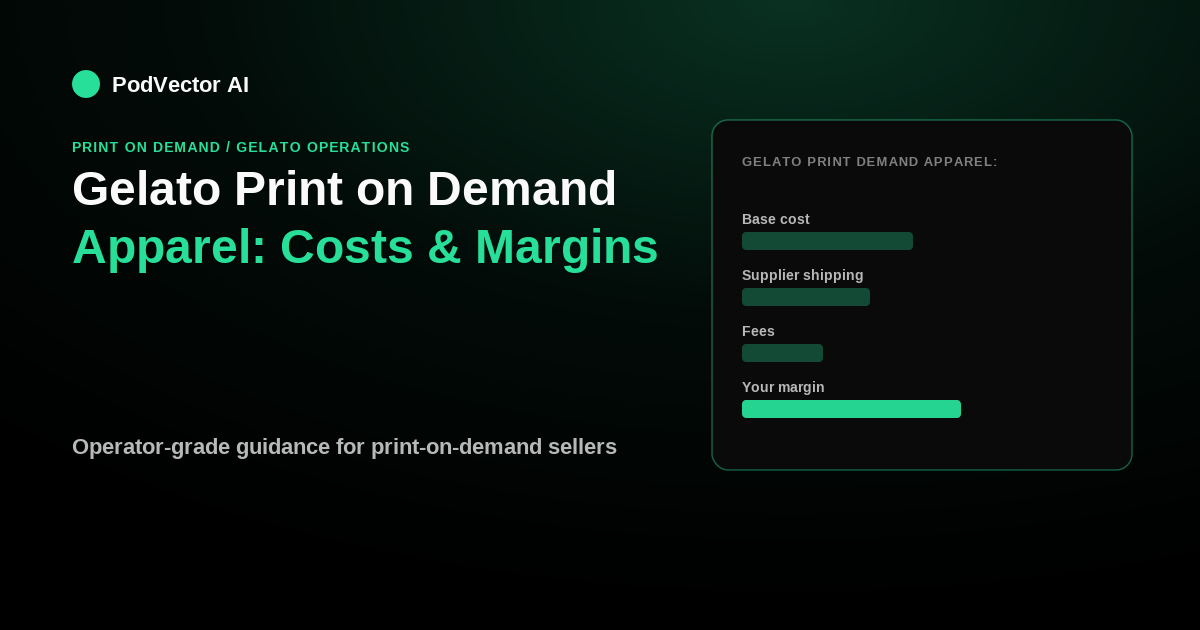
Now the part the ranking pages skip — a full per-order walk. Say you sell a custom hoodie at a $48 retail price. Say your Gelato base cost is $26 and first-item shipping is $8, so your landed product cost is $34.
Say your payment processor keeps about 2.9% plus 30 cents — on a $48 order that's roughly $1.69. So before advertising, each hoodie leaves you $48 − $34 − $1.69 = $12.31.
Now add traffic. Say your store runs 340 orders a month at a $48 average order value on $2,800/month of Meta spend. That's $2,800 ÷ 340 = about $8.24 of ad cost per order. Your real net is $12.31 − $8.24 = $4.07 per hoodie — not the $22 "profit" a base-cost-only view would show you.
That gap is the whole game in apparel. A $48 hoodie that looks like a 45% margin on paper is an 8% margin once ads and fees are in. Change any one input — a 2-point rise in cost of goods, a worse week on Meta — and that $4.07 goes negative without the dashboard numbers moving much. This is why mugs or acrylic prints sometimes out-earn apparel per order despite lower sticker prices: lower base cost, same shipping logic.
Production and delivery times
Gelato lists 1–2 day production for most products, with domestic standard delivery typically landing in a few days and Gelato citing about 90% of orders arriving within five days thanks to local production. Delivery figures are estimates, not guarantees.
For apparel this matters because clothing buyers are impatient and return-prone. Local production turns most "international" orders into domestic carrier legs, which is the structural reason Gelato's cross-border times beat ship-from-one-country setups. Faster delivery also means fewer "where is my order" tickets eating your support time.
Quality: what the reviews actually say
Gelato's Shopify app holds 4.8 stars across more than 1,000 reviews, and apparel-specific feedback is mostly positive on color and craftsmanship. But apparel is also where the complaints cluster — scattered reports of DTG scorch marks, missing labels, and uneven packaging show up in third-party review roundups more for shirts than for posters or mugs.
The operator takeaway isn't "avoid Gelato apparel." It's that print quality on garments varies by hub, and because you can't pick the hub, you manage it with order reviews and sample orders rather than provider selection. Siblings like Gelato pillows and pet products carry less of this DTG-specific risk, which is worth weighing when you plan a drop.
When Gelato+ pays for itself on apparel
Gelato's paid tier, Gelato+, is priced at $29.99/month on the live Shopify listing (with an annual option that works out lower), and it carries product-cost discounts that one tracker lists as up to around 25% on the monthly plan — reverify the current number in your own dashboard before you count on it.
Treat it as pure arithmetic, not a feature decision. At roughly $30/month and a ~25% discount, the plan breaks even once your pre-discount product cost crosses about $120/month: $30 ÷ 0.25 = $120. Any established apparel store clears that in a day, so for you Gelato+ is almost always a yes — but run the division on today's numbers, not a blog's.
Where apparel margin leaks — and the fix
Here's the honest problem. Your Shopify dashboard shows revenue. Gelato shows base cost. Meta shows spend. Klaviyo shows email sales. None of them show you the $4.07 — the actual profit on that hoodie after every cost lands together.
That's the exact gap Victor closes. Victor is PodVector AI's AI employee for POD stores, and he connects to Shopify, Meta Ads, Google Ads, Gelato, Printify, Printful, and Klaviyo. He computes the true per-order profit on every apparel SKU by seeing each order, each ad dollar, and each Gelato base cost together — he knows your garment cost before the first sale, because Gelato publishes it.
Then he acts. Victor pauses the Meta ad set that's running a hoodie underwater, reprices the thin-margin shirts, and runs your template-based Gelato product drops into Shopify so a new design becomes a published listing with mockups. He builds the Klaviyo flow that resells to past buyers and delivers the profit report to your Google Drive. Victor is not a dashboard you read — he's the employee who does the work.
Put Victor on your store and see the real per-garment profit on your Gelato apparel this week.
FAQs
Is Gelato good for selling apparel specifically?
For most operating stores, yes — the local-production model keeps delivery fast and shipping sane, and the apparel catalog covers the core tees, sweatshirts, and hoodies. The caveat is DTG consistency: because you can't choose the printing hub, run sample orders on your top garments and lean on order reviews rather than provider selection.
How much does a Gelato t-shirt or hoodie cost to sell?
Your cost is base production plus per-destination shipping, with the first item paying full shipping and each additional item a small add-on, per Gelato's shipping structure. But the number that decides your business is net after payment fees and ad spend — in the worked example above, a $48 hoodie that looks like a $22 margin nets about $4 once a realistic ad cost per order is included.
Can I choose which factory prints my apparel?
No. Gelato's algorithm routes each order automatically, weighing proximity, stock, and capacity, and it occasionally prints farther away than the nearest hub to optimize delivery. You trade provider-level control for local shipping — the opposite of Printify's pick-your-provider model.
How long does Gelato apparel take to produce and ship?
Most products have 1–2 day production, and Gelato cites about 90% of orders arriving within five days because production is local. These are estimates, not guarantees, so build a small buffer into any delivery promise you make to apparel buyers.
Is Gelato+ worth it for an apparel store?
Almost always, if you're already doing volume. At about $30/month against a discount near 25%, it breaks even around $120/month of pre-discount product cost — a threshold any real apparel store clears quickly. Run the division on your current numbers and the authoritative figures in your own Gelato dashboard before you commit.