
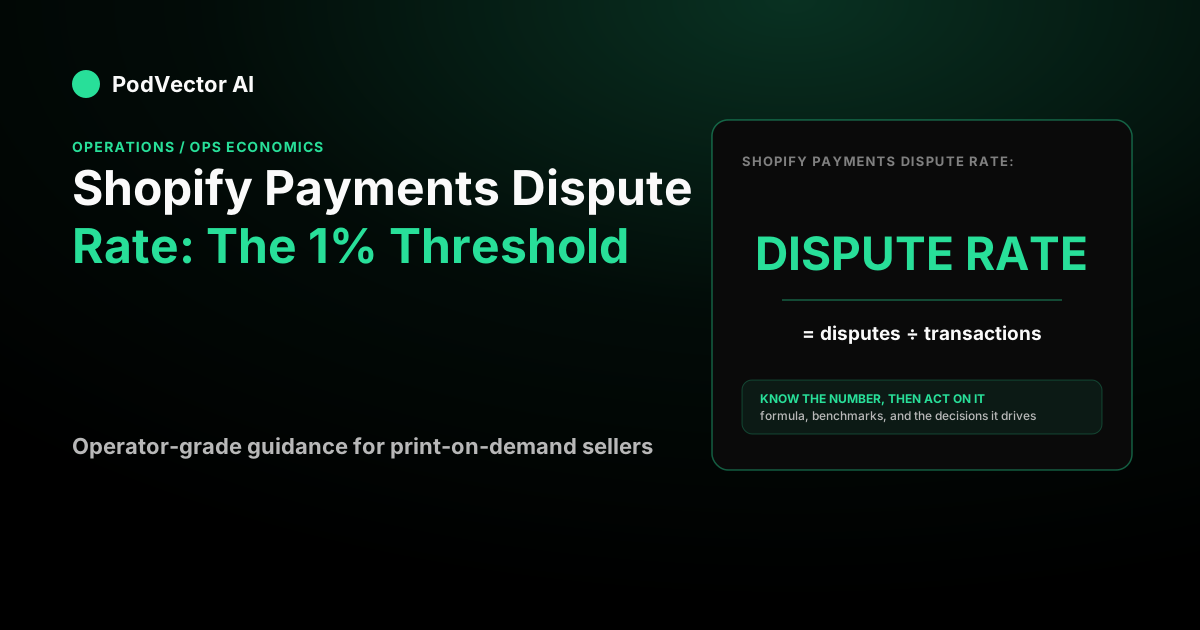
If you sell on Shopify, the 1% dispute rate figure gets repeated everywhere, but almost no page tells you where it comes from, what actually happens as you approach it, or what it does to your profit. This guide fixes that with real thresholds, current fees, and a worked calculation you can run against your own store.
Is the 1% dispute rate threshold a real Shopify rule?
Not exactly. Shopify does not publish an official chargeback or dispute rate limit. Chargebacks911 describes it as "an informal limit for chargebacks on the platform" estimated at 1% of total sales. The chargeback.io team frames the same 1% figure as an industry rule of thumb rather than a formally published policy in their Shopify chargeback guide.
So the "1% threshold" is best understood as the practical line where Shopify's banking partners and the card networks lose patience — not a bright line printed in your merchant agreement. That distinction matters, because the real enforcement machinery sits at the card networks, and it starts moving before you reach 1%.
What "dispute rate" actually measures
Your dispute rate is the share of your transactions that turn into disputes, tracked by the card networks. The trap most sellers miss: a dispute you win still counts. As the Shopify Help Center explains, winning a dispute returns your money and fee but does not remove the case from the ratio the networks monitor.
That means you cannot fight your way to a clean rate. Ten disputes on a thousand orders is a 1% rate whether you win all ten or none.
The thresholds that actually trigger enforcement
The 1% number is a proxy for a stack of specific network programs, each with its own trigger. Here is where the real lines sit, according to Shopify's own fraud and dispute monitoring programs documentation:
- Visa VAMP (Visa Acquirer Monitoring Program): an excessive dispute threshold of 1.5% in most regions, and 2.2% in Central Europe, the Middle East, and Africa (Shopify Help Center).
- Visa's fraud program: a fraud rate threshold of 0.9% (Shopify Help Center).
- Mastercard ECP (Excessive Chargeback Program): the ECM level runs 1.5%–2.99%, and the high-excessive level starts at 3% (Shopify Help Center).
- Mastercard EFM (Excessive Fraud Merchant): a fraud chargeback rate of 0.50% or more (Shopify Help Center).
Notice that the fraud-specific thresholds (0.9% for Visa, 0.5% for Mastercard) sit below the general 1% rule of thumb. If your disputes skew toward fraud reason codes, you can get flagged before your overall rate looks alarming. This is why "stay under 1%" is a floor, not a target — a healthier goal is to keep the rate well below it.
What happens when you cross the line
Hitting Shopify's informal ceiling does not just mean a warning email. Chargebacks911 lists the concrete consequences: a payout reserve of 20% of revenue held for a minimum of 120 days, card-network pass-through fines charged straight to you, and potential account termination.
For a small store, the reserve alone is the dangerous one. Having a fifth of your revenue frozen for four months can break cash flow even when the business itself is fine. And under the Mastercard program, fines escalate the longer you stay enrolled — from a $0–$1,000 band in the first few months up to $100,000-plus after eighteen months, according to the Shopify Help Center.
There is also a per-dispute cost that lands well before termination. Visa's VAMP charges an $8-per-dispute fee to merchants it classifies as excessive, and the qualifying ratio has been tightened repeatedly, per chargeflow.io. Stack that on Shopify's own chargeback fee and each dispute gets expensive fast.
Worked example: how few disputes it takes
Here is the part the SERP pages skip. The 1% threshold sounds forgiving until you translate it into order counts.
Say you run 300 orders a month. One percent of that is just three disputes:
3 disputes ÷ 300 orders = 1.0% dispute rate
Three unhappy customers in a month is not a broken store — it is a Tuesday. A single fraud ring hitting you with four fake "item not received" claims, or one bad product batch generating five disputes, and you are over the line. The lower your volume, the more volatile your rate, because each dispute moves the needle further. At 100 orders a month, a single dispute is already 1%.
This is why the threshold is really a small-merchant problem. High-volume stores absorb noise; a 300-order store cannot.
The profit angle nobody prices in
Every guide tells you to "keep your rate low." Almost none of them show you what a dispute costs, so the urgency never lands. Let's price one.
On Shopify Payments, US merchants pay a chargeback fee of $15 per chargeback, refunded only if you win. But the fee is the smallest piece. chargeback.io estimates a lost dispute costs 2x to 2.5x the order value once you add back the product, shipping, ad spend, and time.
For a print-on-demand seller that math is even worse, because a printed item can never be restocked. Take a $50 order with $18 in supplier product cost, $6 shipping already paid, $8 in ad spend to acquire the buyer, and the $15 fee on a loss:
$50.00 clawed back + $15.00 fee + $18.00 product cost + $6.00 shipping + $8.00 ad spend = $97.00 out of pocket
That is roughly 2x the order value gone on one lost dispute — and the $18 product cost is unrecoverable because a custom item can't return to inventory. Now connect it to the threshold: at 300 orders a month, the same three disputes that put you at 1% can quietly erase the margin from dozens of clean orders. The rate is a compliance problem; the per-dispute loss is the profit problem, and they are the same disputes.
If you want the full breakdown of how chargebacks, refunds, and reprints hit a POD store's margin, the ecommerce ops economics guide walks through each scenario with numbers.
How to stay well under the threshold
You control your dispute rate mostly before the dispute exists. The highest-leverage moves:
- Ship with tracking and delivery confirmation on every order. Delivery evidence is the single strongest defense against "item not received" and fraud reason codes, and most disputes surface 30–90 days after purchase when customers lose track of orders, per chargeflow.io.
- Use a clear, recognizable billing descriptor so customers don't dispute a charge they don't recognize.
- Verify high-risk orders before you fulfill. Shopify's fraud analysis flags risky orders; a quick email or call weeds out fraud before the supplier prints anything.
- Send proactive shipping and delay updates. For POD, total delivery time is production plus shipping, which widens the window for "where is my order?" disputes.
It also helps to know your own numbers. The average general chargeback rate sits around 0.26% per a Sift benchmark cited by chargeflow.io, so if your store is running noticeably above that, you have room to tighten before the networks notice. And set expectations on fighting back: manual dispute responses win only about 8–20% of the time, because issuers screen for reason-code-specific evidence, not written explanations. Prevention beats representment every time.
For deeper tactics, see our roundup of Shopify chargeback news and policy shifts, and if you also sell on other rails, compare the Square chargeback fee and the Amazon chargeback fee so you know which channel is quietly costing you more.
Where per-order profit fits in
The reason the 1% threshold sneaks up on sellers is that most stores track revenue, not per-order profit — so a dispute looks like a $50 refund instead of a $97 hole. If you can't see the true cost of a single order, you can't see the rate creeping toward the ceiling until the reserve hits.
That is the gap PodVector is built to close. It connects Shopify, Meta Ads, Google Ads, Printify, and Printful, and computes your true per-order profit — product, shipping, fees, and ad spend netted out per order, not averaged across the month. Victor, its AI employee, reads that live data and proposes moves, taking Shopify-side actions only with your approval. He is not a dashboard; he analyzes what is actually happening in your orders and tells you where the money is leaking.
Seeing profit at the order level is also what makes a rising dispute rate visible early — while you still have room to fix it, not after the payout is frozen.
FAQs
Does Shopify officially cap my dispute rate at 1%?
No. Shopify does not publish an official limit. The 1% figure is an informal industry benchmark; chargebacks911 calls it an estimated informal limit of 1% of total sales. The enforceable thresholds actually live at the card networks, and some of them sit below 1%.
If I win a dispute, does it still count toward my rate?
Yes. Per the Shopify Help Center, winning returns your money and the fee, but the dispute still counts in the ratio the card networks monitor. You cannot win your way to a clean rate — you have to prevent disputes from opening.
What is the difference between a dispute rate and a fraud rate?
Your dispute rate counts all disputes across every reason code. A fraud rate counts only fraud-coded chargebacks, and it has its own, lower thresholds — Visa's fraud program triggers at 0.9% and Mastercard's EFM at 0.50%, according to the Shopify Help Center. You can get flagged for fraud before your overall rate looks high.
What happens the moment I cross the threshold?
Chargebacks911 outlines a reserve of 20% of revenue held for at least 120 days, pass-through network fines, and possible account termination. The frozen reserve is usually the most immediate threat to a small store's cash flow.
How many disputes is too many for a small store?
It depends on volume, but the math is unforgiving at small scale. At 300 orders a month, three disputes is 1%; at 100 orders, a single dispute is 1%. Lower-volume stores hit the threshold on very few cases, so early prevention matters more the smaller you are.
Is running Etsy alongside Shopify a way to spread the risk?
Partly — different channels have separate dispute systems, so a problem on one doesn't directly move the other's rate. Many sellers run both, and if you're weighing it, our guide on how to export Shopify products to Etsy covers the mechanics of listing across both without doubling your workload.