
What "fulfillment cost" actually means for a POD store
Search "reduce fulfillment costs" and almost every result assumes you run a warehouse: right-size your boxes, consolidate inventory near customers, add picking robots, cut carrying costs. That advice is written for brands that hold stock. None of it applies to you.
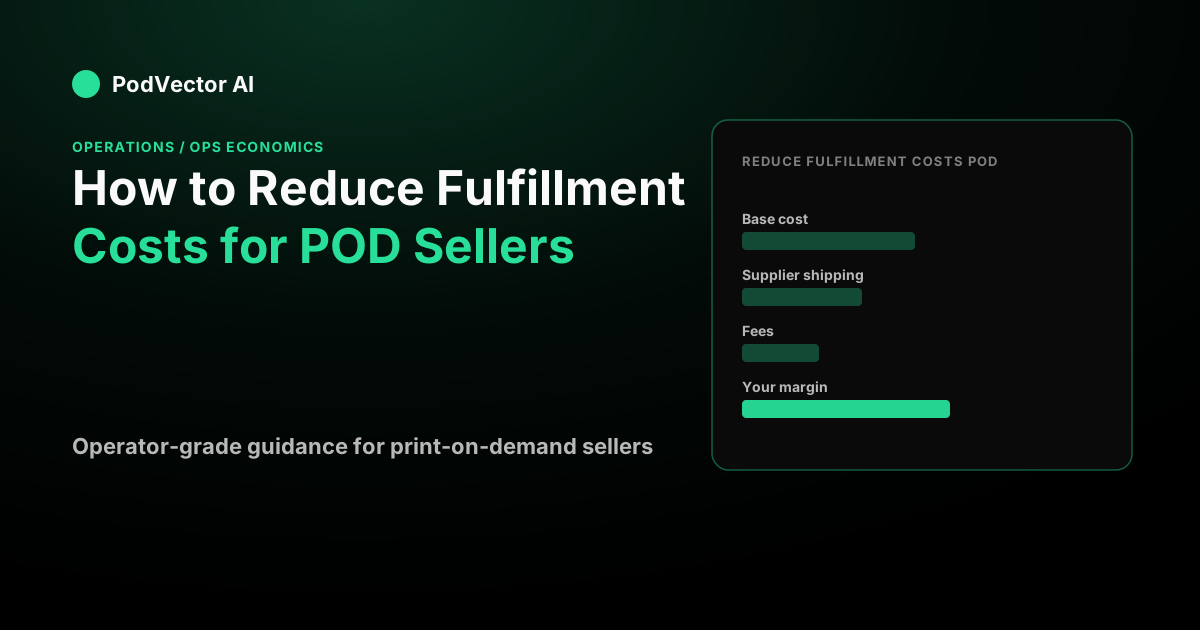
On a print-on-demand store, you own no inventory and operate no warehouse. Your fulfillment cost is a per-order number — the base price your supplier (Printify, Printful, or Gelato) charges to produce the item, plus the shipping they bill you to send it. There are no storage fees, no pick-and-pack labor, no pallet math.
That changes where the savings live. Your fulfillment cost is essentially your cost of goods sold, order by order, which is why it pays to treat it like a unit-economics problem rather than a logistics one. If the vocabulary here feels loose, the cluster overview on ecommerce ops economics and this primer on unit economics are worth a pass first.
The 2026 shipping backdrop you can't ignore
Before you optimize anything, know that the floor moved under you. UPS and FedEx both set a net average general rate increase of 5.9% for 2026, effective in late December 2025 and early January 2026 (Ship24). USPS raised Priority Mail by about 6.6% effective in January 2026 (Pirate Ship).
The headline understates it. Parcel-audit vendors widely report realized cost increases in the region of 8% to 12% once new dimensional-weight rounding and cubic-volume surcharges are layered on, though Ship24 cautions this is a modeled figure, not a carrier-published average (Ship24).
Those increases flow straight into the shipping line your POD supplier bills you. You can't negotiate them away, so the savings have to come from the levers you do control.
Lever 1: Cut your base cost with a provider discount plan
This is the single biggest lever for an operating store, and it's almost pure margin. Both major suppliers sell a subscription that discounts your base product cost on every order.
Printify Premium gives up to about 20% off the catalog for $39 per month on monthly billing, or $24.99 per month on annual billing, as of February 2026 (Ecommerce CEO). Printful's Growth plan gives up to 33% off base prices for $24.99 per month and becomes free once your trailing yearly sales through Printful hit $12,000 (Ecommerce CEO).
The math turns on your order volume. A popular Bella+Canvas 3001 tee runs about $10 in production plus roughly $5 US shipping on Printify (Ecommerce CEO). At 20% off, that $10 production cost drops to $8 — a $2 saving on every single order.
If you ship 340 orders a month, that's $2 × 340 = $680 saved, minus the $39 subscription, for $641 of recovered margin a month you were leaving on the table. The plan pays for itself at roughly 20 orders a month, so any store past its first few weeks should already be on it.
Lever 2: Route each order to the cheapest qualified print provider
Printify and Gelato both let the same design print at multiple providers, often in different regions. The base cost and shipping vary between them — and the shipping variance is a function of distance (zones), which the 2026 rate hikes made more expensive.
Routing a US customer's order to a US print provider instead of a European one can cut both the shipping charge and the delivery window. Shorter delivery windows matter for cost too, because late deliveries are a leading trigger of "item not received" refunds and chargebacks (more on that in Lever 4).
Check the per-provider base cost and shipping before you pick a default. The cheapest provider for a hoodie is rarely the cheapest for a mug, so route by product, not by habit.
Lever 3: Right-size the product and the variant
Your base cost is a choice, not a fixed input. Two tees that look nearly identical to a customer can differ by several dollars in production cost, and that gap is 100% margin on every order.
Audit your best-selling listings against cheaper equivalent blanks from the same provider. If a $14 premium tee and a $10 standard tee convert the same in your store, the standard blank hands you $4 per order with zero change to the customer experience.
Shipping is a product choice too. Heavier and bulkier items cost more to ship under the 2026 dimensional-weight rules, so a lighter garment or a smaller print area can shave the shipping line as well as the base. For a deeper walk through how these inputs roll into margin, see the COGS formula worked with sales and gross profit.
Lever 4: Stop paying for the same order twice
This is the fulfillment cost nobody counts. When a POD order is refunded or lost to a chargeback, the base cost and shipping you already paid your supplier are gone — a printed, personalized item can't go back into stock, so there is no restock to recover.
So every refunded order is a double hit: you lose the sale and you eat the full fulfillment cost. A lost chargeback is worse — on Shopify it carries a $15 fee and typically costs 2x to 2.5x the order value once you add the unrecoverable production, shipping, and ad spend (chargeback.io).
That makes refund and reprint discipline a fulfillment-cost lever. For genuine supplier defects, request the free reprint rather than refunding, so the supplier absorbs the new unit. Ship with tracking on every order and send proactive delivery updates, because the "item not received" claim is what converts a delayed package into a doubled fulfillment cost. How you book these losses matters for your numbers — this guide on recording cost of goods sold shows where they land.
Worked example: a 340-order store
Say you run an operating store doing 340 orders a month at a $31 average order value, with $2,800 a month in Meta spend. Your blended picture before any changes:
- Revenue: 340 × $31 = $10,540
- Fulfillment (base + shipping at $10 + $5): 340 × $15 = $5,100
- Ad spend: $2,800, or about $8.24 per order
Fulfillment is your single largest cost line — bigger than ads. Now apply the levers:
- Provider discount (Lever 1): 20% off the $10 base = $2 per order. 340 × $2 = $680, minus the $39 plan = $641/month.
- Cheaper equivalent blank on your top listing (Lever 3): say half your orders move to a blank that's $3 cheaper. 170 × $3 = $510/month.
- Cutting refund leakage (Lever 4): if 3% of orders were being refunded with no reprint, that's about 10 orders × $15 of sunk fulfillment = $150/month stopped.
Stack those and you've recovered roughly $1,300 a month — about $15,600 a year — without touching price, product, or ad budget. That's margin you already earned and were giving back.
Know your true per-order fulfillment cost
You can't cut a number you can't see, and most stores can't see their real per-order cost because production, shipping, fees, and ad spend live in separate tools.
PodVector AI's Victor is an AI employee that connects your live store data — Shopify, your Meta Ads and Google Ads accounts, Printify, Printful, Gelato, and Klaviyo — and computes true per-order profit, so the fulfillment cost on every order is a real figure, not an estimate. Victor delivers the reports to your Google Drive, and every write action it takes is approval-gated: it drafts, you approve before anything executes. It isn't a dashboard you have to read — it's an operator that does the pulling-together for you.
Put Victor on your store and see your real per-order fulfillment cost on every order.
FAQs
What counts as fulfillment cost for a print-on-demand store?
It's the per-order cost to produce and ship the item: the base price your supplier charges plus the shipping they bill you. Because you hold no inventory, there's no warehouse storage, carrying cost, or pick-and-pack labor — the warehouse-focused advice that dominates search results doesn't apply to you.
Is a Printify or Printful subscription worth it for cutting costs?
For an operating store, almost always yes. Printify Premium pays for itself at roughly 20 orders a month, and Printful's Growth plan becomes free once your yearly sales through Printful reach $12,000 (Ecommerce CEO). Below a handful of orders a month the subscription may not clear its own cost, but any store with real sales history is past that line.
Why do refunds raise my fulfillment cost so much?
Because a printed item can't be restocked. When you refund a POD order, the production and shipping you already paid are unrecoverable, so you lose the sale and eat the full fulfillment cost. A chargeback adds a $15 fee and can cost 2x to 2.5x the order value (chargeback.io), which is why reprints for genuine defects usually beat refunds.
Did fulfillment costs actually go up in 2026?
Yes. UPS and FedEx set an average 5.9% general rate increase and USPS raised Priority Mail about 6.6%, both effective early in 2026, with realized increases widely modeled nearer 8% to 12% after new surcharges (Ship24). Those rises flow into the shipping your POD supplier charges you, which is why the controllable levers matter more now.
How is reducing fulfillment cost different from cutting other operating expenses?
Fulfillment is a variable, per-order cost that scales directly with volume, unlike fixed overhead. That's what makes small per-order wins compound — shaving even a little off each order across hundreds of orders dwarfs most one-time cuts. For how variable and fixed costs behave differently on a real operating statement, see this breakdown of operating expenses in a company 10-K.