
Search "how to reduce shipping costs" and every result tells you the same four things: open more warehouses, negotiate carrier rates, right-size your packaging, and switch to poly mailers. That advice is written for a brand that holds its own inventory and books its own freight.
If you run a print-on-demand (POD) store on Printify, Printful, or Gelato, none of those levers are yours. You don't touch the box, the carrier, or the rate card. Your supplier does. So the real question — the one the ranking pages skip — is how to cut shipping cost when a third party controls the shipment.
This article answers that for an operator, not a beginner. As a running example, we'll use a hypothetical store doing 340 orders a month at a $31 average order value (AOV) with about $2,800/month in Meta spend — illustrative numbers, not benchmarks, so you can follow the math and swap in your own.
Why "negotiate carrier rates" is the wrong advice for POD
In classic D2C, shipping is a line item you control: you pick UPS or USPS, you negotiate a discount off published rates, and you book the freight. Cutting it is a procurement exercise.
In POD, the shipping charge is set by the print provider and bundled into what you pay per order. You pay a product cost plus a shipping fee the provider quotes, and that fee already reflects their carrier contract — which is almost certainly better than any rate a small store could negotiate alone.
So "negotiate with the carrier" is a dead end. Your shipping cost is really a function of four things you do control: which provider prints the order, what the product is, how you price shipping to the customer, and how often you pay to ship the same order twice.
Where your shipping cost actually comes from
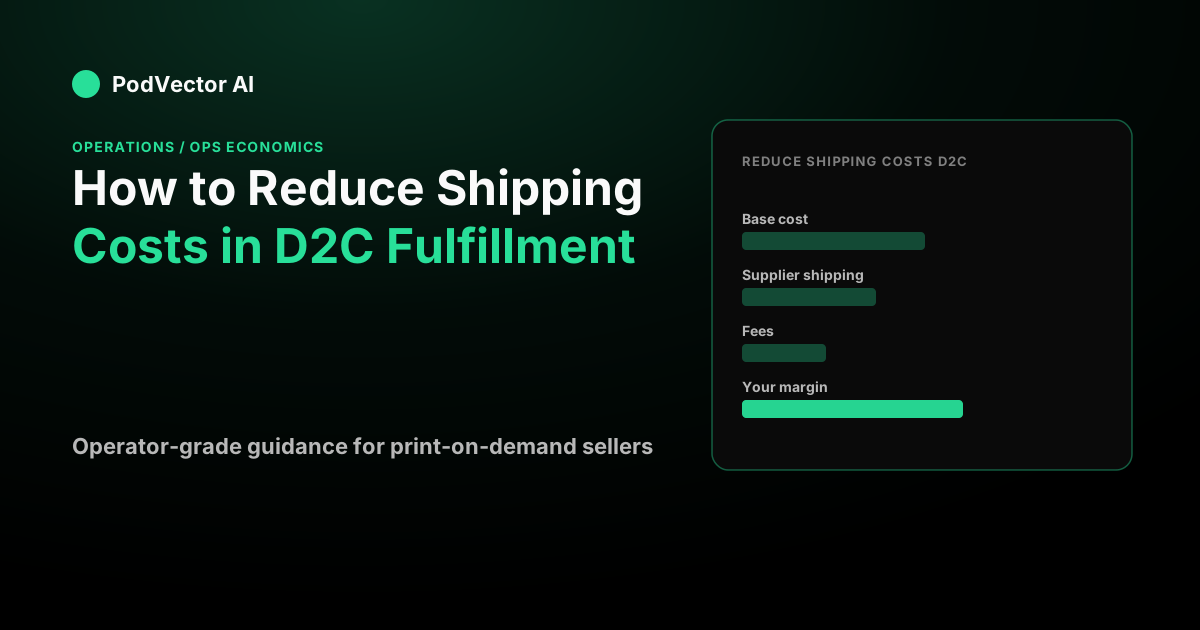
Open any POD order and the economics look like this. On a $31 sticker-and-tee bundle, say the provider charges $12 product cost and $6.50 shipping, so you pay $18.50 to fulfill. That $6.50 is the number this whole article is about.
The trap operators fall into is treating shipping as fixed. It isn't. The same tee shipped to the same customer can cost you $4.20 or $7.80 depending on which print facility the order routes to and which product you listed. Shipping is a variable you shape upstream, at the catalog and routing level, long before checkout.
If you're fuzzy on how shipping, product cost, and fees stack into the cost of a sale, our cost of goods sold T-account walkthrough lays out the mechanics before we optimize them.
Lever 1: Route orders to the print provider nearest the buyer
Printify and Printful both operate a network of print facilities and can fulfill the same product from more than one of them. Where the order prints determines the shipping zone — and the fee.
An order to a US customer printed in a US facility ships domestically and cheaply. The same order routed to a European facility ships international, which is slower and far more expensive. For stores selling into multiple regions, provider-and-facility selection is the single biggest shipping lever you have.
Concrete move: in your provider dashboard, enable the print providers that sit in your biggest customer regions, and make them the default for products you sell most. If 70% of your 340 orders go to US addresses, every one of those should print in a US facility. Letting them default to an overseas provider can add dollars per order across hundreds of orders a month.
Lever 2: Choose products and variants that ship cheap
Shipping cost tracks weight and dimensions, and in POD that's decided entirely by what you put in the catalog. A lightweight poly-mailered item (a tee, a tote, a print) ships for a fraction of what a boxed, heavy item (a hoodie, a mug, a framed poster) costs.
This matters most on your hero products — the ones that drive volume. If your best seller is a heavyweight hoodie that costs $9 to ship, test a mid-weight variant from the same provider that ships for $6. Across a few hundred orders, a $3 shipping delta is real money that drops straight to profit.
It also shapes how you bundle. Two separate items often ship as two shipments at two shipping fees. A single product (a two-sided design on one tee instead of two tees) ships once. The telltale sign of SG&A and fulfillment bloat hiding in plain sight is worth understanding too — see whether SG&A is the same as operating expenses for how these costs get categorized.
Lever 3: Set a free-shipping threshold that protects margin
Free shipping isn't optional anymore — it's an acquisition tool. Nearly half of US shoppers abandon a cart because the extra costs at checkout, shipping included, are too high (eMarketer, reporting Baymard Institute data). One analysis of D2C carts attributes a majority of shipping-driven abandonment specifically to high delivery fees (Eshopbox).
But "free shipping" for you still means someone pays the provider's fee. The goal is a threshold that nudges basket size up enough to absorb it.
Worked example. Your AOV is $31 and your blended shipping cost is $6.50. If you offer free shipping over $45, you need the average order to rise from $31 to at least $45 for the math to hold. Say the threshold pushes 40% of your 340 orders up to a $48 average. On those 136 orders, you added $17 of revenue each ($48 − $31 = $17) and absorbed $6.50 of shipping — a net $10.50 gain per order, roughly $1,428 a month, before product cost on the add-on item.
Run that calculation against your own numbers before you flip it on. If a $45 threshold barely moves basket size, the shipping you eat on every sub-threshold order outweighs the lift, and you're just discounting.
Lever 4: Stop paying to ship the same order twice
The quietest shipping cost in POD is the reship — the second shipment you pay for when the first never arrives. It hides because it looks like customer service, not shipping.
Two cases dominate, and the supplier makes you eat both. When a customer enters a wrong or invalid address, Printify refunds only the product price, not shipping, and the reshipment is your responsibility (Printify Help). Printful's policy is the same shape: on a bad customer-entered address, the merchant is liable for reshipment costs (Printful Help).
The other case is "delivered but not received." If tracking shows the package was delivered and the customer says it didn't arrive, Printful will not cover a reprint — you reorder at your own expense if you choose to replace it (Printful Help). True carrier loss, confirmed by the carrier inside the reporting window, is covered — but you have to file in time.
How to cut this leakage:
- Add address validation at checkout so fewer orders go out to bad addresses in the first place.
- Ship with tracking on every order so "delivered but not received" claims meet real delivery evidence.
- File transit-loss claims the day they qualify — miss the supplier's window and a free reprint becomes a full reship on your card.
A store absorbing even five wrong-address reships a month at $18.50 each is quietly spending about $92 a month shipping orders it already shipped.
Put shipping cost where you can actually see it
None of these levers work if shipping is buried in a blended "fulfillment" number you glance at once a quarter. Shipping is a per-order variable, and you manage it per order or not at all.
That means computing true per-order profit — sticker price minus product cost, minus the provider's shipping fee, minus the payment fee, minus the ad spend that acquired the customer. When shipping is visible at that grain, a $3 routing win or a leaking reship stops being invisible. For the bookkeeping side of this, see how to record cost of goods sold correctly so shipping lands in the right place on your P&L.
This per-order visibility is exactly what Victor, the AI employee inside PodVector AI, is built to give POD operators. Victor connects your Shopify store, your Printify, Printful, and Gelato fulfillment, your Meta and Google Ads, and Klaviyo, then computes true per-order profit with the provider's shipping fee already in the number — and delivers the reports to your Google Drive. Victor is an operator, not a dashboard: every write action is approval-gated, so you approve before anything executes.
For the full picture of how shipping sits alongside returns, chargebacks, and fees in your margin, start with our ecommerce ops economics hub.
FAQs
Can I negotiate shipping rates with my POD supplier?
Not meaningfully as a small store. The provider's quoted shipping fee already reflects their carrier contract, which is better than you'd get alone. Your leverage is upstream — which provider prints the order, what product it is, and which facility it ships from — not the per-package rate itself.
Does offering free shipping always lose money in POD?
No, but only if it lifts basket size past your threshold. Free shipping below a threshold that doesn't move AOV is just a discount you pay on every order. Model it against your own AOV and shipping cost first: the add-on revenue has to clear the shipping fee you're absorbing plus the product cost of whatever got added.
Why is my POD shipping so much higher than Amazon's?
Because a POD order is production plus shipping from a print facility, not a pick-and-pack from pre-stocked inventory near the buyer. Total delivery windows are longer and the shipping leg often starts farther from the customer. Routing orders to the nearest print provider is the main way to close the gap.
What's the fastest shipping cost win for an operating store?
Audit where your top sellers actually print. If high-volume products are defaulting to a facility far from your biggest customer region, switching the default print provider cuts the shipping zone on hundreds of orders at once — no catalog rewrite required. After that, attack reship leakage with address validation.
How do I know if shipping is eating my margin?
Compute true per-order profit with the provider's shipping fee broken out as its own line, not folded into a blended fulfillment cost. If you can't see shipping per order, you can't tell a routing problem from a product-mix problem from a reship leak — and all three look identical in a quarterly average.