
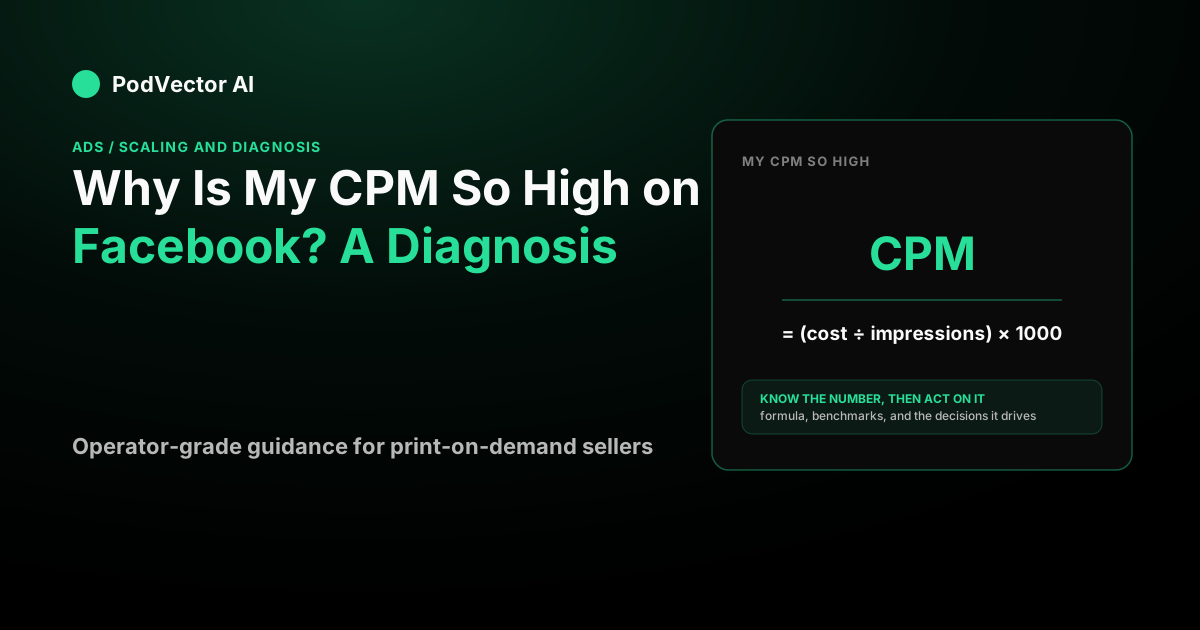
What CPM actually measures
CPM is the cost per one thousand impressions — the market price of attention on Meta right now. You never set it directly. It's an output of the auction, and it moves based on who else is bidding and how much Meta likes your ad.
That's the key mental shift. A high CPM is not a setting you turned on. It's the price the auction handed you this week, and that price has two independent inputs pulling on it.
The two root causes behind "why is my CPM so high"
Every high-CPM story is really one of these two. Confusing them is the most common mistake advertisers make.
External: the auction just got more expensive
Meta runs a live auction for every impression, and the clearing price rises when more advertisers crowd in for the same eyeballs. This is why CPMs climb every fourth quarter — retail floods the platform for Black Friday and the holidays, and even non-retailers compete in those same auctions.
The seasonal swing is large and real. In the e-commerce vertical, the global median CPM averaged about $13.88 across the tracked year, dipping to roughly $11.21 in September and peaking near $21.96 in November, according to Superads' CPM benchmark data. That's close to a doubling from the cheapest month to the most expensive — and none of it is your ad's fault.
For context on where "normal" sits, the median CPM across all industries landed around $13.48, per Visible Factors' 2025 benchmark analysis. If your CPM jumped in November, compare it to that November peak before you assume something broke.
Internal: your ad quality decayed
The second cause is on you, and the good news is it's fixable. Meta's auction winner is not the highest bidder — it ranks on total value, roughly your bid multiplied by the estimated action rate, adjusted for ad quality. A relevant, high-engagement ad can win the impression and pay a lower CPM than a competitor who bid more.
Flip that around and you get the penalty. When people scroll past, hide, or ignore your ad, Meta's estimated action rate drops and negative feedback climbs, so it charges you more to keep showing an ad the audience doesn't want. Narrow audiences make this worse: a small pool saturates fast, frequency climbs, and you're paying rising prices to re-show the same tired creative to the same tired people.
How to tell which one is hurting you
Run this check before changing anything. The goal is to separate a pricier market from a decaying ad, because the fixes point in opposite directions.
Is CPM up while CTR and conversion rate are flat? Then it's auction density — the external cause. The market got more expensive; your ad is performing the same. Widening the audience or geography, or simply accepting a seasonal cost, is the move here.
Is CPM up while CTR is falling and frequency is climbing? Then it's internal. Your audience is saturating and your creative is fatiguing, and Meta is penalizing weak engagement. The fix is fresh creative and a bigger audience, not a bid change.
One trap to rule out first: a large edit can throw an ad set back into Meta's learning phase, where delivery is less stable and cost per result runs higher. An ad set exits learning at roughly fifty optimization events in a seven-day window, and as this Meta learning-phase explainer notes, significant edits — big budget jumps, new audiences, new creative, a changed optimization event — reset that clock. If you just made a big change, your high CPM may simply be the learning tax, and the fix is to stop editing and let it stabilize.
The fixes, matched to the cause
If it's the market (CPM up, engagement flat): widen your audience so you're pulling from more auctions instead of the same crowded slice, expand geographies if your economics allow, or ride out the seasonal spike and lean harder on retargeting where prices are calmer. Chasing this with creative changes just resets learning for no reason.
If it's your ad (CPM up, CTR down, frequency up): refresh creative on a real cadence, broaden the audience so frequency has room to breathe, and cut the ads with the worst engagement ranking. Because creative is now the dominant targeting signal on Meta, a stronger hook often lowers CPM more than any audience tweak. There's a full playbook for this in our guide to Facebook ads scaling best practices.
And if the CPM spike showed up after you raised budget, you may have two problems at once — a learning reset plus diminishing returns. Our walkthrough of Facebook ads scaling strategies covers how to add spend without triggering both, and the twenty-percent budget-increase rule explains the cadence practitioners use to stay under the reset threshold.
The part everyone skips: CPM isn't the number that pays you
Here's what the top-ranking articles never tell you. A high CPM is only a problem if it breaks your profit math — and you can't see that from CPM alone. What matters is the customer acquisition cost that CPM rolls up into, measured against your margin.
Say you sell a product at a $50 average order value with a 50% contribution margin, so you clear $25 of gross profit per order before ad spend. At a $15 CPM with a 2% click-through rate, one thousand impressions buys 20 clicks; at a 3% conversion rate, that's 0.6 orders. Your CAC is $15 ÷ 0.6 = $25 per order — exactly break-even. Fine, but no profit.
Now the auction doubles your CPM to $30 in November while everything else holds. That same math becomes $30 ÷ 0.6 = $50 CAC. You're now losing $25 on every order, even though your ad "works" exactly as well as before. The break-even line is set by your margin — break-even ROAS is simply 1 ÷ your contribution margin — so a rising CPM quietly pushes you underwater without your dashboard turning red. You can pressure-test your own number with our break-even ROAS calculator.
This is why the smartest response to a high CPM is often not on the ad platform at all. If you raise your average order value — a bundle, a post-purchase upsell, a free-shipping threshold — you lower the break-even ROAS your ads have to clear, which means a pricier CPM stops being fatal. See how that ties together in our hub on profitable ad scaling.
Where a true-profit view comes in
The reason CPM panic is so common is that most sellers only see ad-platform numbers, which stop at ROAS and never subtract product cost, shipping, and fees. You can't tell a scary-but-profitable CPM from a quiet-but-losing one without stitching the ad data to the actual order economics.
That's the gap PodVector closes. It connects your Shopify, Meta Ads, Google Ads, Printify, and Printful accounts and computes the true per-order profit behind each campaign, so a CPM spike shows up as what it really is — a margin event, not just a metric. Victor, the AI employee inside it, reads that combined picture and proposes moves, then executes the writes you approve on the Shopify side; Victor does not touch your ad account, and it's not a dashboard you have to go read. It's the profit context that tells you whether this week's high CPM actually matters. Start free and connect your stores.
FAQs
Why is my CPM so high all of a sudden?
A sudden jump is almost always one of three things: the auction got seasonally expensive (check the calendar — fourth-quarter and sale events spike CPMs for everyone), you made a significant edit that reset the learning phase, or your creative fatigued and engagement dropped. Check CTR and frequency alongside CPM: flat engagement points to the market, falling CTR with rising frequency points to your ad.
Is a high CPM always bad?
No. CPM is the price of attention, not a measure of profit. A $30 CPM that produces cheap, high-converting orders can be far more profitable than a $10 CPM that converts poorly. Judge CPM by the customer acquisition cost it produces against your margin, never in isolation.
Does a high CPM mean my targeting is wrong?
Sometimes, but not the way people think. A narrow audience saturates quickly, frequency climbs, and Meta charges more to keep re-showing your ad — so broadening usually helps. But if CPM rose while your engagement metrics held steady, targeting isn't the issue; the market simply got more expensive, and no audience tweak will change that.
How do I lower my Facebook CPM?
Match the fix to the cause. If it's auction density, widen your audience and geography or wait out the seasonal peak. If it's ad quality, refresh creative, cut the worst-engaging ads, and give frequency room by enlarging the audience. If you just made a big edit, stop editing and let the ad set finish learning before you judge the price.
What is a normal Facebook CPM for ecommerce?
It varies enormously by vertical, geography, and season, so treat any single number as a reference point, not a target. For rough orientation, the e-commerce median CPM averaged around $13.88 globally with a November peak near $21.96, per Superads' benchmark data. Your own break-even CPM depends on your margin and conversion rate, which is the number that actually matters.
Should I pause a campaign when CPM spikes?
Rarely, and not on CPM alone. Pausing resets the learning phase, so you pay the learning tax again when you restart. Diagnose first: if the campaign is still profitable at the higher CPM, keep it running; if it's underwater, fix the creative or margin lever before reaching for the off switch.