
What is Shopify conversion rate optimization?
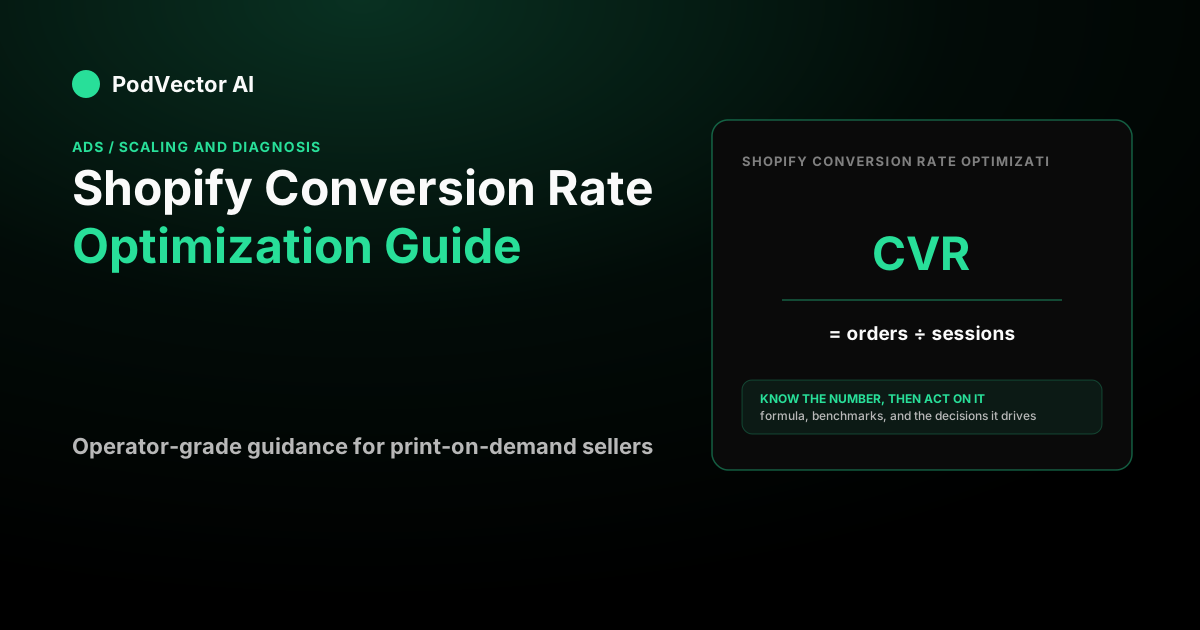
Your conversion rate is the share of visitors who buy. If 1,000 people visit and 20 order, that's 20 ÷ 1,000 = 2%.
Conversion rate optimization on Shopify means systematically raising that number by removing whatever stops people from checking out. The appeal is simple: you already paid to get the traffic, so every extra order is close to free margin.
Most guides stop there and hand you a checklist. The problem is that a "win" on the percentage can still lose you money — and a boring change can quietly make you rich. This guide keeps score in profit.
What counts as a good Shopify conversion rate?
Benchmarks are a starting point, not a target. According to Craftberry's 2025 Shopify data, the average Shopify store converts around 1.4%, anything above 3.2% lands you in the top fifth of stores, and above 4.7% puts you in the top tenth.
The catch is that "good" depends heavily on what you sell. Shopify's own benchmark data shows food and beverage converting at 6.22% while home and furniture sits at 1.41% — so a home-goods store at two percent may be outperforming a food store at four.
For global context, Statista data cited by Shopify put worldwide ecommerce conversion at 1.6% in the third quarter of 2025. Compare yourself to your category and your own past, not to a universal number.
Why conversion rate is a profit lever, not a vanity metric
Here is the math that makes CRO worth your time. Say you get 1,000 visitors a month and convert at two percent: 1,000 × 0.02 = 20 orders. At a $50 average order value, that's 20 × $50 = $1,000 in revenue.
Now lift conversion to three percent with the same traffic: 1,000 × 0.03 = 30 orders, or 30 × $50 = $1,500. That's a fifty percent revenue jump and you spent nothing extra on ads to get it.
This is why conversion rate optimization on Shopify compounds with your paid media. A better conversion rate lowers the break-even ROAS your ads have to clear, and profitable ads let you scale — a loop worth understanding, which is the whole point of our guide to profitable ad scaling.
The break-even link is pure arithmetic. Break-even ROAS is 1 ÷ contribution margin, so a store keeping fifty cents on the dollar after variable costs needs 1 ÷ 0.50 = 2.0x just to break even. Push conversion up and you clear that bar on more of your traffic without touching the ad account.
Where Shopify stores actually leak conversions
Before you A/B test button colors, plug the big leaks. These are the ones with data behind them.
The checkout leak
Checkout is where intent goes to die. Per the Baymard Institute's cart-abandonment research, the average documented abandonment rate is about 70.19%, and unexpected extra costs — shipping, taxes, fees revealed late — are the number-one reason, cited by 48% of shoppers who bailed.
The same Baymard data shows forced account creation is the second-biggest killer at 26%. Two fixes follow directly: show total cost early (or build shipping into price with a free-shipping threshold), and offer guest checkout.
A free-shipping threshold does double duty — it can lift both conversion and order value at once. If you want the mechanics of raising average order value alongside conversion, our breakdown of how to increase CVR and AOV together walks the tradeoffs.
The speed leak
Slow pages bleed mobile buyers. The Google-commissioned Deloitte "Milliseconds Make Millions" study found that a 0.1-second improvement in mobile site speed lifted retail conversions by 8.4% and average order value by 9.2%.
On Shopify, the usual culprits are heavy apps, oversized images, and bloated themes. Audit your app list, compress images, and cut any script you can't tie to revenue.
The trust and clarity leak
Shoppers abandon when they can't tell whether to trust you or what they're actually buying. Clear photos, honest reviews, a visible return policy, and a fast-loading product page do more than any popup.
Write product descriptions that answer the objection, not just the spec sheet. For a deeper tactical list, see our companion piece on how to increase conversion rate on Shopify.
A profit-first CRO workflow
Good conversion rate optimization Shopify strategies follow a loop, not a one-time cleanup. Here's a workflow that keeps profit in the frame.
One, measure in profit, not just percentage. Track orders and contribution margin per order, so you notice if a "winning" test attracts cheaper buyers who tank your margin.
Two, fix leaks in order of size. Checkout and speed usually outrank cosmetic tweaks — start where the data says the money leaves.
Three, test one variable at a time. Change the headline, the offer, or the checkout flow in isolation so you know what moved the number.
Four, feed the winners back into acquisition. A higher conversion rate makes more of your ad audiences profitable, which changes how aggressively you can test budgets — the same logic behind choosing CBO vs ABO for small-budget testing.
Five, capture more from every buyer. The customer who just converted is the cheapest one to sell again, which is why a well-built post-purchase upsell on Shopify is one of the highest-leverage profit moves you can make.
Where PodVector fits
The hardest part of profit-first CRO is knowing your real per-order profit — most stores are flying on revenue and ROAS, which hide COGS, shipping, and fees.
PodVector connects your Shopify, Meta Ads, Google Ads, Printify, and Printful accounts and computes true per-order profit from that live data. It is not a dashboard you have to read; Victor, its AI employee, analyzes your data and proposes Shopify-side moves you can approve — and he does not touch your ad account.
That means when you test a checkout change or a new price, you can see whether it actually added profit, not just orders. You can try it free and connect your store in a few minutes.
When to hire a Shopify CRO agency vs do it yourself
Most stores under a few thousand orders a month don't need a Shopify conversion rate optimization agency yet. The leaks above are self-serviceable, and you learn your own customers faster by doing the work.
Consider an agency when you have enough traffic to run statistically valid tests and the internal fixes are already done. Below that volume, an agency mostly sells you a testing matrix your traffic can't power.
Whether you hire out or DIY, insist on one thing: decisions scored in profit per order, not conversion rate in isolation. A rate that goes up while margin goes down is a worse business.
FAQs
What is a good conversion rate for a Shopify store?
It depends heavily on your category. Overall, Craftberry's data puts the Shopify average near 1.4% with the top fifth above 3.2%, but Shopify's benchmarks show food converting far higher than furniture — so compare within your niche and against your own trend.
Does a higher conversion rate always mean more profit?
No. If a change attracts lower-margin buyers or you discount to win the order, conversion can rise while profit falls. Always score tests on contribution margin per order, not the percentage alone.
What's the fastest way to improve my Shopify conversion rate?
Fix the checkout and the speed first — they have the most data behind them. Baymard blames surprise costs and forced accounts for most abandonment, and the Deloitte study tied a tenth-of-a-second speed gain to an 8.4% retail conversion lift.
How does conversion rate affect my ad spend?
A higher conversion rate lowers your break-even ROAS, since more of the same traffic buys. That makes more of your ad audiences profitable, which is what lets you scale spend without losing money — the core idea in our profitable ad scaling guide.
Do I need a CRO app or agency to start?
Not at first. You can plug the biggest leaks yourself, and the main thing you need is honest per-order profit visibility so you know which changes actually paid off — which is exactly what PodVector's Victor computes from your connected Shopify and payment data.