
Most guides treat average order value as a revenue trick. That's the shallow read. The real reason to pursue an AOV increase is that it changes the math your ads live inside — and that's the angle almost every ranking article skips.
This piece covers the same tactics they do (upsells, bundles, thresholds), then shows you the profit calculation underneath. If you're scaling paid traffic, AOV work is one of the highest-leverage moves you have.
What average order value actually is
AOV is simple arithmetic: total revenue divided by number of orders. If you did $2,000 across 100 orders, your AOV is $2,000 ÷ 100 = $20.
Benchmarks vary wildly by vertical. Shopify puts the global average around $145 per order, with luxury above $300 and beauty often in the $15–$90 range. Treat any benchmark as a rough compass, not a target — a $28 apparel store and a $180 supplement store play completely different games.
Why increasing AOV is really an ad-efficiency lever
Here's the insight the SERP buries. Your ads have a break-even ROAS — the return at which ad revenue exactly covers the cost of goods plus the ad spend. The clean identity is arithmetic:
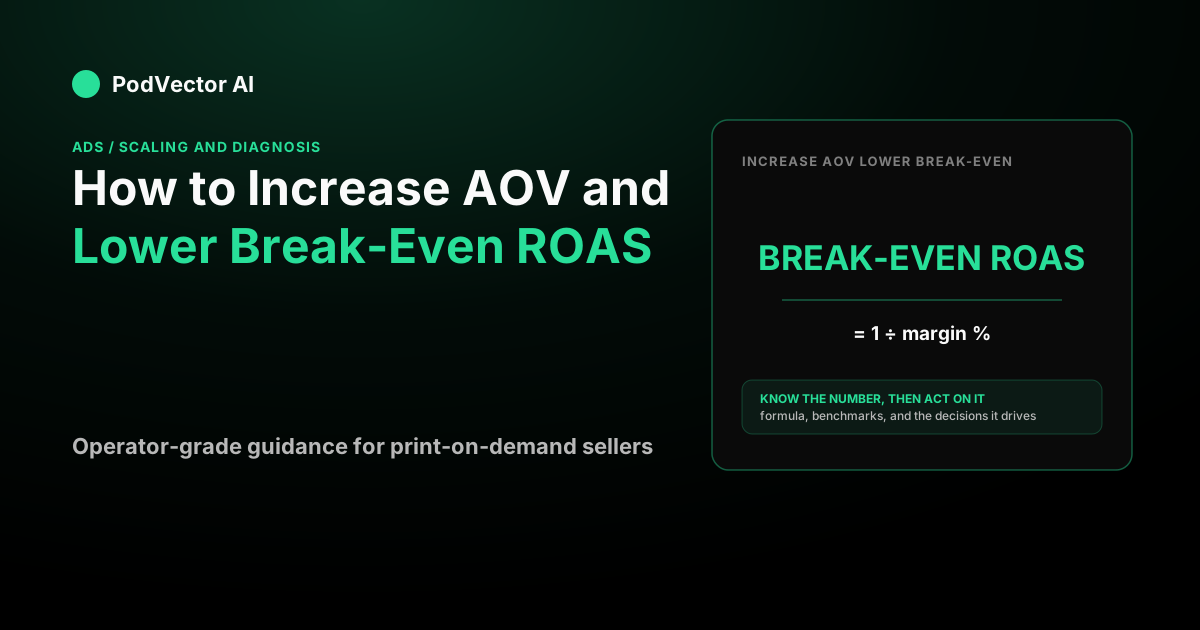
Break-even ROAS = 1 ÷ contribution margin
Contribution margin is the share of revenue left after variable costs (COGS, shipping, payment fees, pick-and-pack), before ad spend. So a store at 50% margin needs 1 ÷ 0.50 = 2.0x just to break even. A thin 30% margin store needs 1 ÷ 0.30 = 3.33x — paid acquisition gets hard fast down there.
Now raise AOV while holding margin rate steady. Margin dollars per order climb, but the ad still only has to buy one order. That means the same 2.0x ROAS that broke even before now throws off real profit. You didn't touch your ad account — you moved the finish line closer.
This is why AOV buys you scaling headroom. As you push budget, the auction serves your cheapest audience first, so your marginal ROAS falls even while average ROAS looks fine (a trap we unpack in our guide to profitable ad scaling). A higher AOV lets you keep spending further down that diminishing-returns curve before the last dollar crosses break-even. If you want to see exactly where your line sits, run the numbers through our break-even ROAS calculator.
The highest-leverage ways to increase AOV
Post-purchase upsells (zero added ad cost)
A one-click offer after checkout is the highest-leverage AOV move for advertisers, because the customer already converted — the upsell costs zero additional acquisition spend. Take rates are real but modest: Focus Digital's 2025 study of 1,847 businesses measured a 14.6% average post-purchase conversion rate.
Walk the math. Say you sell a $50 product and add a $15 one-click upsell that converts at that ~14.6% rate. On 1,000 orders, that's roughly 146 accepts × $15 = $2,190 of extra revenue — and because it lands after the sale, none of it required more ad spend. Every dollar of that flows almost entirely into contribution margin.
Bundles and kits
Selling complementary items together raises AOV and often improves margin, since you ship one package instead of two. In one case documented by Saras Analytics, a wellness brand lifted AOV 20% after launching product kits. Treat that as an illustration of the mechanism, not a number you're owed.
Bundles work because they simplify the decision. Instead of asking the shopper to assemble a set, you present a finished one at a single price.
Free-shipping thresholds (state the tradeoff honestly)
Set a free-shipping threshold slightly above your current AOV so customers add an item to qualify. The pull is strong: Saras Analytics cites data that 90% of U.S. shoppers add extra items to hit free shipping.
But this is not free money, and the competing guides rarely say so. The shipping you now absorb reduces contribution margin per order. It only helps ad efficiency if the AOV lift outweighs the shipping cost you eat — so tune the threshold and watch margin, not just basket size. A common starting point is your current AOV plus roughly 15–30%.
Order bumps and cross-sells at cart
An order bump — a small "add this too" checkbox at cart or checkout — captures incremental spend at peak intent. Saras Analytics notes that "add X for a discount" post-checkout offers can boost incremental AOV by 10–15%. Broader upsell and cross-sell programs are commonly cited as lifting AOV 10–30% on average, though the real number depends entirely on your catalog and offer relevance.
Price testing (optimize margin per session, not orders)
Raising price lifts AOV and margin per order but usually lowers conversion rate, which raises your cost per acquisition. Lowering price does the reverse. Neither "more orders" nor "higher price" wins on its own.
The metric that actually governs the decision is contribution margin per session — how much profit each visitor generates on average. More orders at a CAC your thinner margin can't cover is a loss dressed as growth. Your on-site conversion work and your pricing sit on the same lever, which is why our CRO guide and your AOV strategy should move together.
A worked example: how one AOV lift resets the math
Say you sell a $50 product at 50% contribution margin. Break-even ROAS is 1 ÷ 0.50 = 2.0x, and your channel is running right at 2.0x — a break-even wash, no profit.
Now add a post-purchase upsell and an order bump that lift blended AOV to $68 at the same 50% margin rate. Your margin per order goes from $25 to $34. At the same 2.0x ROAS and the same ad spend, you're now clearing $9 of profit on every order that used to break even.
Nothing changed in the ad account. You simply gave each order more margin to work with — which is exactly what makes a stalled campaign scalable again. That extra headroom is what lets you keep spending as you scale Facebook ads without losing ROAS.
Where PodVector fits
The hard part isn't the tactic — it's knowing your true per-order profit after COGS, shipping, fees, and the ad cost that drove the sale. Most tools show you ROAS, which ignores all of that.
PodVector connects Shopify, Meta Ads, Google Ads, Printify, and Printful and computes your real per-order profit from that live data. Victor, its AI employee, analyzes that data and proposes moves, executing approved actions on your Shopify store — he reads your ad data but does not touch your ad account. That gives you the margin picture AOV decisions actually depend on. Try PodVector free to see your true per-order profit.
Common AOV mistakes
Chasing basket size while ignoring margin is the big one. A free-shipping threshold that lifts AOV but eats more shipping than it earns is a step backward — the number on the dashboard goes up while your profit goes down.
The second trap is treating AOV as separate from your ad strategy. It isn't. Every point of AOV feeds directly into break-even ROAS, which is why weak creative and weak upsells are two halves of the same efficiency problem — our note on Facebook ad CTR covers the front-end half.
FAQs
What is a good average order value?
There's no universal "good" number — it's entirely vertical-dependent. Shopify pegs the global average near $145, but beauty stores often sit far below that and jewelry far above. The useful comparison is your own AOV over time, not someone else's benchmark.
How do I increase AOV without hurting conversion rate?
Lean on the tactics that add value without adding a purchase decision up front: post-purchase upsells and order bumps capture more revenue after the shopper has already committed. That's why the post-checkout upsell is so powerful — Focus Digital found it converts around 14.6% of the time with no impact on your primary conversion rate.
Does increasing AOV really make my ads more profitable?
Yes, and it's arithmetic, not marketing. Break-even ROAS equals 1 ÷ contribution margin, and a higher AOV at a steady margin rate puts more profit dollars behind each order. That lowers the ROAS your ads must clear, so campaigns that were breaking even start generating profit at the same spend.
Should I raise prices to increase AOV?
Sometimes — but optimize for contribution margin per session, not AOV in isolation. A price increase lifts margin per order but usually lowers conversion rate, so the right price is the one that maximizes profit per visitor. Test it, and judge the winner on margin per session rather than raw order count.
Is a free-shipping threshold worth it?
Often, but only when tuned. The threshold pulls shoppers to add items — Saras Analytics cites that 90% of U.S. shoppers do — yet you absorb the shipping, which trims margin. Set it above your current AOV and confirm the added margin dollars beat the shipping you now eat.