
If you run an operating store, you already know your CPM moved this year. The question is whether it moved because the whole auction got pricier or because something in your account slipped. This benchmark gives you the number to measure against — and the profit math most benchmark posts skip entirely.
What is the average Meta/Facebook CPM in 2025?
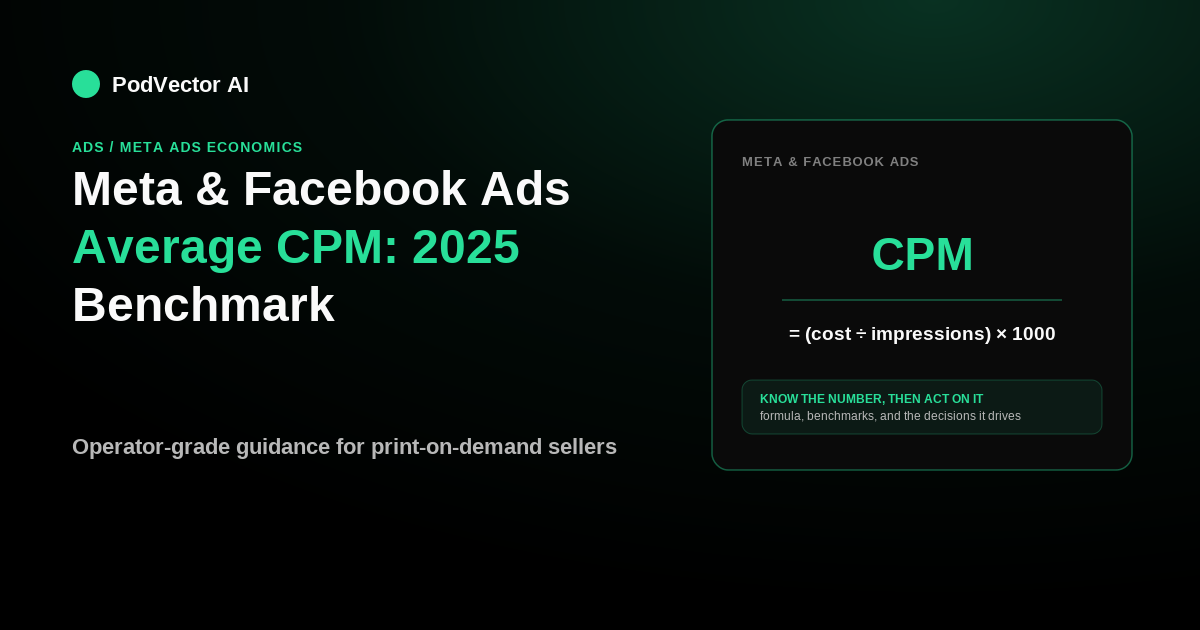
CPM is the cost per thousand impressions — the market price of attention on Meta's platforms. Across all industries in the US, Meta's CPM averaged about $15.06 for the trailing year, up roughly 13.24% from $13.30. That same source puts a single recent month (November) as high as $16.06.
Other datasets land higher because they weight different accounts. One benchmark set puts the US average Meta CPM at $20.48, with the overall median CPM around $8.15 and an average CPC near $0.70. The spread tells you something important: there is no single "true" CPM, only ranges that shift by country, industry, and season.
The headline for store owners is the direction, not the decimal. CPMs rose across the board this year, so if your number crept up a few dollars, you are likely moving with the market — not failing at it.
Facebook ads CPM benchmarks by industry (2025)
Your vertical matters more than the platform average. The table below shows reported 2025 CPMs and CPCs for common ecommerce categories, per Madgicx's benchmark data:
| Industry | Average CPC | Average CPM |
|---|---|---|
| Fashion / Apparel | $0.45 | $5.99 |
| Beauty / Cosmetics | $1.81 | $13.91 |
| Sports / Fitness | $1.90 | $14.02 |
| Home Improvement | $2.93 | $12.17 |
Notice apparel — the heart of most print-on-demand catalogs — runs well under the platform average. That is not because apparel advertisers are smarter; it is because the creative stops the scroll cheaply and the audience is broad, so Meta can fill impressions without bidding up.
For the broader retail and ecommerce bucket, the average click-through rate is about 1.90%, with CPC near $0.21 and a reported ROAS around 3.56x. Treat those as a mirror, not a target — your own trend line over the last few months tells you far more than one industry median.
Why ecommerce CPMs sit below the platform average
Ecommerce and retail consistently price under the global baseline — that median near $13.88 against roughly $20.59 is about a third cheaper. Three mechanics drive it.
First, product creative tends to earn high engagement, and Meta rewards relevant, high-click ads with a lower CPM. A relevant ad can win an impression against a higher bidder because Meta ranks on total value, not raw bid.
Second, ecommerce audiences are large and easy to fill, so the auction rarely has to reach deep into expensive, saturated pockets. Third, many lead-gen and B2B verticals bid aggressively for scarce audiences, pulling the global average up and leaving retail comparatively cheap.
What actually drives your CPM up or down
Before you blame your account, split the cause. A rising CPM has two very different roots, and the fix depends on which one you are looking at.
The first is external — auction density. More advertisers chasing the same people pushes everyone's price up, which is why CPMs climb in Q4 and around big sale events. You cannot tweak your way out of a seasonal spike; you can only widen your audience, accept the cost, or shift timing.
The second is internal — ad quality decay. If your relevance drops, your click-through rate falls, or a narrow audience saturates and frequency climbs, Meta charges you more to keep showing a poorly-received ad. That one is fixable with fresh creative or a broader audience.
The quick test: is your CPM up while CTR and conversion rate are flat? Then it is the market. Is CPM up while CTR is sliding and frequency is rising on the same creative? Then it is fatigue, and new creative is the lever.
CPM is a cost input, not a scoreboard
Here is what every CPM benchmark post leaves out: a lower CPM can still lose you money, and a higher CPM can still print profit. CPM only tells you what attention costs. Whether that attention pays depends on your conversion rate, your average order value, and your margin.
The number that governs whether an ad is worth running is your break-even ROAS, which is simply one divided by your contribution margin. If goods, shipping, and fees eat half of each sale, your contribution margin is 50% and your break-even ROAS is 1 ÷ 0.50 = 2.0x. Below that, ad-driven revenue does not even cover the product.
Say you run a POD store doing 340 orders a month at a $31 average order value, spending $2,800/month on Meta. That is $9,520 in ad-driven revenue, or a 3.4x ROAS. At a 45% contribution margin your break-even ROAS is 1 ÷ 0.45 = 2.22x — so 3.4x clears it and you keep real money. Now your CPM rises 20% in Q4 and ROAS drops to 2.6x. Still above break-even, still profitable — the scary CPM headline didn't actually break your store.
Flip it. If your margin were 30%, break-even ROAS is 1 ÷ 0.30 = 3.33x, and that same 2.6x Q4 ROAS now loses money on every incremental order — even though your CPM is identical to the profitable example. The CPM never told you that. The margin did. For the full picture of what a healthy return looks like, see our guide to what counts as a good ROAS for Facebook ads.
How to read your CPM against the benchmark
Pull your own trailing CPM and compare it two ways. Against the platform and industry benchmarks above, to see if you are in a normal range for your vertical. And against your own last few months, to catch drift early.
Then do the one calculation benchmarks never do for you: multiply your CPM through to per-order profit. A $14 CPM at a 1.9% CTR and a 3% landing conversion rate means roughly 1,000 impressions buy 19 clicks buy about 0.57 orders — so your cost per order is about $14 ÷ 0.57 = $24.60. Hold that against your margin dollars per order and you know, instantly, whether the ad is a business or a leak.
This is tedious to do by hand across every ad set, every product, and every supplier cost — which is exactly where an operator-grade view earns its keep. If you want the mechanics behind the whole channel, our Meta ads economics guide walks the full chain from CPM to profit, and the 2026 CPM benchmark breakdown shows where costs are heading next.
Where Victor fits
Victor is the AI employee inside PodVector AI. He connects to your Meta Ads and your Shopify store, sees every order, every ad dollar, and every supplier cost from Printify, Printful, or Gelato together, and computes the true per-order profit on each product — the exact math above, for every ad set, continuously.
When a rising CPM pushes an ad set below break-even, Victor pauses the losing ad set and shifts budget toward the ones still clearing margin. He reprices thin-margin SKUs, edits audiences, and changes budgets and bids directly in Meta Ads — so your CPM becomes a number you act on, not one you stare at. Victor is not a dashboard; he does the work.
For a deeper look at how spend, CPM, and total cost connect, read how much it costs to run Facebook ads in 2026. When you want the profit math run for your store instead of a generic benchmark, put Victor to work.
FAQs
What is a good CPM for Facebook ads in 2025?
There is no single "good" number — it depends on your industry and your margin. Ecommerce and retail tend to run below the platform average, with a median around $13.88 versus a global baseline near $20.59. A CPM is "good" if, after your CTR and conversion rate, the resulting cost per order still clears your break-even ROAS.
Why did my Facebook CPM go up this year?
Partly the whole market: Meta's US CPM rose about 13% year over year to roughly $15.06. The rest is account-specific — audience saturation, creative fatigue, or Q4 auction density. Check whether your CTR and conversion rate held steady; if they did, the increase is the market, not you.
Is a lower CPM always better?
No. A cheap CPM that attracts the wrong people and never converts is worse than a pricier CPM that brings buyers. Optimize for contribution margin per order, not for the cheapest thousand impressions. CPM is a cost input, not a measure of success.
How is CPM different from CPC and CPA?
CPM is cost per thousand impressions — what you pay for reach. CPC is cost per click, and CPA is cost per acquisition (a purchase or lead). The reported ecommerce average CPC sits near $0.21 with a CTR around 1.90%; CPA depends on how many of those clicks turn into orders.
Does a high CPM mean I should pause the campaign?
Not on its own. Pause decisions should rest on profit, not CPM. If a rising CPM drags an ad set's ROAS below your break-even (1 ÷ contribution margin), that ad set is losing money and is a candidate to pause or rework — but an ad set with a high CPM that still clears margin is doing its job.