
If you run Meta ads for a store with real order history, these three metrics show up on every report. The problem is that most definitions stop at the formula and never tell you how to read the number. This guide gives you the exact math, real benchmark ranges with sources, and the profit context the other explainers skip.
CPM: the price of attention
CPM stands for cost per mille — cost per one thousand impressions. An impression is one time your ad is rendered on a screen, not a click and not a sale.
The formula is simple:
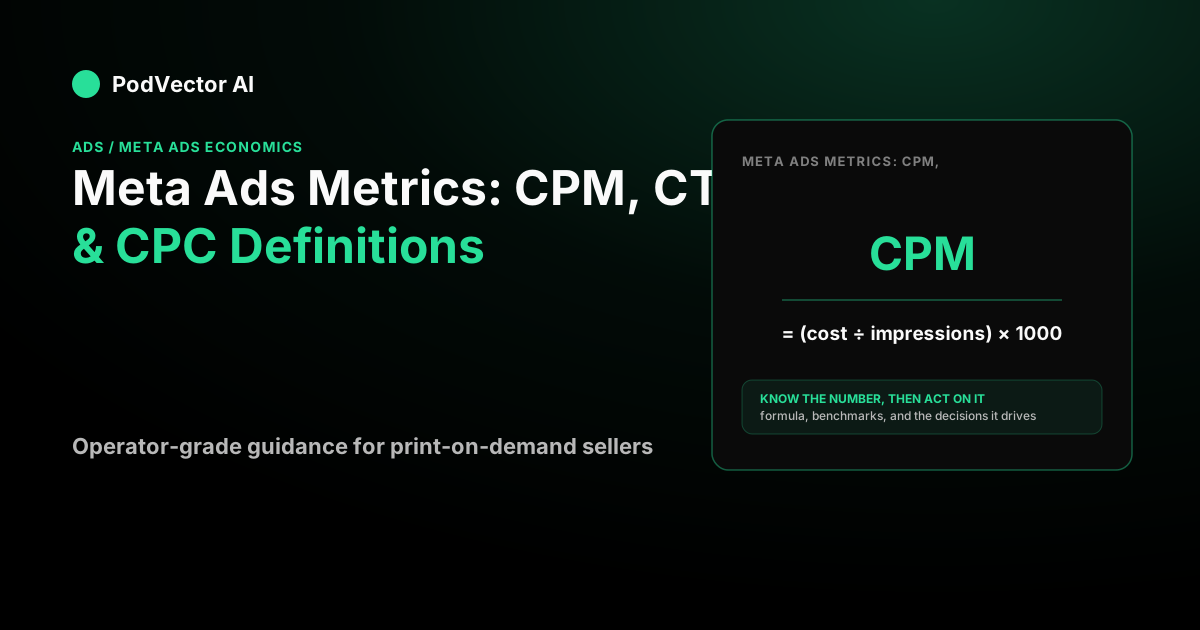
CPM = (total spend ÷ impressions) × 1,000
Say you spent $2,800 and your ads were shown 400,000 times. Your CPM is (2,800 ÷ 400,000) × 1,000 = $7.00. You paid seven dollars every time a thousand people saw the ad.
CPM is mostly a market price, not a score of your ad. It rises when more advertisers compete for the same users and falls when your ad is relevant enough that Meta's auction rewards it. Across ecommerce brands, Triple Whale's 2026 data puts the median Meta CPM at $15.06, with apparel and accessories closer to $13.25 over the August 2025 to July 2026 window.
Seasonality moves CPM hard. Top Growth Marketing reports that Q4 CPMs run roughly 40–60% higher than the rest of the year for most DTC brands, peaking from mid-November through Cyber Monday. So "my CPM went up" in December usually means the auction got crowded, not that your ad got worse. We break the drivers down further in the Meta CPM benchmark guide.
CTR: whether the ad earns the click
CTR stands for click-through rate — the percentage of impressions that produce a click.
CTR = (clicks ÷ impressions) × 100
Using the same campaign: 400,000 impressions produced 6,000 link clicks. Your CTR is (6,000 ÷ 400,000) × 100 = 1.5%. One and a half out of every hundred people who saw the ad clicked it.
CTR is the closest thing you have to a creative score. A high CTR means the hook, image, and offer are stopping the scroll; a falling CTR on the same creative usually means fatigue — the audience has seen it too many times. For reference, WordStream's 2026 benchmarks put the average Facebook traffic-campaign CTR near 1.93%, while Triple Whale's ecommerce median lands at 2.39% across Facebook and Instagram.
One caution: watch link CTR, not "all clicks." All-clicks CTR counts likes, comments, and profile taps, so it looks flattering and tells you nothing about traffic to your site.
CPC: what each click actually costs
CPC stands for cost per click — the average price you pay for one click to your site.
CPC = total spend ÷ clicks
From the example: $2,800 ÷ 6,000 clicks = $0.47 per click. The important thing is that CPC is an output, not a dial you set. You don't choose your CPC; it falls out of your CPM and your CTR.
Here is the identity that ties the three together:
CPC ≈ CPM ÷ (CTR × 10)
Plug in the numbers: $7.00 CPM ÷ (1.5 × 10) = $0.47. That matches. The practical read: you lower CPC by either paying less to be seen (lower CPM) or earning more clicks per impression (higher CTR) — and CTR is the lever you actually control through creative. For context, WordStream's 2026 data shows an average Facebook CPC around $0.60 for traffic campaigns, though yours will swing with your niche and season.
How the three metrics connect
Read them as a funnel, not three separate scores:
- CPM = the price of getting in front of people.
- CTR = how well your creative converts attention into a click.
- CPC = what those two produce together, per click.
A strong creative with a higher CTR can win cheaper clicks than a rival at a higher CPM, because Meta's auction rewards ads people engage with. That is why "fix the creative" is almost always the first move when CPC climbs. The Meta ads economics guide walks the full chain from impression to profit if you want the complete picture.
It also explains a common trap. When you launch or make a big edit to an ad set, Meta restarts its learning phase, and cost per result is less stable until the ad set gathers about 50 optimization events within roughly seven days. A spiky CPC in the first few days after a change is often just the learning tax, not a broken ad.
The metric these three never show: profit
Here is where most definitions quit — and where your money is actually made or lost. CPM, CTR, and CPC describe the traffic. None of them knows your product cost, your shipping, or your fees.
Walk it through. Your $2,800 spend bought 6,000 clicks at $0.47. Say 2% of those clicks convert — that's 120 orders. Your cost to acquire each customer is $2,800 ÷ 120 = $23.33.
Now bring in the economics. Say your average order is $31 and your contribution margin — what's left after the Printify base cost, shipping, and payment fees — is 50%, or $15.50 per order. You paid $23.33 to win $15.50 of margin. Every one of those "cheap" 47-cent clicks lost you almost eight dollars.
That is the whole point: a healthy CPM, CTR, and CPC can still sit on top of an unprofitable campaign. The gate is break-even ROAS, which is simply 1 ÷ contribution margin — at a 50% margin, you need 1 ÷ 0.50 = 2.0x return on ad spend just to break even. To go deeper on the number that should actually govern your scaling decisions, see what counts as a good ROAS for Facebook ads. And if your goal is followers rather than orders, the math shifts again in the cost-per-follower breakdown.
Reading these metrics without a spreadsheet
The hard part isn't the formulas — it's connecting them to your real costs, every day, across every ad set. That is the job Victor, the AI employee inside PodVector AI, does for POD store owners.
Victor connects your Shopify store, your Meta Ads and Google Ads accounts, and your Printify, Printful, or Gelato supplier, so he sees every order, every ad dollar, and every product cost together. He computes the true per-order profit behind each campaign — not just the CPC. When an ad set's clicks are cheap but the orders lose money, Victor pauses the losing ad set and shifts budget toward the ones clearing your break-even. He also builds and sends the Klaviyo flow that lifts repeat revenue, and drops a profit report into your Google Drive so you read the story, not the spreadsheet.
Victor is not a dashboard you have to interpret. He reads CPM, CTR, and CPC the way you would if you had all day — then does the work. Which placements he leans into is covered in the Advantage+ placements breakdown.
FAQs
What is a good CPM for Meta ads?
It depends on your niche and the season, but Triple Whale's 2026 ecommerce data puts the median around $15.06, with apparel closer to $13.25. Expect it to climb in Q4 — 40–60% higher than the rest of the year is normal for DTC brands during the holidays.
What is the difference between CTR and CPC?
CTR measures how often people click (clicks ÷ impressions, as a percentage). CPC measures how much each click costs (spend ÷ clicks). CTR is a quality signal for your creative; CPC is the price that comes out of your CTR and CPM together.
Is a low CPC always good?
No. A low CPC just means clicks are cheap — it says nothing about whether those clicks buy anything or whether the orders are profitable. A campaign can have a great CPC and still lose money if the cost to acquire a customer is higher than your margin per order.
Should I optimize for CTR or for conversions?
Use CTR as an early-warning gauge for creative fatigue, but judge the campaign on orders and profit. A high CTR with weak conversions usually means a scroll-stopping ad that attracts the wrong people — attention you paid for but can't bank.
Why did my CPM suddenly jump?
Two very different causes. Either the auction got more expensive — seasonality, a competitor entering, a sale event flooding the market — or your ad quality decayed and Meta is charging you more to keep showing it. If CPM is up while CTR holds steady, it's the market; if CPM is up and CTR is falling, look at your creative.
Do these three metrics tell me if my ads are profitable?
No, and that's the key thing to internalize. CPM, CTR, and CPC describe the traffic, not the economics. Profit depends on your product cost, shipping, fees, and conversion rate — which is why you pair these metrics with break-even ROAS before deciding to scale or pause.