
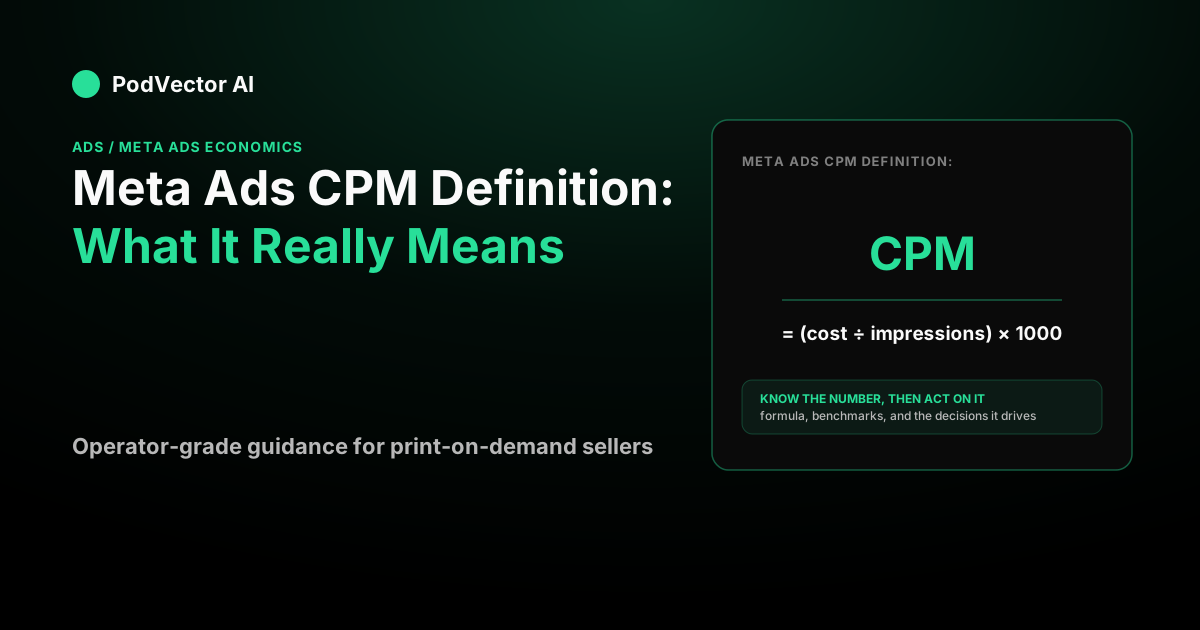
What CPM means in Meta ads
CPM stands for cost per mille — the cost per one thousand impressions of your ad. An impression is counted each time your ad is rendered on screen, so CPM is the price Meta charges to put your creative in front of people a thousand times.
One detail trips people up: Meta counts total impressions, not unique viewers. As SaveMyLeads notes in its CPM breakdown, CPM is "cost per thousand times your ad is shown," not cost per thousand people — if one person sees your ad three times, that is three impressions.
Think of CPM as rent on attention. It tells you how expensive the auction is right now for the audience you are buying. It says nothing about whether that attention turns into clicks, orders, or margin.
How to calculate CPM (with a worked example)
The formula is simple: divide what you spent by the impressions you got, then multiply by one thousand.
CPM = (ad spend ÷ impressions) × 1,000
Say you run an ad set for a week and spend $900 to earn 60,000 impressions. Your CPM is (900 ÷ 60,000) × 1,000 = $15.00. You paid fifteen dollars for every thousand times Meta showed your ad.
You almost never set CPM directly. Under Meta's default "Highest Volume" bidding you optimize for an outcome — purchases, usually — and CPM is an output of the auction, the by-product of how much Meta thinks it costs to find your buyer. That is why CPM moves on its own even when you change nothing.
What a good CPM looks like for a store
There is no single "good" number, because CPM depends on your niche, your geography, and the season. But operating ranges exist.
For most ecommerce campaigns, a reasonable CPM sits in the $8 to $20 band, with competitive categories like beauty and supplements running $25 to $40 or higher, according to Top Growth Marketing's 2026 benchmarks. The blended ecommerce average is near the middle of that: Triple Whale's data across roughly thirty-five thousand brands put the ecommerce CPM around fourteen dollars, cited in Influee's cost report.
Two things matter more than the headline number. First, CPM has been climbing — Meta's CPM rose about twenty percent year over year through 2025, per the same report, so last year's benchmark is already stale. Second, CPM spikes hard in Q4 around Black Friday and Cyber Monday as more advertisers flood the same auctions.
So "is my CPM good?" is the wrong first question. The right one is "is my CPM good relative to what it buys me downstream?" A $25 CPM that produces profitable orders beats a $9 CPM that produces nothing. For the full cost picture across clicks and results, see our 2026 breakdown of average Facebook ad CPC and CPM.
What pushes your CPM up or down
Your CPM has two very different root causes when it moves, and diagnosing which one you are facing is half the battle.
The market got more expensive (external). Every impression goes through an auction, and the winner is not the highest bidder — Meta ranks on total value, roughly your bid times your estimated action rate plus ad-quality signals. When more advertisers compete for the same users, auction density rises and CPMs climb for everyone. This is why Q4 is expensive and why a competitor entering your niche can lift your costs. It is not your fault, and you fix it by widening your audience or geography, or by accepting a seasonal premium.
Your ad quality decayed (internal). A relevant, high-engagement ad can win the auction and pay a lower CPM, because Meta rewards creative it predicts people will act on. The reverse is also true: rising negative feedback, a saturated narrow audience, or a tired creative pushes your CPM up as Meta charges more to keep showing an ad people ignore.
The practical test: if CPM is up while your click-through rate and conversion rate are flat, it is market density, not you. If CPM is up and CTR is falling, your creative is fatiguing. To judge the downstream half of that equation, our guide to a good cost per result on Facebook ads walks through the signals worth watching.
Why CPM alone won't tell you if you're profitable
This is the part the definition pages skip. CPM is the top of a funnel, and profit lives at the bottom. Here is the whole chain for an operating store.
Say your contribution margin is 50% on a $42 average order — that is $21 of gross profit per order before ad spend. Your break-even ROAS is 1 ÷ 0.50 = 2.0x, so you can afford to pay up to $21 to acquire one order before you start losing money.
Now run the CPM through to a real cost per order. You spend $1,500 on an ad set at a $15 CPM, which buys 100,000 impressions. At a 1.5% click-through rate that is 1,500 clicks, or a $1.00 cost per click. At a 3% conversion rate those clicks produce 45 orders — so your cost per acquisition is 1,500 ÷ 45 = $33.33 per order.
That ad set is losing money: $33.33 to acquire a $21-margin order is a $12 loss every time, even though the $15 CPM looked perfectly healthy. Say you drop the CPM to $10 with sharper creative and a broader audience — same CTR and conversion rate — and the same $1,500 buys 150,000 impressions, 2,250 clicks, and about 67 orders, cutting your cost per order to roughly $22.40. Now you are near break-even, and the next improvement tips you into profit.
That is the point: CPM is a lever on profit, but only when you read it alongside CTR, conversion rate, margin, and your break-even ROAS for Facebook ads. The whole system is laid out in our Meta ads economics guide, and the metric itself gets a deeper treatment in our CPM in Meta ads explainer.
Where Victor fits in
Reading CPM in isolation is easy. Tying it to true per-order profit — across your ad spend, your Shopify orders, and your Printify, Printful, or Gelato product costs — is the tedious part, and it is exactly what PodVector AI handles.
Victor is a senior AI employee who connects your Shopify store, Meta Ads, Google Ads, and Klaviyo, computes the true profit on every order, and acts on what he finds. When a CPM spike pushes an ad set below break-even, Victor pauses the losing ad set, shifts budget toward the campaigns clearing their margin, and reprices the thin-margin SKUs — then delivers the report to your Google Drive. He sees every order, every ad dollar, and every supplier cost together, so he can tell you which CPM is actually buying you profit.
FAQs
What does CPM stand for in Meta ads?
CPM stands for cost per mille — the cost per one thousand impressions, where "mille" is Latin for thousand. It is the price you pay to have your ad shown a thousand times on Facebook or Instagram, whether or not anyone clicks.
Is CPM the same as cost per click?
No. CPM is cost per thousand impressions (ad views); cost per click, or CPC, is what you pay each time someone clicks through to your site. CPM measures exposure, CPC measures interest. You can have a low CPM and a high CPC if your creative gets shown cheaply but rarely earns a click.
What is a good CPM for Facebook and Instagram ads?
For most ecommerce stores, roughly $8 to $20 is a workable range, with high-competition niches running higher, per Top Growth Marketing's 2026 benchmarks. But "good" depends on what the impressions produce — a higher CPM that drives profitable orders beats a cheap CPM that drives none.
Why did my Meta CPM suddenly go up?
Two causes. Either the auction got more crowded — seasonality, Q4, a new competitor — which raises CPM for everyone, or your ad quality slipped, meaning rising negative feedback or a fatiguing creative made Meta charge more. Check whether CTR is flat (market) or falling (creative) to tell them apart.
Does a low CPM mean my ads are profitable?
No. CPM only measures the price of attention. Profit depends on your click-through rate, conversion rate, average order value, and margin. A $9 CPM can still lose money if those impressions never convert, while a $20 CPM can be profitable if they do.
How do I lower my Meta ads CPM?
Improve the signals Meta rewards: stronger creative with a better hook, broader audiences that are not saturated, and refreshing ads before frequency climbs and negative feedback builds. You can also avoid the most expensive auction windows, since CPMs spike around major sale events.