
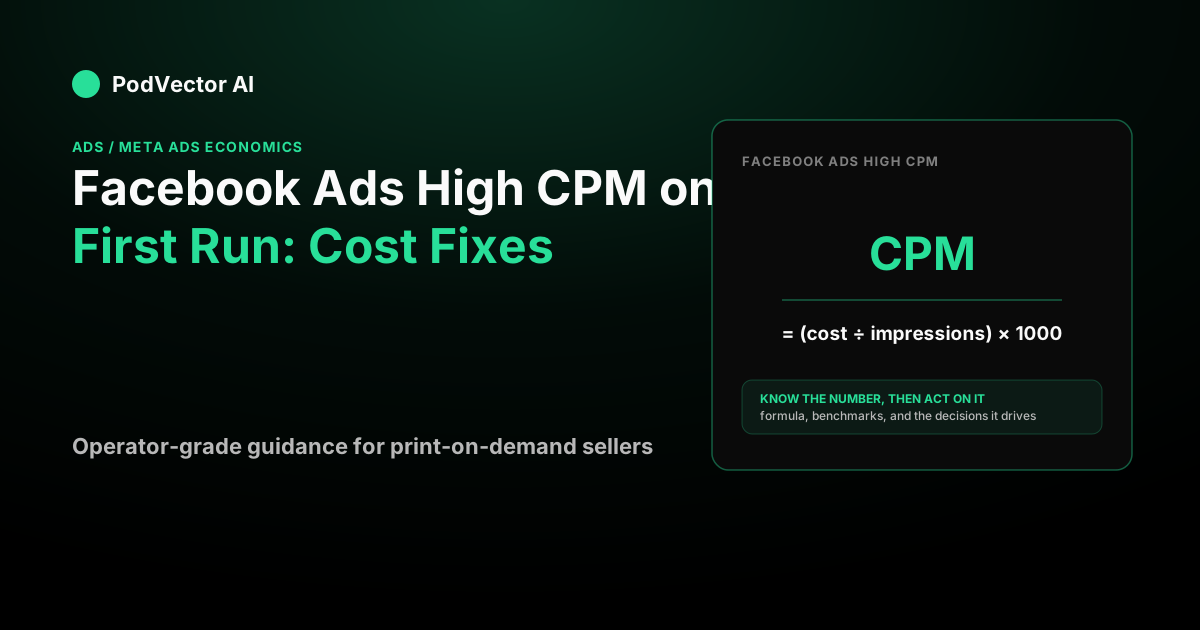
If you already run Meta profitably and just launched a fresh ad set, you have probably watched the CPM open at nearly double your usual rate and felt the urge to kill it. Don't — at least not yet. First-run CPM is a predictable tax, and the operators who waste the most money are the ones who react to it instead of diagnosing it.
This is a consideration-stage decision: you know your numbers, you have spend history, and you need to know whether this launch is broken or just young. Let's separate the two, then do the math on whether to keep paying.
Why first-run CPM is high (and usually temporary)
Your CPM is set in an auction, and the price is driven by how confident Meta is that your ad will perform. On a new ad set it has no history on your creative, so it hedges — it shows the ad cautiously, to more expensive inventory, until real engagement data arrives.
Two forces stack on a fresh launch. The first is the learning phase: Meta's delivery system looks for about 50 optimization events in a seven-day window before an ad set stabilizes, a threshold Meta documents in its Business Help Center guidance. Until it hits that count, delivery is volatile and cost per result swings.
The second is account-level trust. Newer accounts or newer creative tend to see elevated costs for a stretch — one troubleshooting breakdown of high Facebook CPM causes describes a roughly one-to-three-month trust-building window where CPMs sit above where they eventually settle. That is a reason to be patient, not a reason to keep spending blindly.
What a "high" first-run CPM even is
You need a baseline to judge against. Average Facebook CPM lands around eight to eleven dollars, with conversion-objective campaigns running higher than awareness, per Revealbot and AdEspresso ranges compiled here. If your stabilized conversion ad sets usually run, say, eleven dollars and a new one opens at eighteen, that is a normal first-run premium — not a crisis.
Placement matters too. The same compilation puts Facebook Feed in the eight-to-fourteen-dollar range and Reels at roughly four to eight dollars, so a launch leaning on Feed inventory will read higher before you've concluded anything about your creative.
The real test: is the first run still clearing break-even?
Here is where operators separate from beginners. A high CPM only matters if it pushes you past break-even, and break-even is pure arithmetic from your margin — not a guess. The relationship that governs everything is laid out in our Meta ads economics guide: break-even ROAS = 1 ÷ contribution margin.
Say you run a store doing 340 orders a month at a $31 AOV with $2,800 in monthly Meta spend. Your variable cost per order — blank, print, shipping you absorb, and payment fees — is $15.50. That leaves a contribution margin of 50%, so your break-even ROAS is 1 ÷ 0.50 = 2.0x. Every order has $15.50 of gross profit, which is the most you can pay to acquire it.
Now plug in the CPM. Suppose the new ad set spends $300 in its first week at an $18 CPM, versus the $11 your stabilized sets run. That higher CPM buys fewer impressions per dollar, so your cost per purchase rises. If those $300 produced 14 orders, your CAC is $300 ÷ 14 = $21.43 — above your $15.50 ceiling. The launch is underwater this week.
That is the number to watch, not the CPM in isolation. A first-run ad set can carry a scary CPM and still clear break-even if the creative converts well; it can also carry a "fine" CPM and bleed money if conversion is weak. CPM is an input, CAC against margin is the verdict.
Marginal ROAS, not the headline
One more operator distinction. If you launched this ad set by piling budget onto an already-scaling campaign, the drop you're seeing may not be the new CPM at all — it may be diminishing returns on spend you added. The way to tell is marginal ROAS: (revenue now − revenue before) ÷ (spend now − spend before). If you added $800 of spend and got $900 of new revenue, the margin is barely positive regardless of what the account average says. Our breakdown of what counts as a good ROAS for Facebook ads walks through why the average hides this.
What to fix (the levers you actually control)
You cannot argue the auction down. You can change the three inputs that move your estimated action rate, which is what quietly lowers CPM.
Creative relevance
This is the biggest lever and the one you fully own. Meta rewards ads that stop the scroll and earn clicks with cheaper impressions, because engagement raises its confidence. If a new concept opens hot, the fastest honest fix is a stronger hook, not a budget edit. Weak creative is also the usual cause of the CTR decay that the seven causes of high CPM list ties to a roughly thirty-percent-plus click-through drop signaling fatigue.
Audience size and overlap
Too small an audience and frequency climbs fast, saturating the pool and pushing CPM up as Meta charges more to keep showing a tiring ad. Give the ad set room — broad targeting with strong creative now generally outperforms narrow interest stacks. And don't launch three near-identical ad sets at once; overlapping audiences make you bid against yourself and inflate your own CPMs.
Tracking signal
If your pixel and Conversions API are dropping events, Meta undercounts your conversions, keeps the ad set trapped in learning, and prices accordingly. A first-run "high CPM, no stabilization" symptom is often a measurement problem wearing a delivery costume. Confirm your platform-reported purchases reconcile against your store's actual orders before you touch anything else.
What NOT to do
Resist the biggest edits. Large budget changes, swapping the optimization event, or rewriting the audience all count as significant edits that can reset the learning phase — meaning you pay the first-run tax twice. Nudge, don't overhaul. A new ad set deserves enough runway to approach that ~50-event window before you judge it.
Timing the launch
You don't control the market price of attention, but you can avoid launching into the most expensive weeks. Q4 CPMs run meaningfully above the rest of the year — the benchmark compilation cites Q4 running twenty-five to fifty percent or more above Q1, and the troubleshooting breakdown puts seasonal spikes at thirty to sixty percent above average. Testing fresh creative in a cheaper window means your first-run tax is smaller in absolute dollars. For the full picture on what Meta costs across a month, see our guide to Facebook ads cost per month.
Where Victor fits
Diagnosing a first-run launch means holding CPM, CAC, true margin, and store-side revenue in the same view at the same time — which is exactly the reconciliation most sellers do by hand across tabs. PodVector AI's AI employee, Victor, connects to your Meta Ads and Shopify together, computes true per-order profit on your live data, and delivers the report to Google Drive. Victor is not a dashboard you log into to stare at CPM; it's an employee that reads the whole picture and tells you whether the launch is clearing your break-even. Every write action it takes is approval-gated — you approve before anything executes. Put Victor on your ad data and stop guessing whether a high first-run CPM is a problem or a phase.
FAQs
Is a high CPM on a new Facebook ad set bad?
Not by itself. A first-run premium over your stabilized CPM is expected while the ad set gathers the roughly fifty optimization events Meta looks for before it leaves the learning phase, per Meta's documented guidance. It only becomes "bad" when the resulting cost per acquisition exceeds your gross profit per order. Judge it on CAC against margin, not on the CPM number.
How long before first-run CPM comes down?
Often within the first several days as the ad set approaches the ~50-event window, but account-level trust can keep costs elevated for a stretch — one troubleshooting breakdown cites roughly one to three months for newer accounts to settle. The faster path is strong creative that earns early engagement; the slower path is resetting learning with big edits.
Should I lower my budget to fix a high CPM?
Usually no. Budgets that are too low starve the ad set of the events it needs to exit learning, which keeps costs high and volatile longer. If anything, a too-small budget is the problem. The fix is relevance and audience room, not starvation — and a large budget cut can itself count as a learning-resetting edit.
Does a lower CPM mean my ads are profitable?
No. CPM is the price of impressions, not profit. A low CPM with weak conversion can still lose money, and a higher CPM with strong conversion can print profit. Profitability lives in the gap between your CAC and your contribution margin — the same math behind ROAS on Facebook ads. Optimize for profit per order, not the cheapest impressions.
Is it worth paying an agency to manage first-run CPM?
That depends on your spend and margin, not on the CPM itself. If you're weighing it, our breakdown of Facebook ads management cost frames the trade. For most operating POD stores at this spend level, the higher-leverage move is tighter creative testing and clean tracking before adding management overhead.