
Facebook ads cost most ecommerce stores roughly $8 to $20 per 1,000 impressions — a price called CPM, or cost per mille. Across thousands of ecommerce brands, the median Meta CPM was $15.06 in 2026, up double digits year over year. But a low CPM means nothing on its own: what matters is whether the orders those impressions drive clear your break-even ROAS.
If you run an operating store, you already know the number moves around. Some weeks your ads feel cheap; some weeks the same campaign costs twice as much to reach the same people. This guide explains what you are actually paying for, what a healthy price looks like, and the trap that every benchmark post skips: a cheap impression can still lose you money.
What "cost per impression" means on Facebook
Facebook bills you two main ways: by the click (CPC) and by the thousand impressions (CPM). An impression is one time your ad is shown to one person. CPM is the price of 1,000 of those showings, whether or not anyone clicks.
Even when you optimize for purchases and "pay per result," Meta is still buying impressions on your behalf in the background. So CPM is the raw market price of attention, and it sits underneath every other cost metric you track. When CPM rises, your cost per click and cost per order usually follow.
This is why CPM is a consideration-stage metric, not a vanity one. It is the input that tells you whether the auction is getting more expensive or your ad is getting weaker. For the full picture of how these numbers connect, see our Meta ads economics guide.
What a Facebook impression costs right now
For most ecommerce stores, CPM lands between about $8 and $20. The median Meta CPM across ecommerce brands was $15.06 in 2026, up roughly 13% year over year, even as clicks got cheaper over the same period.
Your category matters. The same data set put apparel and accessories near $13.25 and health and wellness around $21.80 — so a supplement brand and a t-shirt store do not pay the same price for the same eyeballs. Treat any single number as a rough reference, not a target.
Season matters even more. Q4 is the most expensive window of the year: U.S. CPMs averaged $25.49 in Q4 2025, about 22% higher than Q1 as every advertiser crowds into the same auction before the holidays. If your CPM jumps in November, the market got more expensive — it is usually not something you broke.
How CPM is calculated
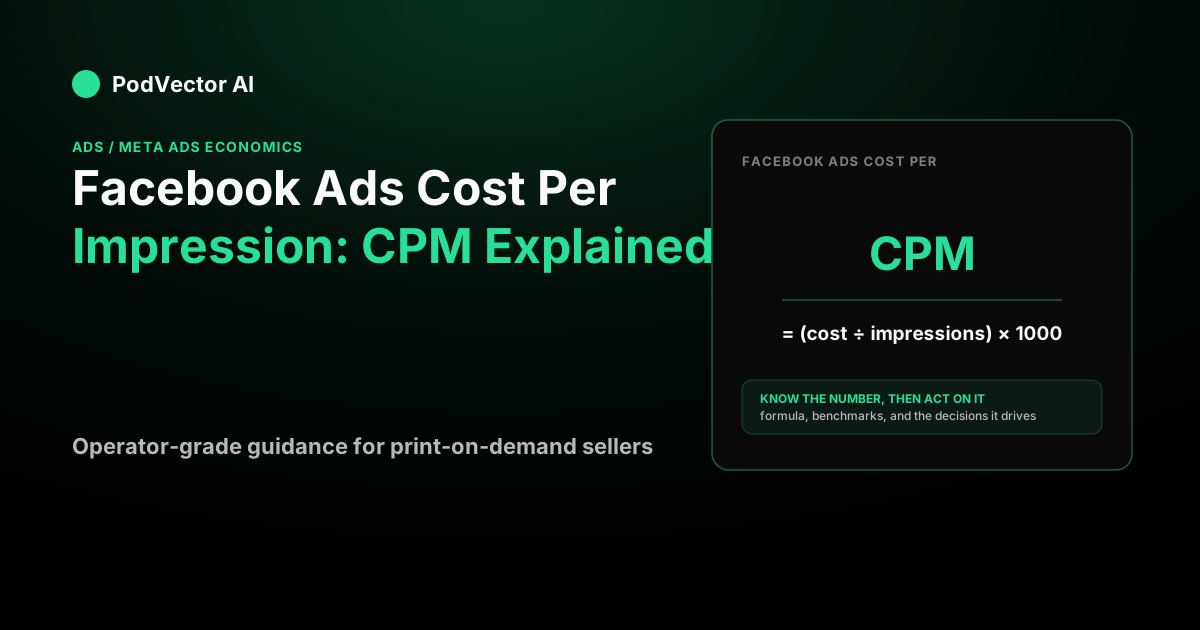
The formula is simple division. CPM equals your total ad spend divided by impressions, times 1,000.
Say your store runs $3,200 a month in Meta spend and that budget earns 280,000 impressions. Your CPM is $3,200 ÷ 280,000 × 1,000 = $11.43. That means every time your ad is shown to a thousand people, you pay about eleven and a half dollars.
You can run that math on any ad set over any window. The number itself is easy — what's hard is knowing whether $11.43 is good or bad for your store, and that depends entirely on what those impressions turn into.
What pushes your cost per impression up or down
CPM moves for two very different reasons, and diagnosing which one hit you decides what to do next.
The market got more expensive. This is external. Seasonality (Q4, Black Friday), a competitor entering your niche, or a sale event flooding the auction all raise CPM for everyone. You can't fix it by editing your ad — you widen your audience or geo, or you accept the seasonal cost.
Your ad quality decayed. This is internal and fixable. Meta runs an auction for every impression and rewards ads people engage with, so a relevant, high-click ad can win the auction at a lower CPM than a higher bidder with a weak ad. When your click-through rate falls or negative feedback rises, Meta charges you more to keep showing a poorly received ad.
The tell: check whether CPM is up while your CTR is flat or falling. Rising CPM with steady CTR points to auction density — the market. Rising CPM alongside a sinking CTR points to creative fatigue — you. For the click side of this equation, our breakdown of the average cost per link click on Facebook ads walks the same logic one step down the funnel.
One more driver: a reset learning phase. Each new ad set has to gather about 50 optimization events within 7 days before delivery stabilizes, and a big edit restarts that clock. During learning, costs are higher and more volatile — so a CPM spike right after you changed a budget or audience is often just the learning tax.
Why a cheap CPM can still lose you money
Here is the part the benchmark posts skip. CPM measures the cost of attention, not the cost of a customer. You can win the cheapest impressions in your category and still go broke.
Walk it through with the store above. CPM is $11.43, so 1,000 impressions cost that much. Say your click-through rate is 1.5% — that's 15 clicks per 1,000 impressions, or a CPC of $11.43 ÷ 15 = $0.76, right around the median traffic CPC of $0.60.
Now add conversion. Say 2.5% of those clicks become orders. Fifteen clicks produce 15 × 0.025 = 0.375 orders, so your cost per order is $11.43 ÷ 0.375 = $30.48. That is what the "cheap" impressions actually cost you to land one sale.
Compare it to your margin. Say your AOV is $34 and your contribution margin is 45%, so each order throws off $34 × 0.45 = $15.30 before ad spend. At a $30.48 cost per order, you are losing about $15 on every sale — with a perfectly normal CPM. The impression price was never the problem; the funnel after it was.
This is why break-even ROAS is the number that governs the decision. Break-even ROAS equals 1 ÷ contribution margin, so at 45% margin you need to clear 1 ÷ 0.45 = 2.22x just to break even. A low CPM only helps if the orders downstream of it beat that line.
The fix usually isn't the CPM at all. Lift conversion to 4% and the same clicks produce 0.6 orders, dropping cost per order to $11.43 ÷ 0.6 = $19.05. Lift AOV to $48 at the same margin and each order now earns $21.60 — suddenly those same impressions are profitable. You changed the store, not the auction.
How to lower your Facebook cost per impression
If you've confirmed the increase is internal, not seasonal, these levers actually move CPM:
- Refresh fatigued creative. A new hook that stops the scroll raises your click-through rate, and a higher CTR is the single biggest downward pressure on CPM in the auction.
- Widen a saturated audience. If frequency is climbing fast, you've exhausted your audience — broadening it lowers how often each person sees the ad and eases the price.
- Don't over-fragment. Too many small ad sets split your events and each restarts its own learning phase. Consolidating often lowers blended CPM.
- Consider Advantage+ carefully. Meta's automated campaigns can lower prospecting CPM, but they aren't always the profit winner — our take on when to turn off Advantage+ covers the tradeoff.
And remember CPM is only one of several ad costs. If you're benchmarking the whole picture, our guide to what sponsored ads on Facebook cost puts CPM next to CPC and cost per purchase.
Let Victor watch the number that actually matters
PodVector AI is where the impression price meets your profit. Victor is an AI employee who sees every order, every ad dollar, and every supplier cost together, so he computes the true per-order profit on each product and each campaign — not just the CPM.
When an ad set's cost per order drifts above what your margin can cover, Victor pauses it inside Meta Ads, shifts budget toward the campaigns that clear your break-even, and reprices the thin-margin SKUs in Shopify that make a cheap CPM unprofitable. He delivers the profit report to your Google Drive so you see exactly where a low impression price is quietly losing money.
Connect your store and ad account and let Victor find the campaigns where CPM looks fine but the orders don't — start free.
FAQs
What is a good CPM for Facebook ads?
For most ecommerce stores, roughly $8 to $20 per 1,000 impressions is normal, with the ecommerce median around $15.06 in 2026. But "good" depends on your category and margin — a higher CPM is fine if the orders those impressions produce still clear your break-even ROAS, and a low one is useless if they don't.
Why did my Facebook CPM suddenly go up?
Two causes. Either the market got more expensive — seasonality like Q4, when U.S. CPMs averaged $25.49, about 22% above Q1, or a new competitor — or your ad quality decayed and Meta is charging more to keep showing it. Check your CTR: flat CTR with rising CPM points to the market; falling CTR points to creative fatigue you can fix.
Is CPM the same as how much I pay per sale?
No. CPM is the cost of 1,000 impressions, not the cost of a customer. You get from CPM to cost per order by multiplying through your click-through rate and conversion rate — which is why a store with a cheap CPM and a weak funnel can still lose money on every order.
Should I optimize my campaigns for CPM?
Not directly. Optimizing to minimize CPM can win you cheap, low-quality impressions that never convert. Optimize for purchases and contribution margin per session, and treat CPM as a diagnostic — a signal to look, not a goal to chase.
How is CPM calculated?
CPM equals total ad spend divided by total impressions, times 1,000. For example, $3,200 spent for 280,000 impressions is $3,200 ÷ 280,000 × 1,000 = $11.43 per thousand impressions.